
ZOLIX Laser-Induced Fluorescence Spectroscopic Diagnostic System
| Brand | ZOLIX |
|---|---|
| Origin | Beijing, China |
| Manufacturer Type | Authorized Distributor |
| Product Category | Domestic |
| Model | Laser-Induced Fluorescence Spectroscopic Diagnostic System |
| Pricing | Upon Request |
Overview
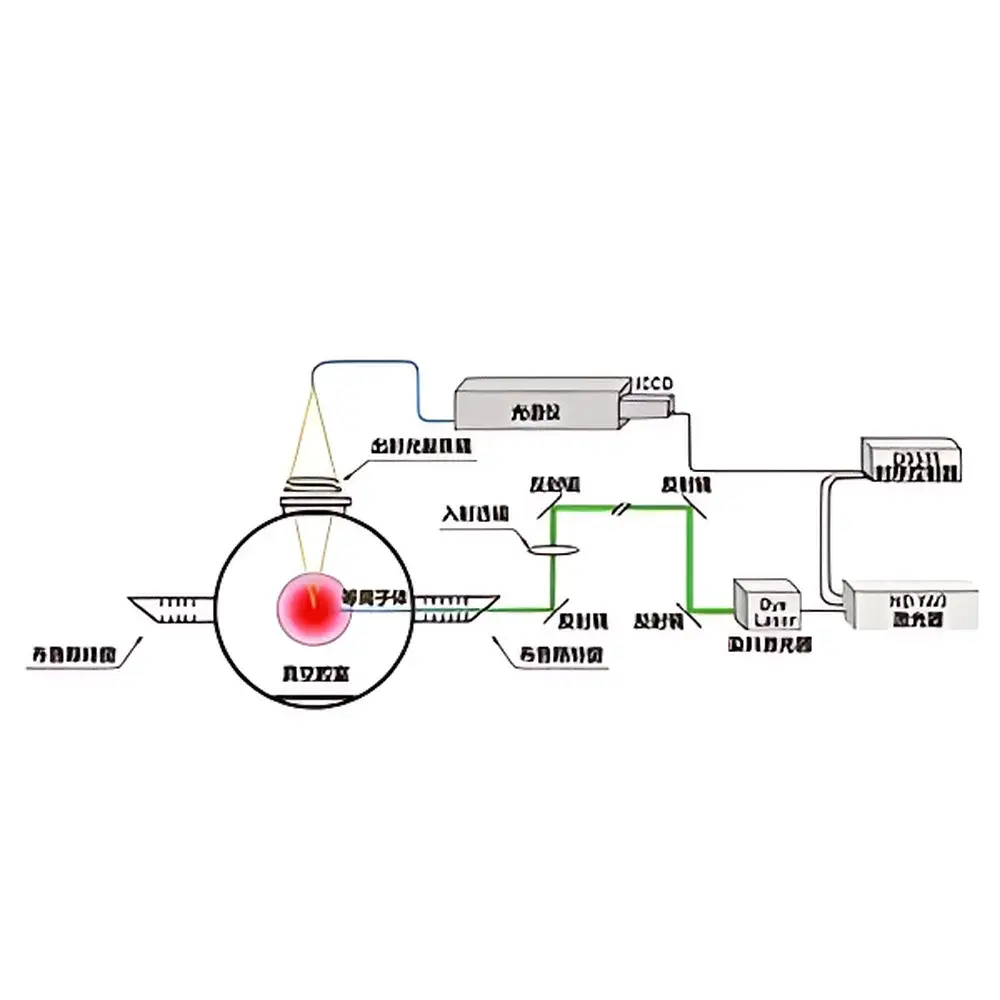
The ZOLIX Laser-Induced Fluorescence (LIF) Spectroscopic Diagnostic System is a precision optical instrumentation platform engineered for quantitative, spatially and temporally resolved measurement of neutral species, metastable atoms, and molecular radicals in low- to medium-pressure non-equilibrium plasmas. Operating on the fundamental principle of resonant two-level (or multi-level) excitation—where a tunable nanosecond-pulsed laser selectively promotes ground- or metastable-state particles to an excited electronic state, followed by spontaneous fluorescence emission at a longer wavelength—the system enables absolute density determination, velocity distribution profiling via Doppler-shift scanning, and state-resolved thermometry (rotational, vibrational, and excitation temperatures). Unlike broad-band optical emission spectroscopy (OES), LIF provides species-specific, background-free detection with sub-micrometer spatial resolution and nanosecond temporal gating capability. Its physical basis lies in quantum mechanical selection rules and Einstein coefficients for stimulated absorption and spontaneous emission, ensuring high signal-to-noise ratio and minimal perturbation to the plasma under investigation.
Key Features
- Tunable nanosecond dye laser source (200–4500 nm range) supporting multi-species excitation—including H (205 nm), CF (261 nm), and Ar (611 nm)—via interchangeable dyes and harmonic generation modules
- High-throughput spectrograph options: Omni-500i and Omni-750i monochromators equipped with 1200 l/mm and 1800 l/mm holographic gratings; alternatively, large-format 207/205 spectrometers with 110 × 110 mm grating area for enhanced light collection efficiency
- Time-gated intensified CCD (ICCD) detector featuring 18-mm image intensifier, 13 × 13 mm active sensor area, and sub-nanosecond gate width control for fluorescence lifetime discrimination
- Integrated timing architecture based on Stanford Research DG645 digital delay/pulse generator, enabling precise synchronization between laser pulse, ICCD gate, and plasma discharge trigger with ≤25 ps jitter
- Modular optical layout compatible with vacuum-compatible kinematic mounts, UV-grade fused silica optics, and motorized filter wheels for spectral bandpass selection
- Designed for operation in controlled environments: UHV-compatible flanges (CF-63/100), radiation-hardened components for prolonged exposure to VUV/UV plasma emission, and EMI-shielded electronics per IEC 61326-1
Sample Compatibility & Compliance
The system supports in situ diagnostics of reactive neutral species—including atomic H, O, N, He, Ar, metastable Ar(⁴P₂,⁴P₀), CF radicals, OH, NO, and CH—in capacitively coupled (CCP), inductively coupled (ICP), microwave (MW), helicon, and ECR plasma sources. It is routinely deployed in laboratories conducting fundamental plasma physics research, thin-film deposition process development (PECVD, sputtering), and plasma-assisted combustion studies. Hardware and software comply with ISO/IEC 17025:2017 requirements for calibration traceability, and optical path design adheres to ASTM E275–22 guidelines for UV–Vis spectroscopic measurement geometry. All laser safety components meet Class IV laser product requirements per IEC 60825-1:2014 and are interlocked with chamber access doors per ANSI Z136.1–2022.
Software & Data Management
Acquisition and analysis are managed through ZOLIX’s proprietary SpectraMaster™ Suite, a Windows-based application supporting real-time spectral preview, multi-channel time-resolved acquisition (up to 1024 time bins per shot), and automated wavelength calibration using Hg/Ne/Ar lamp references. The software implements NIST Atomic Spectra Database (ASD) line identification, Boltzmann plot analysis for rotational/vibrational temperature extraction, and Abel inversion algorithms for axisymmetric plasma tomography. Raw data are stored in HDF5 format with embedded metadata (laser energy, delay time, grating position, slit width), ensuring full FAIR (Findable, Accessible, Interoperable, Reusable) compliance. Audit trails, user authentication, and electronic signatures conform to FDA 21 CFR Part 11 requirements for regulated environments requiring GLP/GMP documentation.
Applications
- Quantitative mapping of H-atom density gradients in hydrogen plasma etching reactors for semiconductor manufacturing process control
- Doppler-resolved velocity distribution function (VDF) measurements of Ar⁺ ions in magnetized plasma thrusters to validate kinetic simulations
- Rotational temperature profiling of OH radicals in atmospheric-pressure plasma jets used for biomedical surface functionalization
- Metastable Ar(⁴P₂) population kinetics during pulsed DC discharge ignition for plasma ignition modeling
- Vibrational distribution function (VDF) analysis of N₂(C³Πᵤ) in afterglow regions to assess electron energy distribution function (EEDF) non-Maxwellianity
- Cross-calibration of Langmuir probe electron temperature data against LIF-derived excitation temperatures in low-density RF plasmas
FAQ
What plasma pressure ranges are suitable for LIF diagnostics using this system?
The system is optimized for low- to medium-pressure plasmas (10 mTorr to 100 Torr), where collisional quenching remains manageable and Doppler broadening dominates over pressure broadening.
Can the system perform two-photon LIF (TALIF) for species with no accessible one-photon transition?
Yes—when configured with frequency-doubled or triply-doubled Nd:YAG-pumped dye lasers and appropriate focusing optics, the platform supports TALIF for atomic species such as He and Ne.
Is spectral calibration traceable to NIST standards?
Yes—each spectrometer is factory-calibrated using certified Hg/Ne/Ar emission lamps, and calibration files include uncertainty budgets compliant with ISO/IEC 17025.
Does the system support automated scanning of laser wavelength for Doppler-profile acquisition?
Yes—integrated motorized grating drives and laser wavelength controllers enable synchronized scan sequences with real-time fluorescence intensity logging and post-acquisition VDF reconstruction.
Are OEM integration options available for embedding LIF into custom plasma chambers?
Yes—ZOLIX offers vacuum feedthroughs, flange-mounted optical ports, and API-accessible control libraries (DLL, LabVIEW, Python) for seamless integration into industrial plasma tool control architectures.



