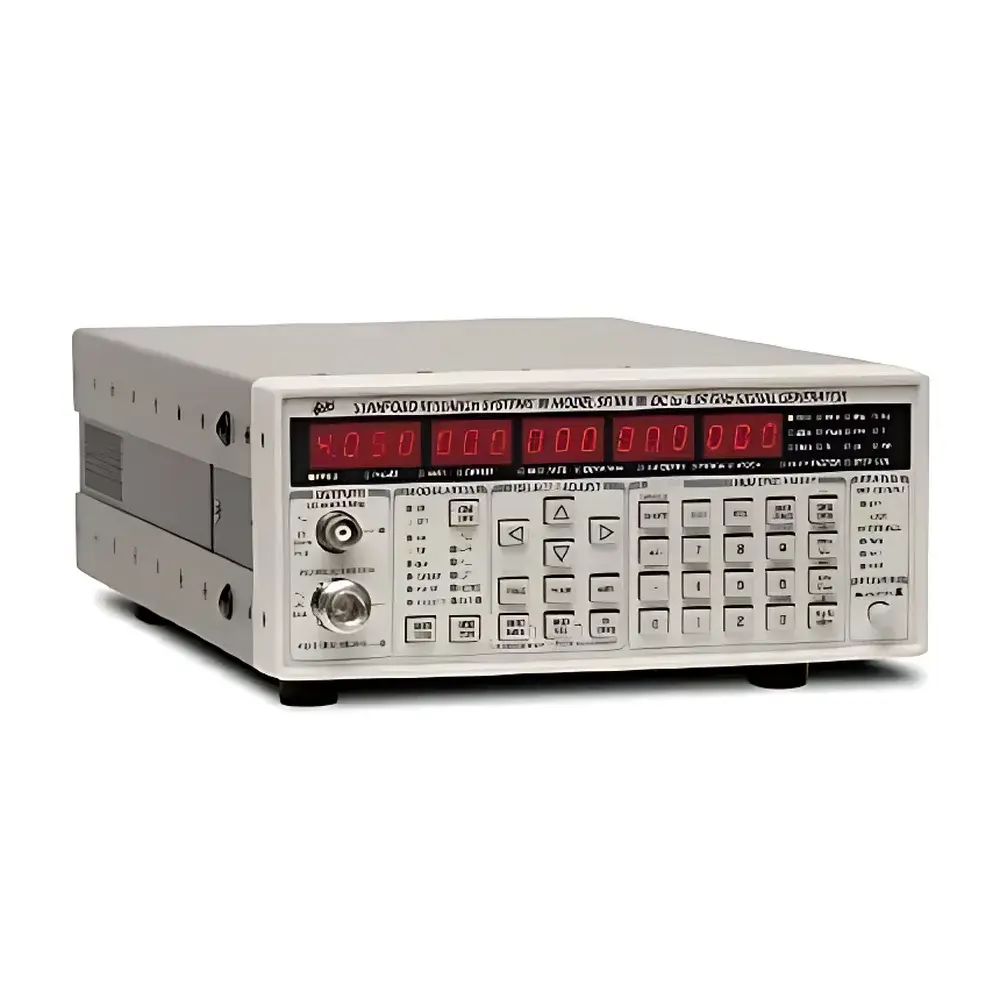
SRS SG384 RF Signal Generator
| Brand | SRS/Stanford Research Systems |
|---|---|
| Origin | USA |
| Model | SG384 |
| Frequency Range | DC to 4.05 GHz (up to 8.1 GHz with Opt. 02 doubler) |
| Frequency Resolution | 1 µHz |
| Phase Noise | −116 dBc/Hz (SSB, 20 kHz offset at 1 GHz) |
| Standard Reference | OCXO |
| Optional Reference | Rubidium Clock |
| Modulation Types | AM, FM, ΦM (phase modulation), PM (pulse modulation), frequency sweep |
| Output Options | Differential low-noise clock output (Opt. 01), analog I/Q input (Opt. 03) |
| Interfaces | Ethernet, GPIB, RS-232 |
Overview
The SRS SG384 RF Signal Generator is a precision microwave synthesis instrument engineered for laboratory and industrial applications requiring exceptional spectral purity, fine frequency control, and broad modulation flexibility. Built upon a direct digital synthesis (DDS)-enhanced architecture combined with analog phase-locked loop (PLL) refinement, the SG384 delivers high-stability, low-phase-noise sinusoidal outputs from DC to 4.05 GHz — extendable to 8.1 GHz via the optional frequency doubler (Option 02). Its 1 µHz frequency resolution enables sub-millihertz-level tuning accuracy, making it suitable for demanding tasks such as atomic physics experiments, quantum control systems, ultra-stable oscillator characterization, and narrowband receiver testing. The instrument’s core architecture minimizes spurious content and supports continuous, gap-free frequency sweeps — critical for impedance analyzer calibration, lock-in amplifier reference sourcing, and swept-frequency network analysis.
Key Features
- Ultra-fine frequency resolution of 1 µHz across the full output range, enabled by high-speed DDS core with fractional-N PLL refinement
- Low phase noise performance: −116 dBc/Hz (SSB) at 20 kHz offset from a 1 GHz carrier, achieved through optimized loop filter design and low-noise voltage-controlled oscillator (VCO) topology
- Standard oven-controlled crystal oscillator (OCXO) with aging rate <±50 ppb/year; optional rubidium reference (Option 04) improves long-term stability to <±5 × 10⁻¹¹ per day
- Comprehensive modulation suite: amplitude modulation (AM), frequency modulation (FM), phase modulation (ΦM), pulse modulation (PM), and linear/logarithmic frequency sweeps
- Dual-output configuration support: primary RF output + optional differential low-jitter clock output (Option 01) for synchronous timing in multi-instrument setups
- Flexible external control interface set: IEEE-488 (GPIB), RS-232, and 10/100BASE-T Ethernet with SCPI command compliance and embedded web server for remote monitoring
Sample Compatibility & Compliance
The SG384 is designed for integration into metrology-grade test environments and regulated R&D laboratories. Its traceable frequency output and stable modulation fidelity support calibration procedures aligned with ISO/IEC 17025 requirements. When equipped with the optional rubidium reference and used with documented environmental controls (temperature, power line conditioning), the unit meets stability criteria referenced in IEEE Std 1139 for time and frequency measurements. While not inherently FDA-certified, its deterministic behavior, audit-ready logging (via Ethernet), and SCPI-based reproducibility make it suitable for GLP-compliant instrumentation validation protocols where signal source integrity is critical — e.g., in RF component qualification or electromagnetic compatibility (EMC) pre-compliance testing.
Software & Data Management
The SG384 operates natively with industry-standard SCPI 1999 commands over all supported interfaces, ensuring seamless integration with LabVIEW, MATLAB, Python (PyVISA), and custom C/C++ applications. An embedded HTTP server provides real-time status monitoring, firmware update capability, and configuration backup/export without third-party software. All modulation parameters, sweep profiles, and system settings are stored non-volatilely and can be recalled via front-panel presets or remote script execution. For traceability-critical workflows, timestamped command logs (including user ID and IP address when accessed via Ethernet) are retained in internal memory and exportable as CSV — supporting 21 CFR Part 11–aligned audit trail practices when paired with appropriate network authentication infrastructure.
Applications
- Atomic, molecular, and optical (AMO) physics: laser locking references, RF-driven ion trap control, and microwave spectroscopy excitation sources
- Quantum computing hardware development: qubit control pulse generation, parametric amplifier pumping, and Josephson junction biasing
- RF/microwave component characterization: mixer LO sourcing, filter passband mapping, and VNA stimulus signal generation
- High-precision timing systems: low-phase-noise clock distribution, jitter-sensitive ADC/DAC synchronization, and PLL reference evaluation
- Education and advanced electronics labs: teaching frequency-domain concepts, modulation theory, and modern synthesis architectures
FAQ
What is the standard frequency stability specification with the OCXO option?
The standard OCXO provides ±50 ppb/day aging and ±100 ppb temperature coefficient over 0–50 °C, with warm-up drift <±200 ppb in 10 minutes.
Can the SG384 generate arbitrary waveforms or only sine waves?
The SG384 is a pure RF synthesizer optimized for high-purity sine-wave generation; it does not support arbitrary waveform synthesis (ARB) — use SRS DS360 or similar function generators for non-sinusoidal outputs.
Is the optional rubidium reference field-replaceable or requires factory service?
The rubidium reference module (Option 04) is user-installable via front-panel access and requires no recalibration after installation.
Does the Ethernet interface support DHCP and static IP configuration?
Yes — both DHCP client mode and manual static IP assignment are configurable via front panel or SCPI command.
How is phase coherence maintained during frequency sweeps?
The SG384 employs continuous-phase sweep algorithms that preserve phase continuity across the entire sweep range, avoiding discontinuities that could induce transient spurs or disrupt phase-sensitive measurements.
Related Products