
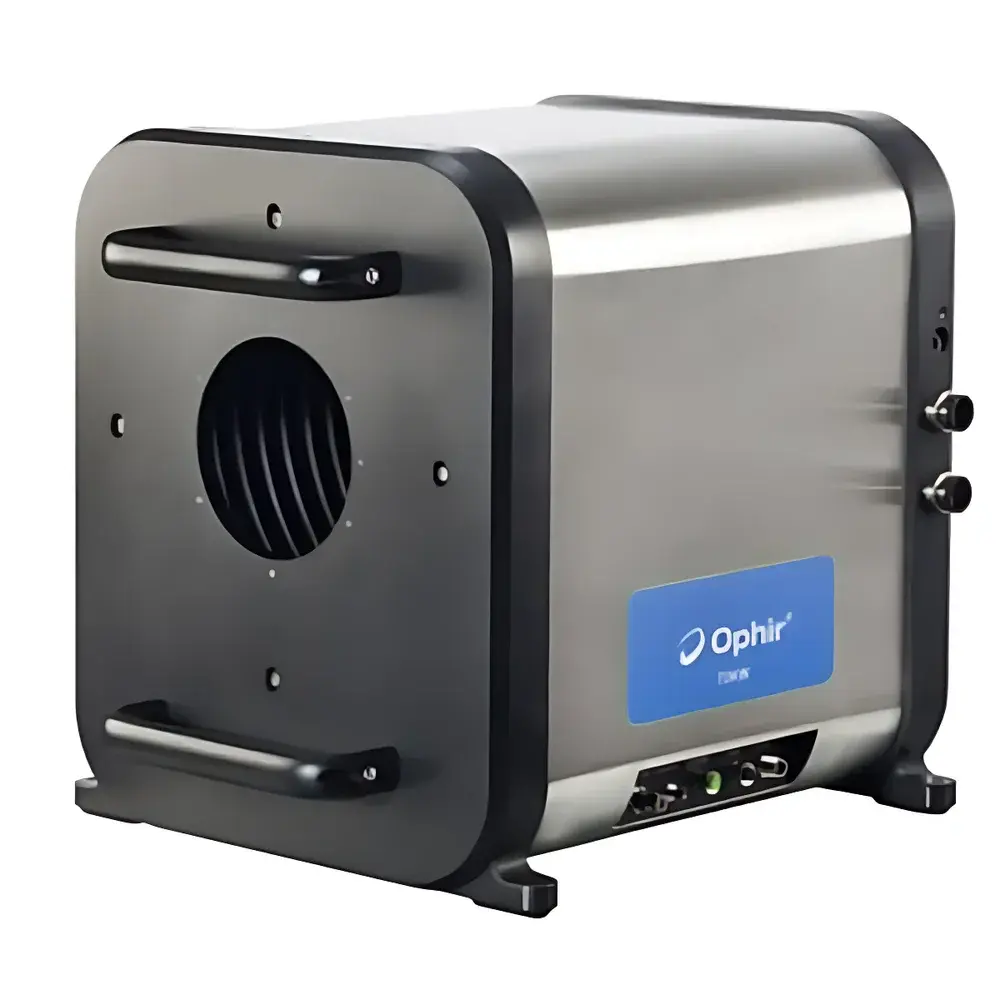
Ophir 70K-W High-Power Laser Power Sensor
| Brand | Ophir |
|---|---|
| Model | 70K-W (7Z07141) |
| Max. Avg. Power | 70 kW |
| Beam Orientation Flexibility | Horizontal & Vertical Mounting |
| Cooling | Water-Cooled |
| Interface | Ethernet & RS-232 |
| Backscatter | ≤0.5% |
| Interlock Output | Yes |
| Fast Photodiode Output | 0–70 mV (ms response time) |
| Calibration Response Time | ~10 s (thermal sensor) |
Overview
The Ophir 70K-W High-Power Laser Power Sensor is a purpose-engineered thermal power measurement device designed for real-time, high-fidelity monitoring of industrial and scientific laser systems operating at continuous average power levels up to 70 kW. Unlike conventional high-power sensors constrained by fixed beam incidence geometry or limited interface options, the 70K-W implements a dual-orientation mechanical architecture grounded in Couette-flow heat dissipation principles and calibrated thermopile detection. Its core sensing element—a water-cooled, absorber-based thermopile—converts incident laser energy into a proportional voltage signal traceable to NIST-traceable standards. The sensor is not a scaled variant between existing 30 kW and 120 kW models; rather, it integrates field-validated ergonomic, thermal, and control-layer innovations specifically for laser OEM integration and high-reliability process monitoring in metal cutting, cladding, welding, and directed-energy applications.
Key Features
- Dual-axis mounting compatibility: Optimized mechanical design supports stable, repeatable operation in both horizontal (beam-in from front) and vertical (beam-in from top) configurations—enabling seamless integration into laser source test benches and industrial processing heads without retooling.
- Integrated fast-response photodiode channel: Delivers a 0–70 mV analog output with sub-millisecond rise time, enabling closed-loop power regulation via third-party PLCs, motion controllers, or real-time feedback systems—complementing the primary thermal measurement path (10 s thermal time constant).
- Low backscatter performance: Optical surface treatment and internal beam dump geometry limit reflected energy to ≤0.5%, reducing stray light hazards and improving measurement fidelity in multi-pass or confined optical environments.
- Industrial-grade connectivity: Standard Ethernet (TCP/IP) and RS-232 interfaces support remote command execution (e.g., zeroing, range switching, calibration recall), data streaming, and synchronization with external timing triggers per IEEE 1588 (PTP) guidelines.
- Safety-critical interlock output: A hardware-level TTL-compatible interlock signal activates upon overtemperature, flow interruption, or sensor fault—enabling direct connection to laser shutter drivers, emergency stop circuits, or safety relays compliant with IEC 61508 SIL-2 requirements.
- Modular handle system: Dual ergonomic handles facilitate rapid orientation change without tools, minimizing downtime during setup transitions or maintenance cycles.
Sample Compatibility & Compliance
The 70K-W accommodates collimated CW and quasi-CW laser beams from CO₂ (10.6 µm), fiber (1.06–1.08 µm), disk (1.03 µm), and diode-pumped solid-state (DPSS) sources. It is compatible with beam diameters ≥30 mm and power densities up to 10 kW/cm² (dependent on wavelength and exposure duration). All materials contacting the beam path meet RoHS 2011/65/EU directives. Thermal calibration is performed per ISO 11554 Annex B and traceable to PTB (Physikalisch-Technische Bundesanstalt) reference standards. The sensor’s electrical interface and interlock logic conform to EN 61496-1 for Type 4 electro-sensitive protective equipment, supporting integration into CE-marked laser processing cells.
Software & Data Management
The 70K-W operates natively with Ophir’s StarLab v4.x and Nova II firmware platforms, providing real-time power trending, statistical analysis (min/max/avg/std dev), and histogram-based stability assessment. Raw analog photodiode output can be acquired via third-party DAQ systems (e.g., National Instruments PXI, Keysight DAQ970A) using standard SCPI commands over Ethernet. Audit trails—including calibration history, firmware version, sensor ID, and user-initiated zeroing events—are stored internally and exportable as CSV or XML. Full compliance with FDA 21 CFR Part 11 is achievable when deployed with validated StarLab configurations, including electronic signatures, role-based access control, and immutable log archiving.
Applications
- Real-time power stabilization in multi-kilowatt fiber laser manufacturing lines
- OEM integration into robotic laser welding cells requiring millisecond-scale power feedback
- Beam delivery validation for high-power laser additive manufacturing (LPBF, DED)
- Thermal load characterization of beam combiners and spectral multiplexers
- Calibration transfer between national metrology institutes and industrial laser service centers
- Long-duration burn-in testing of high-brightness diode stacks and MOPA systems
FAQ
What is the maximum permissible beam diameter for accurate measurement?
The 70K-W requires a minimum beam diameter of 30 mm for uniform power density distribution across the absorber surface. Larger beams (up to 120 mm) are supported with appropriate aperture alignment.
Can the photodiode output be used for absolute power measurement?
No—the photodiode provides relative, high-speed power fluctuation tracking only. Absolute power quantification relies exclusively on the calibrated thermopile path, which undergoes periodic NIST-traceable recalibration.
Is the sensor compatible with non-water-cooling systems?
No. Continuous operation at rated power mandates regulated deionized water flow (≥6 L/min, ΔT ≤5°C, pressure 2–6 bar) per Ophir Technical Note TN-70K-W-01.
Does the interlock output meet functional safety requirements for Class 4 laser enclosures?
Yes—when wired per IEC 61496-1 and integrated with certified safety relays, the interlock circuit satisfies PL e / SIL 2 requirements for laser hazard mitigation.
How often does the sensor require recalibration?
Annual recalibration is recommended for GMP/QA environments; biennial recalibration is acceptable for R&D use with documented stability verification per ISO/IEC 17025 Clause 7.7.



