
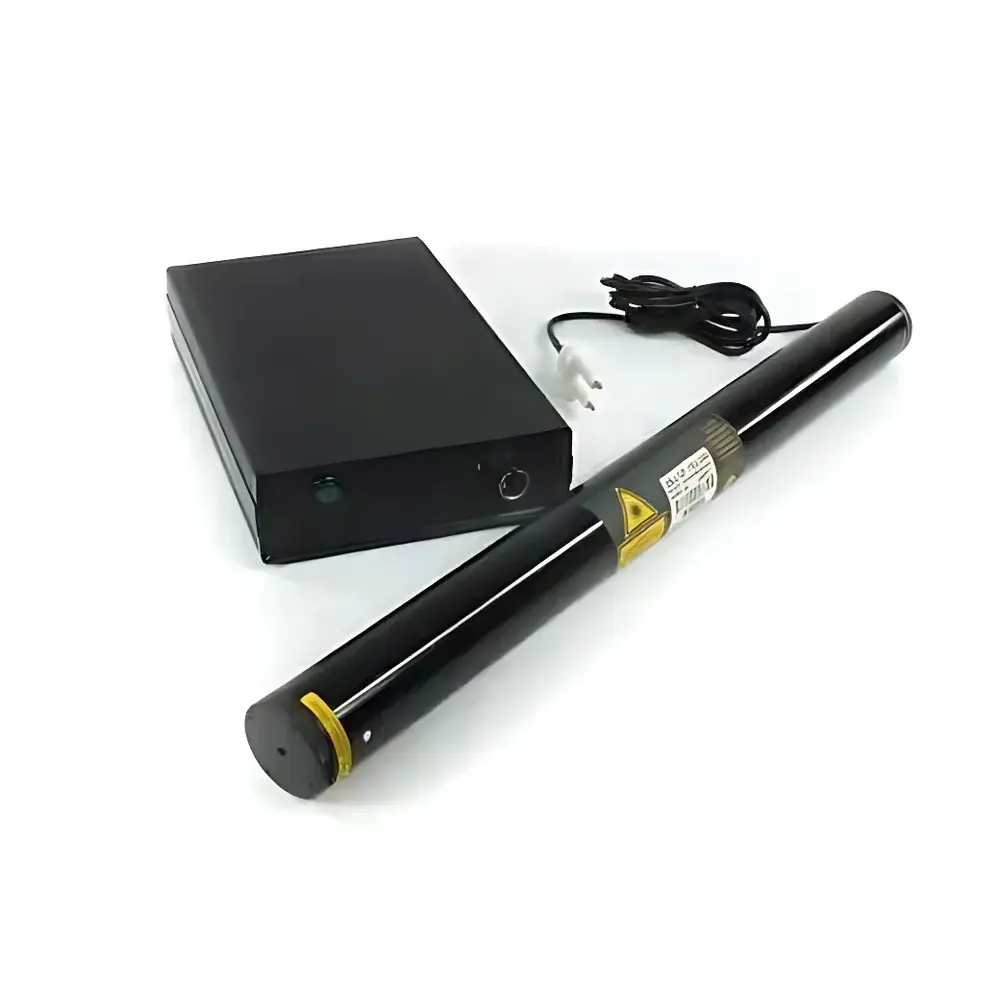
LHP Series Compact Helium-Neon Laser by Pacific Lasertec
| Origin | France |
|---|---|
| Manufacturer Type | Authorized Distributor |
| Origin Category | Imported |
| Model | LHP |
| Price Range | USD $13,500 – $40,500 (FOB) |
| Core Technology | Gas Laser System |
Overview
The LHP Series Compact Helium-Neon (HeNe) Laser is a precision gas laser system engineered for stable, single-transverse-mode (TEM00) continuous-wave (CW) output at the fundamental wavelength of 632.8 nm. Based on mature plasma discharge physics in a sealed He–Ne gas mixture under low-pressure DC excitation, this laser delivers high spatial coherence, exceptional pointing stability (< ±2 µrad/h), and long-term power stability (±0.5% over 8 hours). Designed for integration into metrology platforms, interferometric sensors, alignment systems, and optical teaching laboratories, the LHP series maintains the legacy of Melles Griot’s 40+ years of HeNe laser engineering—now fully continued by Pacific Lasertec following its 2018 establishment in San Diego, California. All units are manufactured to ISO 9001-certified processes and undergo rigorous burn-in and mode verification prior to shipment.
Key Features
- TEM00 Gaussian beam profile with M² < 1.1, ensuring diffraction-limited performance for high-resolution applications
- Compact monolithic cavity design with fused silica Brewster windows and ultra-low-expansion (ULE) spacer, minimizing thermal drift
- High polarization extinction ratio (>500:1) achieved via internal Brewster-angle optics—critical for ellipsometry and polarization-sensitive setups
- Beam diameter tolerance maintained within ±5% (e.g., 0.46 mm for LHP-213), with divergence controlled to ±5% (e.g., 1.77 mrad)
- Free-running longitudinal mode spacing (FSR) ranging from 687 MHz to 1078 MHz, depending on cavity length—enabling precise mode selection in spectroscopic configurations
- Optional stabilized variants (e.g., LHP-211S) available with Zeeman or saturated absorption locking for sub-MHz frequency stability, compliant with ISO/IEC 17025 calibration traceability requirements
Sample Compatibility & Compliance
The LHP series is compatible with standard 1-inch optical mounts (M4 threaded holes) and integrates seamlessly with OEM optomechanical subsystems, including interferometer heads (e.g., Zygo, Keysight), autocollimators, and holographic recording stages. All models meet IEC 60825-1:2014 Class 3R laser safety requirements, with integrated key-switch interlock and emission indicator LED. Electrical compliance includes CE marking per EMC Directive 2014/30/EU and Low Voltage Directive 2014/35/EU. For regulated environments—including pharmaceutical QC labs and aerospace metrology facilities—the laser supports optional documentation packages aligned with FDA 21 CFR Part 11 audit trail requirements when paired with validated control software.
Software & Data Management
While the LHP operates as a stand-alone analog device requiring only +15 VDC input, Pacific Lasertec provides optional USB-enabled power supply modules (PSU-LP Series) with RS-232/USB interfaces. These enable remote monitoring of output power, cathode voltage, and operating temperature via ASCII command protocol. Logged data can be exported in CSV format for traceability in GLP/GMP environments. Firmware updates and configuration presets are managed through Pacific Lasertec’s LaserLink™ Utility (Windows/macOS), which supports timestamped session logs and user-defined alarm thresholds—fully compatible with LabArchives ELN and Thermo Fisher SampleManager LIMS integrations.
Applications
- Length metrology: Primary reference source for heterodyne and homodyne interferometers used in coordinate measuring machines (CMMs) and nano-positioning stages
- Optical alignment: Precision bore-sighting in particle accelerators, telescope collimation, and semiconductor lithography tool setup
- Educational labs: Demonstrating wave optics fundamentals—including diffraction, interference, and polarization—under undergraduate and graduate curricula (ASTM E2917-22 compliant)
- Calibration services: Serving as transfer standards for photodetector responsivity, beam profiler validation, and spectrometer wavelength calibration
- Research-grade interferometry: Supporting gravitational wave detector prototype development, where long-term amplitude and phase noise characteristics (< 0.1% RMS intensity noise, 10 Hz–10 MHz) are rigorously specified
FAQ
What is the typical lifetime of an LHP-series HeNe laser?
Rated mean time between failures (MTBF) exceeds 20,000 hours under continuous operation at 25°C ambient; actual service life often exceeds 30,000 hours with proper thermal management.
Can the LHP be operated in pulsed mode?
No—this is a strictly CW gas laser. Pulsed operation is not supported due to plasma discharge physics constraints inherent to low-pressure HeNe gain media.
Is vacuum-compatible mounting available?
Standard models use epoxy-sealed ceramic feedthroughs rated for 10⁻⁶ Torr; UHV-compatible variants (with metal-ceramic seals and bake-out rated to 150°C) are available upon request with lead time extension.
Do you provide NIST-traceable calibration certificates?
Yes—certificates of conformance include wavelength accuracy (±0.002 nm), output power (±3% at 22°C), and beam pointing stability (±1 µrad/°C), all traceable to NIST SRM 2034 and SRM 1920c.
How does the LHP compare to diode-pumped solid-state (DPSS) 633 nm lasers?
Unlike DPSS sources, the LHP offers intrinsic Gaussian beam quality without spatial mode cleanup, lower relative intensity noise (RIN), and no mode-hopping—making it preferred for metrology-grade interferometry where long coherence length (>20 cm) and temporal stability are mandatory.



