
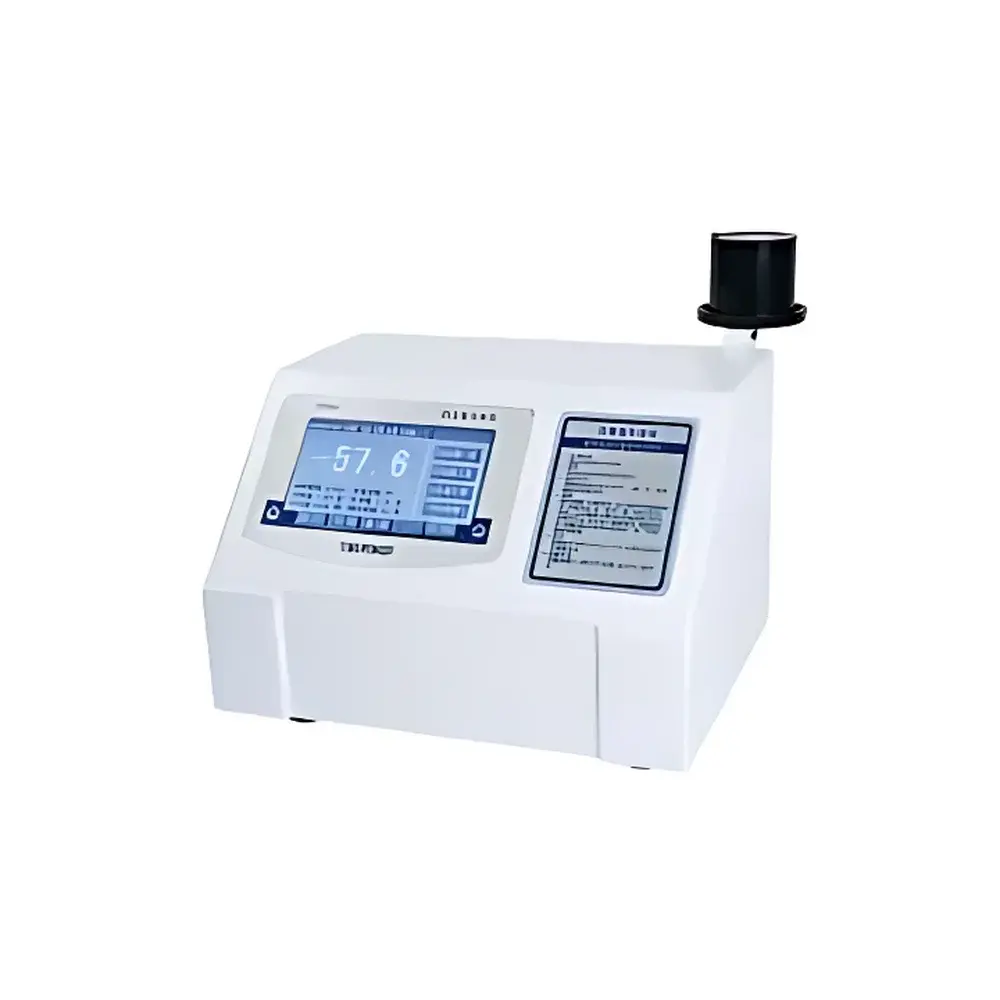
TimePower TP304 Iron Content Analyzer
| Brand | TimePower |
|---|---|
| Model | TP304 |
| Measurement Principle | Photometric Colorimetry (1,10-Phenanthroline Method) |
| Measurement Range | 0.00–200 µg/L |
| Accuracy | ±3% F.S. |
| Resolution | 0.1 µg/L |
| Repeatability | ≤1% |
| Stability | ±1.5% F.S./4h |
| Display | 5.0-inch TFT color touchscreen (Chinese UI) |
| Power Supply | AC 85–265 V, 45–65 Hz |
| Power Consumption | ≤30 W |
| Dimensions | 260 × 200 × 180 mm |
| Weight | 3.2 kg |
| Operating Temperature | 5–45 °C |
| Relative Humidity | ≤90% RH (non-condensing) |
| Data Storage | 256-cycle circular memory |
| Compliance | GB/T 12149–2019 (Industrial Boiler Water and Steam Quality Testing), ASTM D1068–22 (Standard Test Methods for Iron in Water), USP <232> (Elemental Impurities – Limits) |
Overview
The TimePower TP304 Iron Content Analyzer is a benchtop photometric instrument engineered for precise, routine quantification of dissolved ferrous (Fe²⁺) and total iron in low-concentration aqueous matrices. It operates on the well-established 1,10-phenanthroline colorimetric method—standardized in GB/T 12149–2019 and ASTM D1068–22—where Fe²⁺ forms an orange-red complex with 1,10-phenanthroline under controlled pH conditions, exhibiting maximum absorbance at 510 nm. The analyzer employs a stable imported monochromatic cold light source and high-integration analog signal conditioning circuitry to ensure optical stability and minimal thermal drift. Designed specifically for power plant water chemistry monitoring, it supports analysis of boiler feedwater, condensate, steam, generator stator cooling water, drum boiler water, and natural surface waters—environments where sub-100 µg/L iron levels directly impact corrosion product transport, deposition risk, and turbine efficiency.
Key Features
- 5.0-inch capacitive touchscreen interface with native Chinese-language firmware—intuitive navigation, real-time parameter display, and context-sensitive prompts.
- Optimized optical path architecture featuring a temperature-stabilized cold LED light source (510 ± 2 nm bandwidth), delivering consistent photometric output over extended operation cycles without warm-up delay or filament degradation.
- Integrated blank calibration function that compensates for zero-point drift induced by cuvette variability, reagent background, and electronic offset—performed automatically before each measurement series per user-defined protocol.
- Onboard microcontroller (ARM Cortex-M4 core) enables low-power operation (<30 W), deterministic timing control for reaction incubation, and robust noise rejection during analog-to-digital conversion.
- Circular data buffer stores up to 256 measurement records with timestamp, sample ID, and operator tag; overflow management ensures uninterrupted logging without manual intervention.
- Automated timer-based alert system for critical procedural steps—including reagent addition intervals and color development duration—reducing operator dependency and inter-analyst variability.
- Modular hardware design using surface-mount technology (SMT) and conformal coating ensures long-term reliability in industrial environments with fluctuating ambient humidity (≤90% RH) and temperature (5–45 °C).
Sample Compatibility & Compliance
The TP304 is validated for use with deionized water (Type II per GB/T 6682–2008 or ASTM D1193–20), requiring ≥18.2 MΩ·cm resistivity. Sample matrices must be free of suspended solids, strong oxidants (e.g., ClO⁻, MnO₄⁻), and interfering cations (e.g., Cu²⁺ > 0.5 mg/L, Ni²⁺ > 0.2 mg/L) unless masked by appropriate pretreatment. All reagents—including 1,10-phenanthroline, hydroxylamine hydrochloride, and ammonium acetate buffer—must meet analytical grade purity (≥99.5%) and be stored in certified polyethylene containers to prevent leaching or adsorption losses. The instrument conforms to ISO/IEC 17025:2017 requirements for measurement traceability when used with NIST-traceable iron standard solutions (e.g., SRM 3109a). Its operational protocol aligns with GLP documentation standards, supporting audit-ready records for power generation facilities regulated under China’s DL/T 912–2018 and U.S. EPRI TR-102447 guidelines.
Software & Data Management
Data are stored locally in non-volatile flash memory with automatic timestamping (YYYY-MM-DD HH:MM:SS), sample identification fields, and operator login tags. Export is supported via USB 2.0 port in CSV format for integration into LIMS platforms or Excel-based trending dashboards. While the embedded firmware does not implement FDA 21 CFR Part 11 electronic signature controls, all stored entries include immutable metadata (creation time, last access, calibration status flag) to satisfy basic data integrity requirements under IEC 62304 Class B software safety classification. Firmware updates are delivered via encrypted USB stick with SHA-256 checksum verification to prevent unauthorized modification.
Applications
- Continuous monitoring of iron concentration in high-purity boiler feedwater circuits to detect early-stage corrosion in economizers, superheaters, and feedwater heaters.
- Verification of condensate polishing system performance—tracking iron breakthrough after mixed-bed ion exchange units.
- Assessment of steam purity compliance in nuclear and fossil-fueled turbine systems per ASME PTC 19.11 and IAPWS RP-7 guidelines.
- Field-deployable analysis of raw water sources prior to demineralization, supporting predictive maintenance of pretreatment membranes and resin beds.
- Quality control of makeup water in closed-loop generator cooling systems where iron-induced pitting accelerates copper alloy degradation.
FAQ
What is the recommended frequency for blank and calibration curve verification?
Blank calibration must be performed daily prior to the first sample run. A full multi-point calibration curve (using ≥5 concentrations spanning 0–200 µg/L) is required every 14 days—or immediately following reagent lot changes, optical component cleaning, or environmental relocation—to maintain ±3% F.S. accuracy.
Can the TP304 measure total iron without sample digestion?
No. The 1,10-phenanthroline method measures only soluble Fe²⁺ directly. For total iron determination, samples must undergo pre-reduction (e.g., with hydroxylamine hydrochloride) and acid digestion (HCl/HNO₃, 95 °C, 30 min) to convert Fe³⁺ and particulate iron into measurable Fe²⁺—per ASTM D1068–22 Section 8.3.
Is the instrument compatible with third-party LIMS interfaces?
Yes—via USB-host mode exporting time-stamped CSV files containing concentration values, measurement IDs, and QC flags. No native Ethernet or RS-232 communication is provided; external serial-to-USB converters may be used with custom middleware.
What maintenance procedures ensure long-term photometric stability?
Monthly cleaning of the cuvette chamber with lint-free wipes dampened with isopropanol; annual verification of LED spectral output using a calibrated spectroradiometer; biannual replacement of desiccant in the internal humidity control module (if installed in high-humidity zones).





