
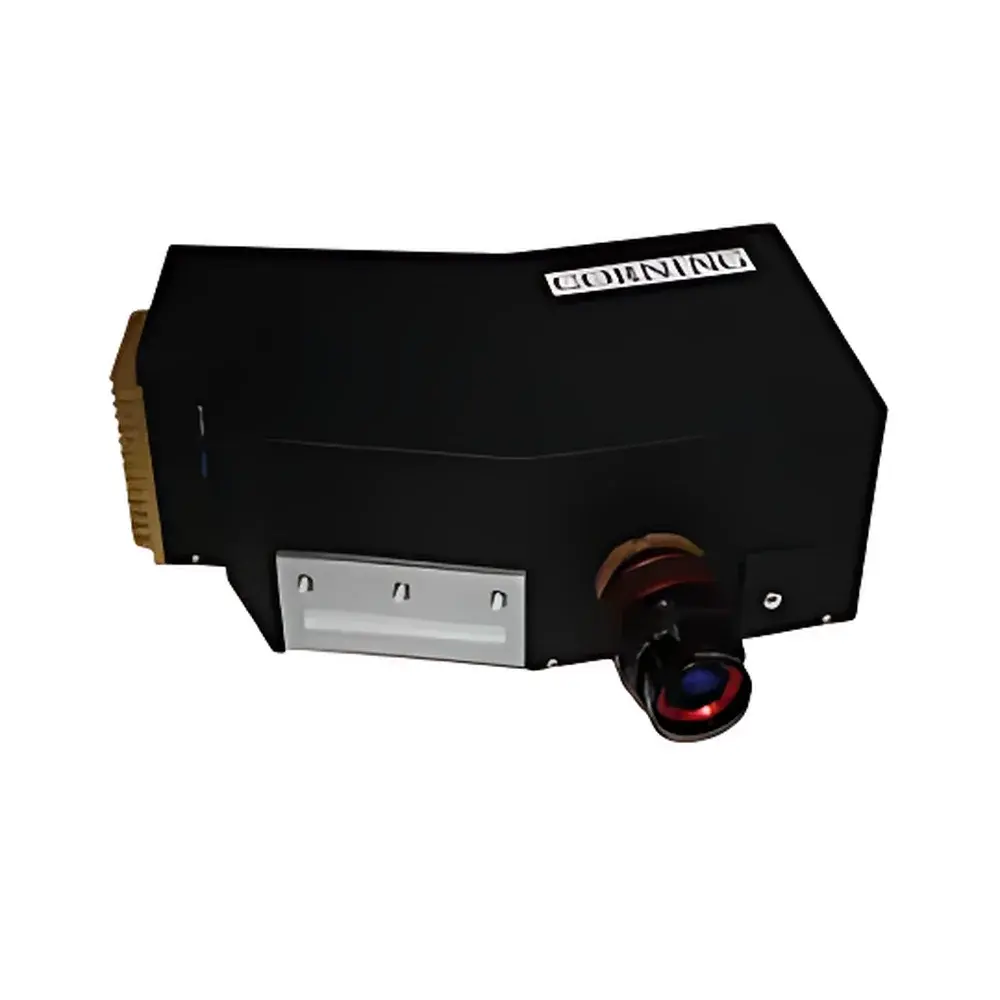
Corning 425 Shark Hyperspectral Imaging System
| Brand | Corning |
|---|---|
| Origin | USA |
| Manufacturer Type | Authorized Distributor |
| Import Status | Imported |
| Model | 425 Shark |
| Spectral Range | 400–2500 nm |
| Spectral Resolution | 4.1 nm (full-band) |
| Spatial Resolution (IFOV) | 15 µm pixel pitch, 640 × 512 FPA |
| Detector | Cooled MCT focal plane array |
| Dynamic Range | 16-bit |
| Frame Rate | Real-time acquisition (hardware-limited) |
| Cooling | Full-band cryogenic cooling |
| Imaging Architecture | Dispersive push-broom (single-optics, single-FPA) |
| Platform Compatibility | Ground-based, airborne (UAV/manned), and OEM integration |
| Dimensions | 9.4 × 18 × 26.7 cm |
| Weight | 3.5 kg (core unit) |
| Power Consumption | 30 W @ 12 VDC |
| Optional Integrated Navigation | MEMS-based IMU + GNSS (RTK-capable) |
| Data Acquisition Modes | Full-spectrum capture, band-subset selection, or feature-band triggering |
| Storage | Internal 1 TB NVMe SSD |
| Software Interface | Web-based GUI (HTML5, cross-browser compatible) |
| Operational Modes | Continuous, area-defined, flight-line, and trigger-based (entry/exit) acquisition |
Overview
The Corning 425 Shark is a commercially engineered, single-detector dispersive hyperspectral imaging system designed for high-fidelity spectral-spatial data acquisition across the full visible-to-short-wave infrared (Vis-NIR-SWIR) spectrum — from 400 nm to 2500 nm. Unlike dual-detector or multi-instrument hybrid configurations, the 425 Shark employs a monolithic optical architecture: one lens, one spectrometer grating, and a single cooled mercury cadmium telluride (MCT) focal plane array (FPA) operating at cryogenic temperatures. This unified design eliminates inter-sensor misalignment, radiometric calibration drift between channels, and post-acquisition spectral stitching artifacts — significantly improving measurement reproducibility and reducing field deployment complexity. Its compact form factor (9.4 × 18 × 26.7 cm), low mass (3.5 kg base unit), and 12 VDC power requirement make it suitable for integration into constrained environments including UAV gimbals, mobile ground platforms, laboratory scanning stages, and embedded OEM instrumentation.
Key Features
- Full-band spectral coverage (400–2500 nm) with uniform 4.1 nm spectral resolution across the entire range — enabled by precision diffraction grating and thermoelectrically stabilized MCT detector
- 640 × 512 pixel indium antimonide (InSb)-compatible MCT FPA with 15 µm pixel pitch and deep-cooling capability ensuring low dark current and high signal-to-noise ratio (SNR) in SWIR
- 16-bit digitization depth supporting >65,000 intensity levels per pixel per band — critical for quantitative reflectance and emissivity modeling
- Dispersive push-broom imaging geometry optimized for motion-compensated acquisition; supports synchronized inertial navigation input for georeferenced data tagging
- Integrated real-time processing engine enabling on-board spectral subset selection, region-of-interest (ROI) masking, and lossless compression (CCSDS 122)
- Web-native control interface accessible via Ethernet/Wi-Fi; no proprietary client software required — compatible with Chrome, Firefox, Safari, and Edge
- Four operational acquisition modes: continuous streaming, predefined geographic area capture, flight-line following (GPS-locked), and hardware-triggered start/stop based on INS-derived position thresholds
Sample Compatibility & Compliance
The 425 Shark does not require sample contact or preparation and is inherently non-destructive. It operates in reflectance, radiance, and emissivity measurement modes — supporting solid, granular, liquid, and semi-transparent materials. Its optical design conforms to ISO 13694 (optical radiation measurement accuracy), ASTM E131 (standard terminology relating to molecular spectroscopy), and ASTM E275 (describing UV-Vis-NIR spectral bandpass definitions). When configured with optional RTK-GNSS and MEMS IMU, the system meets positioning accuracy requirements outlined in FAA AC 91-57C for small UAS remote sensing applications. All firmware and embedded software comply with IEC 62443-4-2 for secure product development lifecycle and support audit-ready logging per GLP/GMP-aligned workflows.
Software & Data Management
Data acquisition, preprocessing, and metadata annotation are managed through a standards-compliant web application served directly from the instrument’s onboard Linux OS. The GUI supports real-time preview of spectral cubes (BIL/BIP/BSQ), live SNR monitoring, and dynamic exposure adjustment. Export formats include ENVI-compatible .hdr/.img, GeoTIFF with embedded RPCs, and HDF5 with CF-1.6 metadata conventions. All raw and processed datasets are time-stamped, checksum-verified, and stored with full traceability: sensor temperature logs, optical path status, GPS ephemeris, and IMU quaternion history are embedded in each file header. Remote access supports TLS 1.2 encryption and role-based authentication, satisfying FDA 21 CFR Part 11 requirements for electronic records and signatures when deployed in regulated environments.
Applications
- Agricultural phenotyping: Crop health assessment via chlorophyll, water content, and nitrogen indices derived from contiguous narrowband reflectance features
- Mineralogical mapping: Identification of hydroxyl-bearing clays, carbonates, sulfates, and iron oxides using diagnostic absorption features between 2100–2400 nm
- Industrial process monitoring: Real-time detection of polymer degradation, coating thickness variation, or pharmaceutical blend uniformity during continuous manufacturing
- Environmental remote sensing: Wetland delineation, invasive species detection, and soil organic carbon estimation using calibrated surface reflectance products
- Defense and security: Camouflage detection, concealed material identification, and standoff chemical residue screening under ambient illumination
- Planetary analog studies: Field validation of orbital spectrometer algorithms using terrestrial proxies for Mars, Moon, or icy moon surface composition analysis
FAQ
What spectral calibration standards are supported?
The 425 Shark includes factory-applied NIST-traceable wavelength and radiometric calibration coefficients. Users may perform field recalibration using portable halogen and quartz-tungsten-halogen (QTH) sources compliant with ASTM E275 and ISO 17025 procedures.
Is the system compatible with third-party GIS or image analysis platforms?
Yes — all exported data conform to OGC Simple Features and GDAL-supported formats. ENVI, ERDAS IMAGINE, QGIS, Python (rasterio, scikit-image, h5py), and MATLAB toolboxes natively ingest its output without conversion.
Can the 425 Shark operate without GNSS/INS integration?
Absolutely — the core imaging functionality remains fully operational in standalone mode. Georeferencing becomes optional; spatial metadata can be added post-hoc using external survey-grade GCPs or orthorectification pipelines.
What maintenance is required for the MCT detector cooling system?
The closed-cycle Stirling cooler requires no consumables or scheduled servicing over its rated 20,000-hour lifetime. A built-in health monitor reports compressor status, cold-finger temperature stability, and thermal gradient metrics via the web interface.
Does the system support real-time spectral library matching?
Yes — the onboard processor supports configurable spectral angle mapper (SAM), spectral feature fitting (SFF), and binary encoding algorithms. Match results are streamed as overlay masks or JSON-encoded classification vectors for downstream telemetry integration.




