
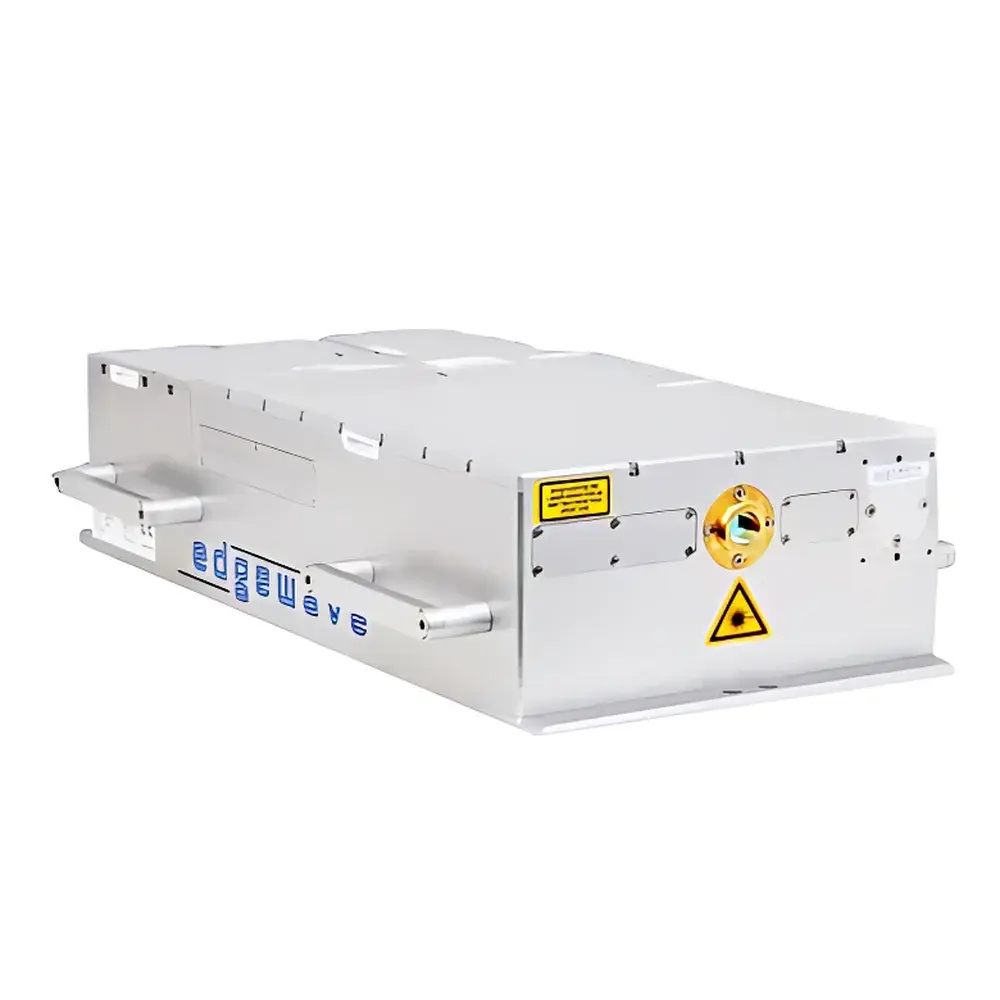
EdgeWave PX-Series Picosecond Ultra-Short Pulse Laser System
| Origin | Germany |
|---|---|
| Manufacturer Type | Authorized Distributor |
| Origin Category | Imported |
| Model | PX-Series |
| Price Range | USD 68,000 – 136,000 (FOB Hamburg) |
| Core Technology | Diode-Pumped Mode-Locked Solid-State Oscillator-Amplifier |
| Beam Quality (M²) | < 1.5 (PX-1: 1.1 |
| PX-2 | 1.1 |
| PX-3 | 1.5 |
| PX-4 | 2.0) |
| Pulse Energy | up to 1500 µJ |
| Pulse Duration | 10 ps (FWHM) |
| Peak Power | up to 150 MW |
| Repetition Rate | up to 50 MHz |
| Average Output Power | up to 400 W |
| Wavelength Options | 1064 nm (IR), 532 nm (Green), 355 nm (UV), 266 nm (DUV) |
Overview
The EdgeWave PX-Series is a family of industrial-grade, diode-pumped, mode-locked solid-state ultrafast laser systems engineered for high-repetition-rate picosecond pulse generation. Based on EdgeWave’s proprietary InnoSlab architecture—a monolithic slab geometry optimized for thermal management, gain uniformity, and transverse mode control—the PX-Series delivers exceptional beam quality (M² < 1.5), high average power stability, and outstanding pulse-to-pulse reproducibility. Unlike conventional rod or fiber-based ultrafast lasers, the InnoSlab design enables scalable energy extraction while maintaining near-diffraction-limited beam propagation, making it particularly suitable for precision micromachining, nonlinear frequency conversion, and time-resolved spectroscopy applications requiring high spatiotemporal coherence.
Key Features
- Monolithic InnoSlab gain medium with integrated cooling channels for minimal thermal lensing and long-term power stability
- Passively mode-locked oscillator combined with multi-stage regenerative and multipass amplification stages
- Wavelength flexibility across four harmonics: fundamental IR (1064 nm), second harmonic (532 nm), third harmonic (355 nm), and fourth harmonic (266 nm)
- Fixed pulse duration of 10 ps (FWHM), independently verified via autocorrelation and FROG measurements
- Repetition rate tunable from single-shot to 50 MHz in discrete or continuous steps, depending on configuration
- Integrated electronic synchronization interface (TTL/PECL) for pump-probe experiments and external triggering
- Hermetically sealed optical head with vibration-isolated baseplate and alignment-free factory collimation
Sample Compatibility & Compliance
The PX-Series supports operation in Class 1 and Class 4 laser environments when integrated into OEM workstations or enclosed processing chambers per IEC 60825-1:2014 and ANSI Z136.1-2022 standards. Its wavelength options enable compatibility with a broad range of optical materials—including fused silica, sapphire, polyimide, copper, and silicon carbide—without inducing excessive thermal damage zones. All models comply with CE marking requirements for electromagnetic compatibility (EMC Directive 2014/30/EU) and low-voltage safety (LVD Directive 2014/35/EU). Optional FDA-compliant documentation packages are available for medical device manufacturing and regulated R&D workflows under ISO 13485 and 21 CFR Part 11.
Software & Data Management
System operation is managed via EdgeWave’s LaserControl Suite v4.x—a Windows-based application supporting remote monitoring, real-time parameter logging, and hardware interlock status visualization. The software provides full access to repetition rate, pulse energy, harmonic selection, and Q-switch delay settings through intuitive GUI controls or programmable API (TCP/IP and USB-VCOM protocols). All operational parameters are timestamped and stored in CSV-compatible format with optional integration into LabVIEW, MATLAB, or Python-based data acquisition pipelines. Audit trails, user-level permissions, and electronic signature support align with GLP/GMP traceability requirements for quality-critical laboratories.
Applications
- Precision ablation of transparent and reflective materials in display manufacturing (e.g., OLED layer patterning, cover glass cutting)
- High-throughput drilling of fuel injector nozzles and turbine blade cooling holes in aerospace alloys
- Time-resolved photoluminescence (TRPL) and transient absorption spectroscopy in semiconductor research
- Two-photon polymerization for micro-optical element fabrication and biomedical scaffold structuring
- Optical parametric amplifier (OPA) pumping in ultrafast spectroscopy setups requiring stable 10-ps drive pulses
- Surface texturing of medical implants to enhance osseointegration without phase transformation
FAQ
What is the typical warm-up time required to achieve spectral and power stability?
Stabilization is achieved within ≤15 minutes after cold start, with RMS power fluctuation < ±0.7% over 8 hours under constant ambient conditions (22 ± 1°C, <50% RH).
Can the PX-Series be configured for burst-mode operation?
Yes—optional burst controller modules support user-defined pulse trains (1–100 pulses per burst) at variable intra-burst spacing (10 ns–10 µs), preserving pulse energy and temporal profile.
Is water cooling mandatory, or does air-cooled operation exist?
All PX-Series models require closed-loop deionized water cooling (chiller temperature: 20–24°C, flow rate ≥6 L/min); no air-cooled variants are offered due to thermal load constraints at >100 W average power.
How is pulse duration verified during factory calibration?
Each unit undergoes interferometric autocorrelation using a commercial SHG-FROG system traceable to PTB (Physikalisch-Technische Bundesanstalt) reference standards, with full report included in delivery documentation.
What maintenance intervals are recommended for optimal long-term performance?
Preventive maintenance is scheduled every 12 months, including cavity realignment verification, harmonic crystal inspection, and coolant filter replacement—per EdgeWave’s Service Manual Rev. 3.2.




