
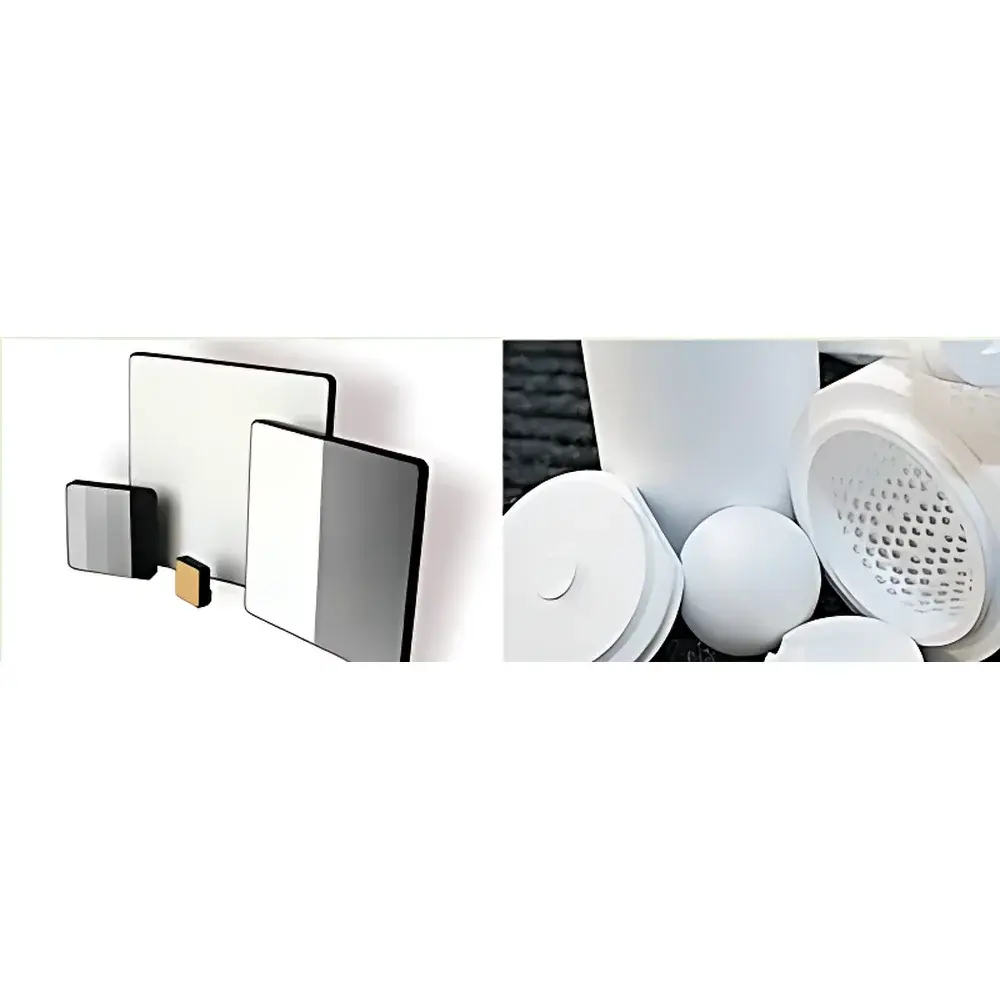
Spectralon® Spectraflect® Diffuse Reflectance Materials and Coatings
| Brand | Labsphere |
|---|---|
| Origin | USA |
| Model | Spectraflect® |
| Reflectance | Up to 99% (250–2500 nm) |
| Lambertian Performance | Excellent |
| Spectral Range | UV-VIS-NIR-SWIR (250–16,000 nm, material-dependent) |
| Durability | Chemically inert, hydrophobic, non-outgassing, non-toxic |
| Compliance | NASA-qualified, MIL-STD-810G tested, ISO 9001 certified manufacturing |
| Material Options | Spectralon® (PTFE-based), Duraflect® (ceramic-reinforced polymer), Infragold® (electroless gold-plated aluminum) |
Overview
Spectralon® Spectraflect® diffuse reflectance materials are engineered optical standards designed for high-fidelity radiometric and photometric calibration across ultraviolet, visible, near-infrared (NIR), short-wave infrared (SWIR), and mid-wave infrared (MWIR) spectral regions. These materials operate on the principle of volume scattering within highly homogeneous, sintered polytetrafluoroethylene (PTFE) or ceramic-polymer composites—enabling near-perfect Lambertian reflectance behavior and spectrally flat response. Unlike surface-scattering coatings, Spectralon® and Spectraflect® rely on subsurface Mie scattering from controlled pore structures, yielding exceptional bidirectional reflectance distribution function (BRDF) uniformity and angular independence. As primary and transfer standards, they serve critical roles in instrument validation, system-level throughput characterization, and reference target deployment in laboratory, field, and space-borne optical systems.
Key Features
- Ultra-high diffuse reflectance: up to 99% absolute reflectance from 250 nm to 2500 nm (Spectralon®); >95% from 2.5 µm to 16 µm (Infragold®)
- Exceptional Lambertian character: BRDF deviation < ±1.5% over ±80° viewing angles (per ASTM E275 and ISO 20647)
- Broadband spectral coverage: validated performance across UV (250 nm), VIS (380–780 nm), NIR (780–2500 nm), SWIR (1–3 µm), and MWIR (3–5 µm)
- Environmental resilience: hydrophobic surface, resistance to UV degradation, non-outgassing (tested per ASTM E595), and compatibility with vacuum and cleanroom environments
- Chemical and mechanical stability: inert to common solvents, acids, and bases; abrasion-resistant surface (Duraflect®); no chipping or delamination under thermal cycling (−40°C to +80°C)
- Traceable calibration: NIST-traceable reflectance data supplied with each certified standard; optional ISO/IEC 17025 accredited calibration reports available
Sample Compatibility & Compliance
Spectralon® and Spectraflect® materials are compatible with a wide range of optical instrumentation—including integrating spheres, spectroradiometers (e.g., Ocean Insight, Avantes, ASD FieldSpec), FTIR systems, laser-induced fluorescence setups, and satellite sensor ground calibration facilities. Their physical forms include rigid plates, curved hemispheres, custom-machined targets, and spray-applied coatings (Spectraflect®). All materials comply with stringent aerospace and defense requirements: NASA MSFC-STD-3003 (optical contamination control), MIL-STD-810G (environmental testing), and ECSS-Q-ST-70-08C (spacecraft material outgassing). Manufacturing adheres to ISO 9001:2015 quality management systems, and product documentation supports GLP/GMP traceability for regulated pharmaceutical and medical device applications.
Software & Data Management
Labsphere provides spectral reflectance datasets in standardized formats (ASCII, CSV, and XML) compatible with industry-standard analysis platforms including MATLAB, Python (NumPy/Pandas), LightTools, TracePro, and OpticStudio. Reflectance curves are delivered with uncertainty budgets per ISO/IEC Guide 98-3 (GUM), including contributions from measurement repeatability, lamp drift, detector nonlinearity, and reference standard traceability. For integration into automated test systems, Labsphere supports SCPI command sets and LabVIEW drivers for programmable reflectance target positioning and spectral acquisition synchronization. Audit trails for calibration history, environmental exposure logs, and handling records are maintained in accordance with FDA 21 CFR Part 11 requirements when used in regulated QC/QA workflows.
Applications
- Radiometric calibration of hyperspectral imagers and multispectral sensors (e.g., UAV-mounted, airborne, and Earth observation payloads)
- Reference targets for environmental light measurement—ambient illuminance mapping, daylight harvesting system validation, and automotive headlamp photometry
- Laser power and beam profile characterization using calibrated diffuse targets for LIDAR, free-space optical communication, and pulsed laser ablation studies
- Diffuse reflectance spectroscopy (DRS) standards in biomedical optics, pharmaceutical tablet analysis, and agricultural remote sensing
- Integrating sphere coating and baffle linings for stray light suppression and throughput optimization in UV-Vis-NIR spectrophotometers
- Primary reflectance references in national metrology institutes (NMIs) for inter-laboratory comparison campaigns under CIPM Mutual Recognition Arrangement (MRA)
FAQ
What is the difference between Spectralon® and Spectraflect®?
Spectralon® is a sintered PTFE-based solid material with intrinsic broadband reflectance and superior BRDF uniformity; Spectraflect® is a proprietary spray-applied coating formulation enabling conformal application on complex geometries while retaining high diffuse reflectance and durability.
Can Spectralon® be cleaned without degrading performance?
Yes—gentle rinsing with deionized water or isopropyl alcohol followed by nitrogen drying is recommended; abrasive cleaning or ultrasonic treatment is prohibited as it may alter surface microstructure.
Is Infragold® suitable for high-power laser applications?
Infragold® electroless gold plating provides excellent thermal conductivity and damage threshold (>10 J/cm² for 10 ns pulses at 1064 nm); however, peak irradiance limits must be evaluated per application-specific laser parameters.
Do these materials require recalibration over time?
Under normal laboratory conditions and proper handling, Spectralon® exhibits negligible reflectance drift (<0.1%/year); annual verification against a master standard is recommended for ISO/IEC 17025 compliance.
Are custom shapes and sizes available?
Yes—Labsphere offers CNC machining, diamond turning, and custom coating services for OEM integration, including curved surfaces, apertures, and multi-material hybrid targets.
Related Products






