
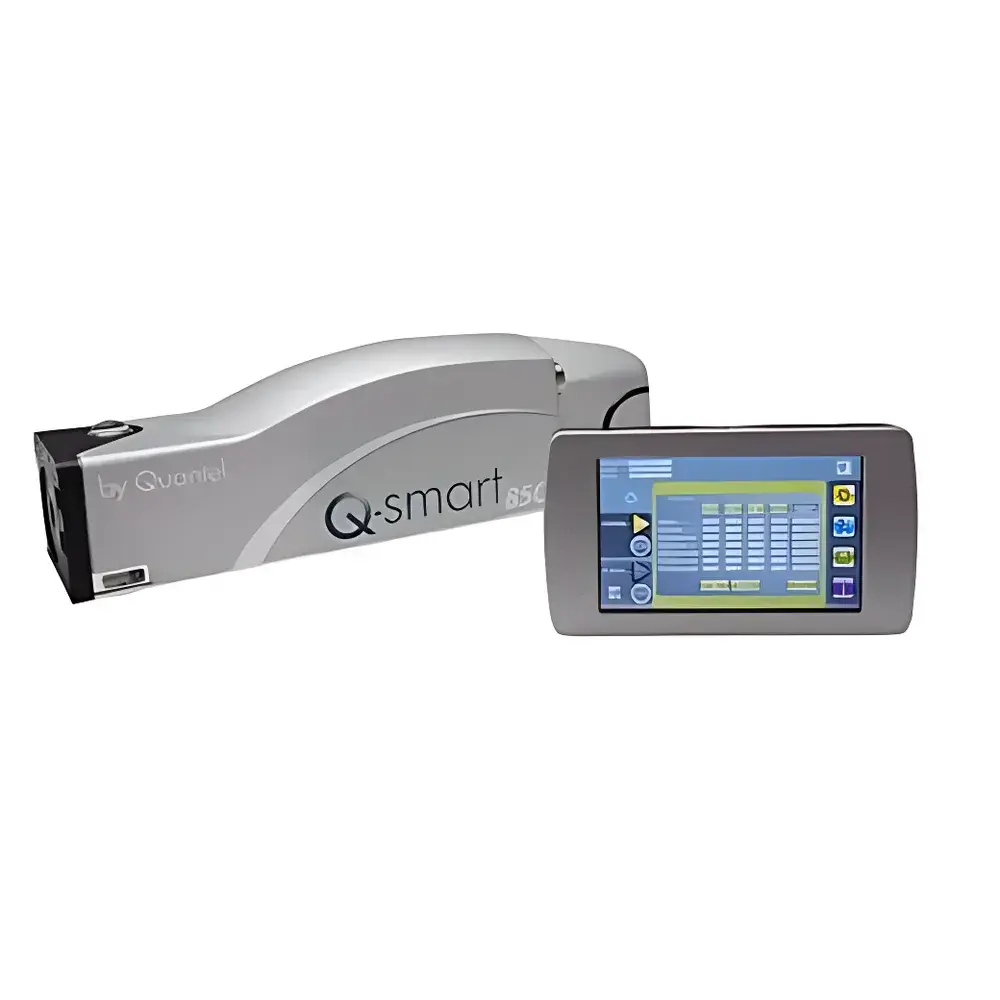
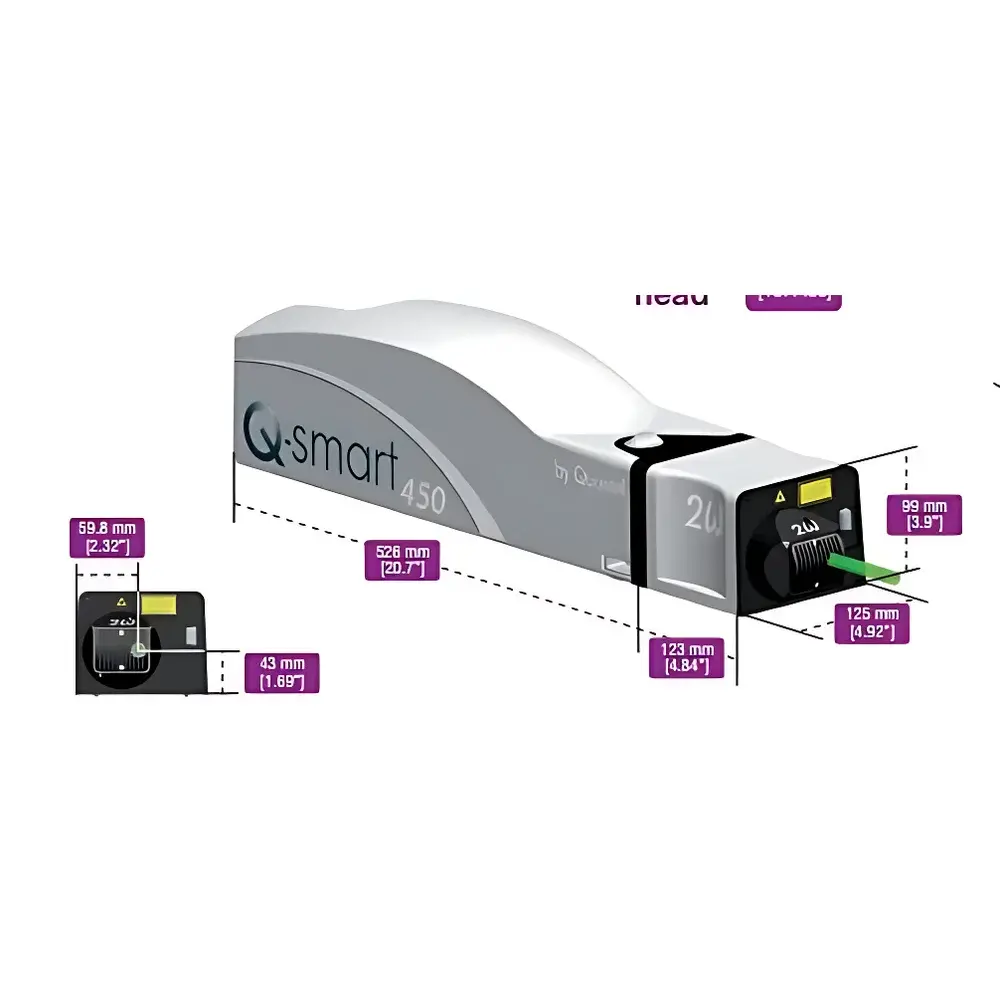
Quantel Q-smart Modular Nd:YAG Laser System
| Brand | Quantel |
|---|---|
| Origin | France |
| Model | Q-smart |
| Type | Solid-State Nd:YAG Laser System |
| Output Wavelengths | 1064 nm, 532 nm, 355 nm, 266 nm, 213 nm |
| Repetition Rate | 10 Hz (Q-smart 850/450), 20 Hz (Q-smart 450) |
| Pulse Energy (1064 nm) | 850 mJ / 450 mJ / 400 mJ |
| Pulse Energy (532 nm) | 430 mJ / 220 mJ / 200 mJ |
| Pulse Energy (355 nm) | 185 mJ / 80–130 mJ / 75–120 mJ |
| Pulse Energy (266 nm) | 100 mJ / 60 mJ / 50 mJ |
| Pulse Energy (213 nm) | 20 mJ / 10 mJ / 8 mJ |
| Pulse Width (1064 nm) | 6–6 ns |
| Beam Diameter (1064 nm) | 9–7 mm |
| Beam Divergence | < 0.5 mrad |
| Energy Stability (RMS, 1064 nm) | 0.6% |
| Flashlamp Lifetime | > 100 million shots |
| Cooling | Dual Independent Temperature-Controlled Units (Laser Head & Harmonic Modules) |
| Control Interface | Touchscreen Console |
| Warranty | 2 Years |
Overview
The Quantel Q-smart is a high-performance, modular solid-state Nd:YAG laser system engineered for precision scientific, industrial, and metrology applications requiring stable, multi-wavelength pulsed output. Based on flashlamp-pumped neodymium-doped yttrium aluminum garnet (Nd:YAG) gain media, the Q-smart operates on fundamental emission at 1064 nm and delivers harmonically converted outputs at 532 nm (second harmonic), 355 nm (third harmonic), 266 nm (fourth harmonic), and 213 nm (fifth harmonic) via integrated, thermally stabilized nonlinear crystals. Unlike conventional fixed-configuration Nd:YAG lasers, the Q-smart implements a true plug-and-play harmonic module architecture—enabling rapid, tool-free wavelength switching without opening the laser head. This design eliminates optical realignment and minimizes downtime during experimental reconfiguration. The system employs ceramic lamp housings resistant to thermal degradation and chemical corrosion, ensuring long-term operational integrity under repetitive high-energy discharge conditions. Its fully enclosed laser head mitigates contamination risk from ambient particulates and moisture, directly contributing to extended mean time between failures (MTBF). The Q-smart succeeds the acclaimed Brilliant B series while introducing enhanced thermal management, improved spatial beam quality, and expanded environmental tolerance—making it suitable for integration into cleanroom environments, mobile LIDAR platforms, and automated spectroscopy workstations.
Key Features
- Modular harmonic generation architecture with hot-swappable, independently temperature-controlled frequency conversion modules
- Ceramic-based flashlamp housing ensuring >100 million shot lifetime and immunity to thermal stress-induced cracking
- Hermetically sealed laser head reducing particulate ingress and maintaining long-term cavity alignment stability
- Integrated touchscreen control interface enabling intuitive parameter setting, real-time diagnostics, and waveform monitoring
- Automatic crystal angle optimization algorithm maximizing conversion efficiency and pulse energy reproducibility across all harmonics
- Compact form factor with industry-leading power-to-volume ratio—laser head and PSU optimized for space-constrained OEM integration
- Robust thermal design accommodating ambient operating temperatures from 15 °C to 35 °C without active chiller dependency
Sample Compatibility & Compliance
The Q-smart is compatible with standard optical tables, beam delivery optics (e.g., fused silica lenses, dielectric mirrors), and common detection systems including ICCD cameras, photomultiplier tubes (PMTs), and spectrometers equipped with UV-enhanced gratings. Its spectral output meets ISO 11146-1:2019 requirements for beam parameter measurement and complies with IEC 60825-1:2014 Class 4 laser safety standards when operated with appropriate interlocks and enclosures. Harmonic output stability supports GLP-compliant calibration workflows in analytical laboratories, and its deterministic pulse timing enables synchronization with time-resolved detection systems adhering to IEEE 1588 Precision Time Protocol (PTP) specifications. Full CE marking and RoHS compliance are certified per EU Directive 2014/30/EU (EMC) and 2011/65/EU.
Software & Data Management
The Q-smart includes Quantel’s LaserLink™ embedded firmware with USB 2.0 and RS-232 interfaces for remote command execution (SCPI-compatible syntax). Optional LabVIEW™ and Python SDKs enable full API-level integration into custom data acquisition pipelines. All operational parameters—including shot count, energy history, temperature logs, and fault registers—are timestamped and stored internally with non-volatile memory retention. Audit trails comply with FDA 21 CFR Part 11 requirements when used with validated third-party LIMS or ELN platforms. Firmware updates are delivered via signed binary packages with SHA-256 verification to ensure system integrity.
Applications
- Laser-Induced Breakdown Spectroscopy (LIBS) for elemental analysis in geoscience and metallurgy
- Pump-probe transient absorption spectroscopy requiring synchronized 213 nm/1064 nm pulses
- Time-of-flight mass spectrometry (TOF-MS) ionization source for organic and biomolecular characterization
- Nonlinear optical parametric oscillator (OPO) pumping across UV–NIR spectral ranges
- Remote sensing and atmospheric LIDAR systems leveraging 355 nm eye-safe transmission windows
- Micro-machining and thin-film ablation where precise pulse energy control at 266 nm reduces thermal damage
- Calibration of radiometric sensors and photodetectors traceable to NIST-standard reference detectors
FAQ
What harmonic wavelengths are supported, and how is wavelength selection performed?
The Q-smart generates 1064 nm, 532 nm, 355 nm, 266 nm, and 213 nm outputs. Wavelength switching is accomplished by inserting pre-aligned, thermally stabilized harmonic modules—no manual alignment or disassembly required.
Is the system compliant with regulatory requirements for use in pharmaceutical QC labs?
Yes—the Q-smart supports 21 CFR Part 11-compliant data logging when integrated with validated software environments and maintains energy stability (<0.6% RMS) required for USP & EP laser-based assay methods.
How is flashlamp lifetime verified, and what maintenance is required?
Flashlamp endurance is validated through accelerated life testing per MIL-STD-810G; no routine replacement is scheduled within the 2-year warranty period. Preventive maintenance consists solely of periodic optical surface inspection and cooling system filter cleaning.
Can the Q-smart be synchronized with external equipment such as delay generators or oscilloscopes?
Yes—TTL-compatible trigger outputs (sync-out, Q-switch, flashlamp) provide sub-nanosecond jitter performance and support master-slave configurations with commercial timing controllers.
What cooling method does the Q-smart employ, and is chilled water required?
The system uses closed-loop air-to-air heat exchangers with dual independent thermal regulation zones. No external chiller or tap water connection is needed—only standard AC power and ambient airflow clearance.





