
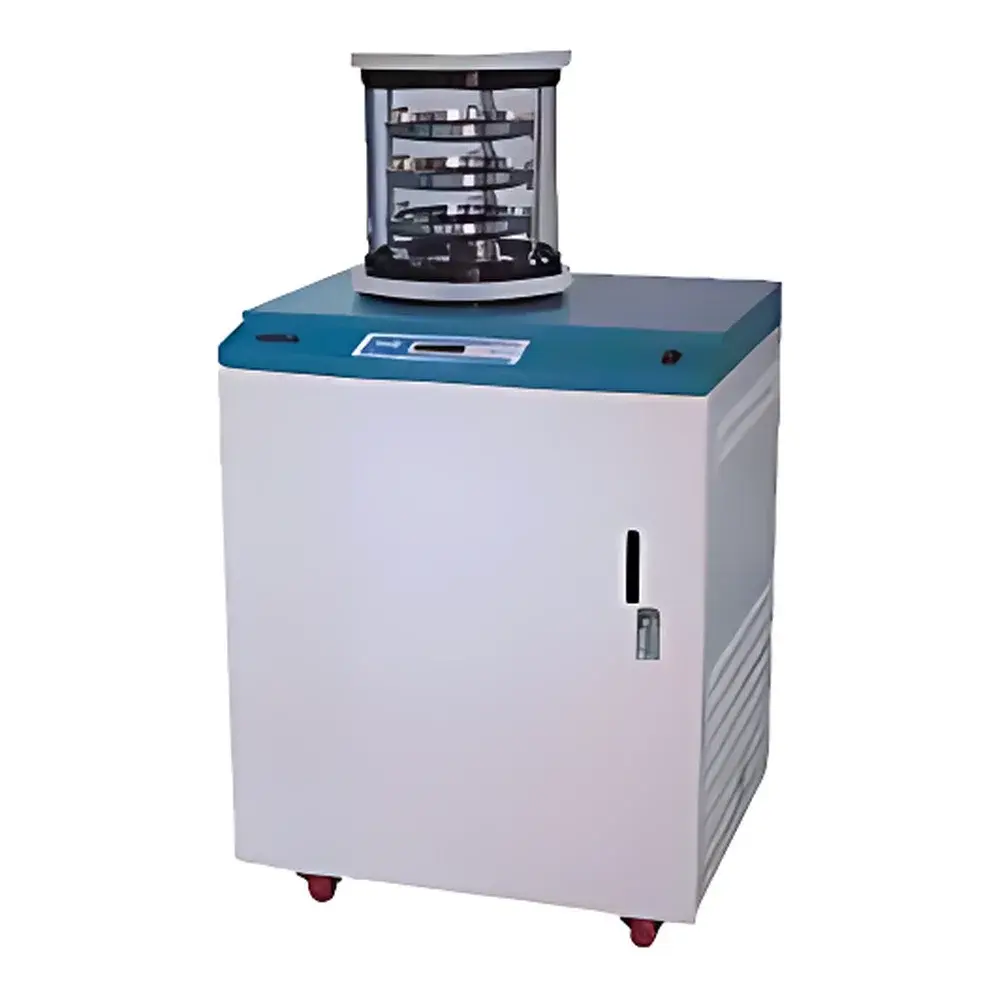
Hanil CleanVac 8S Laboratory Freeze Dryer
| Brand | Hanil |
|---|---|
| Origin | South Korea |
| Model | CleanVac 8S |
| Chamber Dimensions | Ø310 × 250 mm (D × H) |
| Maximum Sample Capacity | 8 L |
| Compressor Power | 1/2 HP |
| Vacuum Gauge | Pirani-type, Range: 0.005–760 torr (logarithmic scale, resolution: 0.5 per decade) |
| Temperature Sensor | Pt100, Range: –85°C to +40°C, Resolution: 1°C |
| Dimensions (W×D×H) | 740 × 600 × 965 mm |
| Power Supply | 220 V, 60 Hz, Single-phase, 1.5 kW |
| Certifications | CE-compliant design, GLP-ready architecture |
Overview
The Hanil CleanVac 8S is a benchtop laboratory freeze dryer engineered for reproducible lyophilization of heat-sensitive biological, pharmaceutical, and analytical samples. It operates on the fundamental principles of sublimation under controlled low-pressure and low-temperature conditions: frozen water in the sample transitions directly from solid to vapor phase without passing through liquid state, preserving structural integrity, enzymatic activity, and immunogenicity. The system integrates a high-efficiency 1/2 HP hermetic compressor-based refrigeration unit, a stainless steel condenser coil capable of reaching –85°C, and a transparent cylindrical acrylic drying chamber (Ø310 × 250 mm) enabling real-time visual monitoring of sample status. Designed for routine use in QC labs, academic research facilities, and pre-formulation development units, the CleanVac 8S delivers consistent primary drying performance with minimal operator intervention.
Key Features
- Modular front-panel access simplifies maintenance of the vacuum pump and refrigeration components—no disassembly of the main chassis required.
- High-capacity dual-stage refrigeration system achieves rapid cooling to –85°C at the condenser, reducing cycle time and minimizing thermal stress on labile samples.
- Pirani-type vacuum gauge provides continuous, stable pressure measurement across a wide dynamic range (0.005–760 torr), calibrated to logarithmic scale for accurate interpretation during primary and secondary drying phases.
- Microprocessor-based controller with backlit LCD interface displays real-time values for chamber pressure, shelf/condenser temperature, elapsed time, and current process stage.
- Automated end-point detection algorithm executes periodic vacuum hold tests: after every 60 minutes of drying, the vacuum pump pauses for 60 seconds while pressure rise is monitored; if ΔP remains within user-defined thresholds (e.g., <5 mtorr/min), the system flags completion and prompts operator confirmation.
- Heated shelf assembly compatible with standard Petri dishes and glass vials—temperature controllable up to +40°C with ±1°C accuracy—enables active secondary drying and residual moisture reduction in accordance with ICH Q5C guidelines.
- Robust mechanical architecture includes vibration-dampened compressor mounting, reinforced acrylic chamber housing, and sealed electrical compartments compliant with IP20 environmental rating.
Sample Compatibility & Compliance
The CleanVac 8S accommodates a broad spectrum of sample formats—including aqueous solutions in serum vials (up to 20 mL), cell culture media in multi-well plates, microbial suspensions in cryovials, and protein formulations in glass ampoules—without requiring custom trays or adapters. Its chamber geometry supports uniform heat transfer and vapor flow distribution. The system adheres to core elements of Good Laboratory Practice (GLP) and current Good Manufacturing Practice (cGMP) frameworks: all operational parameters are logged digitally with timestamping, and the microprocessor retains the last 10 complete drying cycles for audit review. While not FDA 21 CFR Part 11–certified out-of-the-box, its data output format (CSV via optional RS232/USB interface) is compatible with validated third-party electronic lab notebook (ELN) and LIMS integration workflows.
Software & Data Management
The onboard firmware supports manual and semi-automated protocols with up to five programmable drying profiles, each comprising ramp/hold segments for shelf temperature and pressure setpoints. Process data—including vacuum pressure (torr), condenser temperature (°C), chamber temperature (°C), and runtime (hh:mm)—are stored internally and exportable via serial communication. Optional PC software (Hanil FreezeView™, v3.2+) enables remote monitoring, graphical trend analysis, deviation alerting, and PDF report generation compliant with ISO/IEC 17025 documentation requirements. All parameter changes are recorded with user ID and timestamp where authentication is enabled.
Applications
- Stabilization of monoclonal antibodies, vaccines, and recombinant enzymes prior to long-term storage or transport.
- Preparation of reference standards for HPLC, GC-MS, and elemental analysis where solvent residue must be eliminated.
- Drying of bacterial and fungal cultures for strain preservation in microbiology and biobanking laboratories.
- Dehydration of tissue sections and histological specimens for SEM imaging without shrinkage artifacts.
- Processing of nanomaterial dispersions and colloidal formulations where particle aggregation must be avoided during solvent removal.
FAQ
What is the maximum batch volume the CleanVac 8S can handle?
The system is rated for up to 8 liters of frozen aqueous solution, assuming optimal loading density and uniform ice layer thickness across the chamber floor.
Does the CleanVac 8S support controlled shelf heating during secondary drying?
Yes—the heated shelf operates from ambient to +40°C with ±1°C stability, adjustable in 1°C increments via the LCD interface or external software.
Is the Pirani vacuum gauge factory-calibrated and traceable to NIST standards?
The gauge is pre-calibrated at manufacture against certified reference pressures; full calibration certificate (ISO/IEC 17025-accredited) is available upon request at additional cost.
Can the system operate continuously for extended cycles (e.g., >48 hours)?
Yes—thermal management and compressor duty cycle are designed for uninterrupted operation; recommended maintenance intervals are every 500 operating hours or annually, whichever occurs first.
What safety interlocks are implemented?
The unit features over-temperature cut-off for condenser and compressor, door-open vacuum interlock, and automatic pump shutdown upon excessive oil temperature or low refrigerant pressure.



