
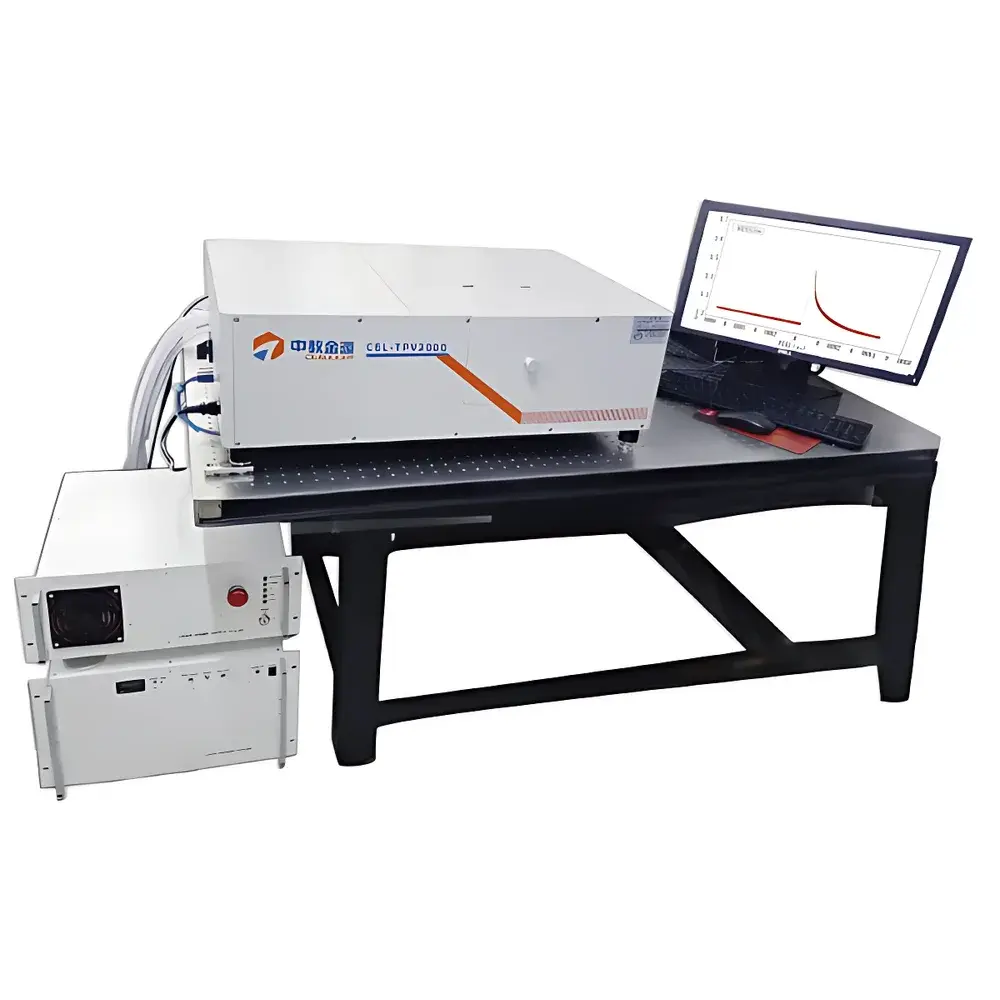
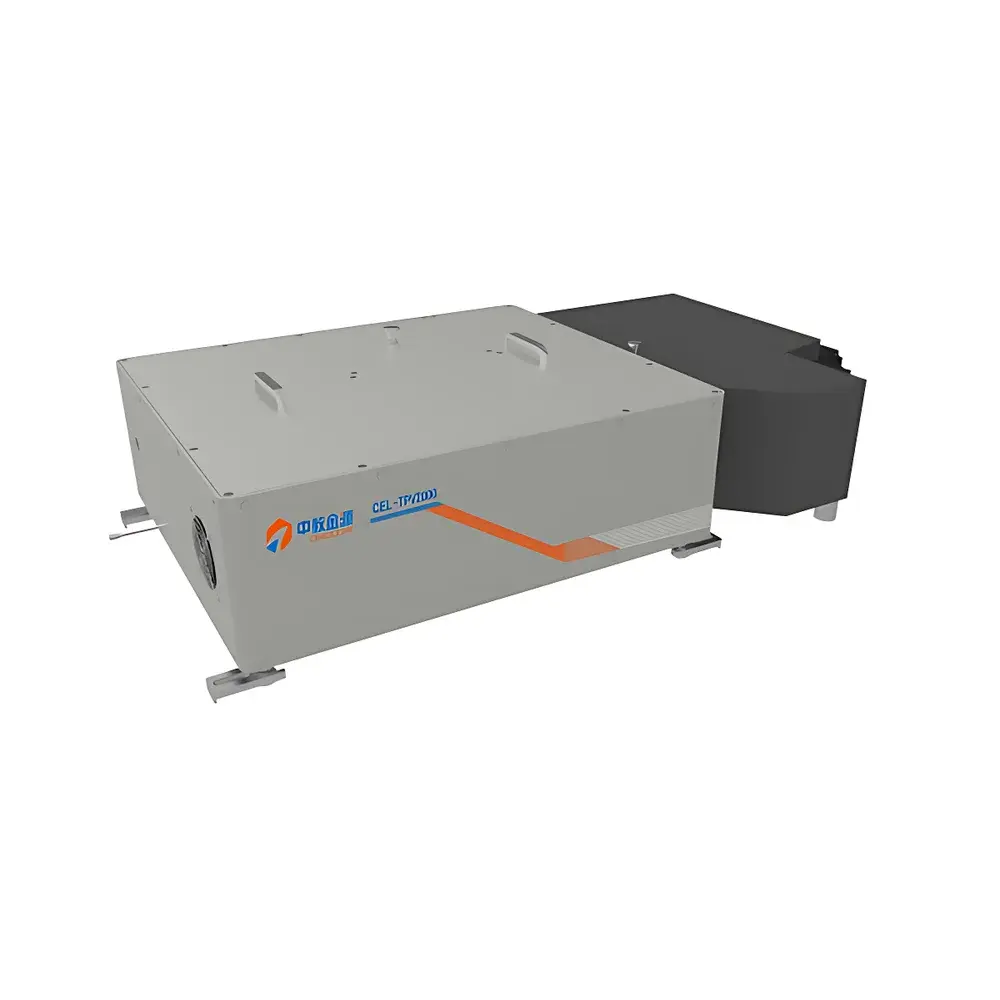
CEL-TPV2000 Transient Surface Photovoltage Spectrometer
| Brand | CEA-Light (Zhongjiaojinyuan) |
|---|---|
| Model | CEL-TPV2000 |
| Laser Source | Nd:YAG pulsed nanosecond laser (imported full unit) |
| Wavelength Options | 1064 nm (320 mJ), 532 nm (180 mJ), 355 nm (60 mJ), 266 nm (40 mJ) |
| Pulse Width | 10–14 ns (at 1064 nm) |
| Tunable Output Range | 210–2200 nm (OPO, computer-controlled) |
| Peak Energy Output | >20 mJ |
| Repetition Rate | 20 Hz |
| Time Resolution | 5 ns |
| Detection Sensitivity | 0.1 mOD |
| Data Acquisition | 12-bit / 16-bit high-resolution digital oscilloscope |
| Sample Chamber | Electromagnetically shielded, dual-path (horizontal/vertical) configurable, sandwich-type cell (FTO / sample / mica / Pt mesh) |
| Temperature Control Precision | ±0.05 °C |
| Optical Power Meter Range | 190–11000 nm, 0–2000 mW |
| Software | Integrated control of laser/OPO, synchronization, acquisition, amplification, curve fitting (mono-/bi-/tri-exponential), 2D/3D transient photovoltage mapping, quantum efficiency calculation, background subtraction, single-shot & averaged acquisition |
Overview
The CEL-TPV2000 Transient Surface Photovoltage Spectrometer is an advanced, research-grade instrument engineered for time-resolved characterization of photogenerated charge carrier dynamics at semiconductor surfaces and interfaces. It operates on the physical principle of transient surface photovoltage (TPV), a contactless, non-destructive electro-optical technique that detects minute changes in surface potential induced by pulsed optical excitation. Unlike steady-state surface photovoltage spectroscopy (SPS), the CEL-TPV2000 captures temporal evolution—on nanosecond to millisecond timescales—of photovoltage transients arising from electron/hole separation, interfacial transfer, recombination, and trapping processes. Its core measurement modality relies on synchronized nanosecond laser excitation and high-bandwidth voltage detection, enabling direct observation of charge transport kinetics without electrode bias or electrical contacts. This makes it particularly suitable for probing intrinsic surface electronic properties of fragile, insulating, or solution-processed photoactive materials—including metal oxides (e.g., TiO₂), polymeric semiconductors, perovskites, carbon nitrides (g-C₃N₄), chalcogenides (CdS), phosphides, and molecular photocatalysts—where conventional electrical methods are impractical or perturbative.
Key Features
- Imported Nd:YAG nanosecond pulsed laser system with four harmonic wavelengths (1064/532/355/266 nm), delivering precise, reproducible excitation pulses (10–14 ns width, up to 320 mJ at 1064 nm)
- Computer-controlled optical parametric oscillator (OPO) extending tunable output continuously from 210 nm to 2200 nm, supporting wavelength-dependent TPV mapping and band-edge analysis
- Electromagnetic interference (EMI)-shielded sample chamber constructed from high-conductivity mu-metal and grounded copper enclosures, ensuring signal integrity in electrically noisy laboratory environments
- Dual-axis optical path architecture enabling seamless switching between horizontal (solid powder/film) and vertical (liquid-phase/electrolyte) configurations without realignment
- Modular sandwich-type sample cell with FTO substrate, mica spacer, active material layer, and Pt mesh counter electrode—designed for controlled interfacial geometry and minimal parasitic capacitance
- Sub-5 ns temporal resolution achieved via low-jitter laser triggering, high-bandwidth transimpedance amplification, and 12-/16-bit digital oscilloscope acquisition
- Integrated temperature-stabilized stage with ±0.05 °C precision, compatible with optional cryogenic or heating modules for thermally resolved carrier dynamics studies
Sample Compatibility & Compliance
The CEL-TPV2000 accommodates diverse sample formats without modification: thin-film electrodes (spin-coated, drop-cast, sputtered), pressed powder pellets, colloidal suspensions, and liquid-solid junctions. Its contactless detection eliminates electrode-induced artifacts and preserves native surface chemistry and morphology—critical for GLP-compliant materials screening and structure–property correlation studies. The system meets electromagnetic compatibility (EMC) requirements per IEC 61326-1 for laboratory equipment. All software data handling conforms to ALCOA+ principles (Attributable, Legible, Contemporaneous, Original, Accurate, Complete, Consistent, Enduring, Available); audit trails, user access controls, and electronic signature support align with FDA 21 CFR Part 11 readiness for regulated R&D environments. Calibration protocols follow traceable NIST standards for optical energy (Joules) and temporal delay (ns), and spectral responsivity is validated against certified reference detectors across the 210–2200 nm range.
Software & Data Management
The proprietary TPVControl Suite provides unified control of laser firing, OPO wavelength tuning, oscilloscope triggering, and real-time signal averaging. It supports both single-shot acquisition (for irreversible or low-repetition experiments) and multi-cycle integration (up to 10⁶ averages) with automatic baseline drift correction. Data processing includes point-wise lifetime extraction via mono-, bi-, and tri-exponential decay fitting; 2D contour plots of photovoltage amplitude vs. delay time and excitation wavelength; and 3D volumetric rendering of transient spectra. Quantum yield calculations incorporate incident photon flux (measured in situ via integrated power meter, 190–11000 nm range), sample absorbance (optional UV-Vis add-on), and geometric collection efficiency. Export formats include ASCII, HDF5, and MATLAB .mat—ensuring interoperability with Python-based analysis pipelines (e.g., SciPy, lmfit) and institutional LIMS platforms.
Applications
The CEL-TPV2000 serves as a primary tool in photovoltaics, photocatalysis, and optoelectronic materials development. It quantifies electron injection lifetimes at dye-sensitized solar cell (DSSC) interfaces, maps trap-state distributions in perovskite absorbers, resolves hole-transfer kinetics across organic heterojunctions, and discriminates surface vs. bulk recombination pathways in nanostructured metal oxides. In photocatalytic water splitting or CO₂ reduction research, it correlates interfacial charge separation efficiency with co-catalyst loading, surface passivation, or defect engineering. For emerging materials—including MOFs, COFs, and 2D heterostructures—it enables mechanistic deconvolution of ultrafast (<100 ps) interlayer charge transfer versus slower (µs–ms) recombination events. Its compatibility with in situ electrochemical cells also supports operando TPV studies under applied bias, bridging photoelectrochemical impedance spectroscopy (PEIS) and transient optoelectronic characterization.
FAQ
What is the minimum detectable photovoltage signal?
The system achieves a detection limit of ≤0.1 mOD-equivalent voltage change under optimal signal-to-noise conditions (10⁴ averages, 532 nm excitation, TiO₂ film on FTO).
Can the CEL-TPV2000 be used for liquid-phase photocatalysis studies?
Yes—the vertical optical configuration supports quartz cuvettes and custom electrochemical cells with transparent windows; optional magnetic stirring and gas purging ports enable kinetic studies under reaction-relevant conditions.
Is calibration traceable to national standards?
Laser energy calibration is performed using NIST-traceable thermopile sensors; temporal jitter is verified with fast photodiodes and RF spectrum analyzers per IEEE Std 1139.
Does the system support low-temperature measurements?
The base chamber accepts commercial cryostats (4–300 K) and vacuum-compatible cold fingers; optical access remains unobstructed in both horizontal and vertical modes.
How is data integrity ensured during long-duration acquisitions?
Hardware-triggered acquisition prevents clock drift; all timestamps are synchronized to the laser’s internal oscillator; raw binary files include metadata headers compliant with FAIR data principles (Findable, Accessible, Interoperable, Reusable).




