
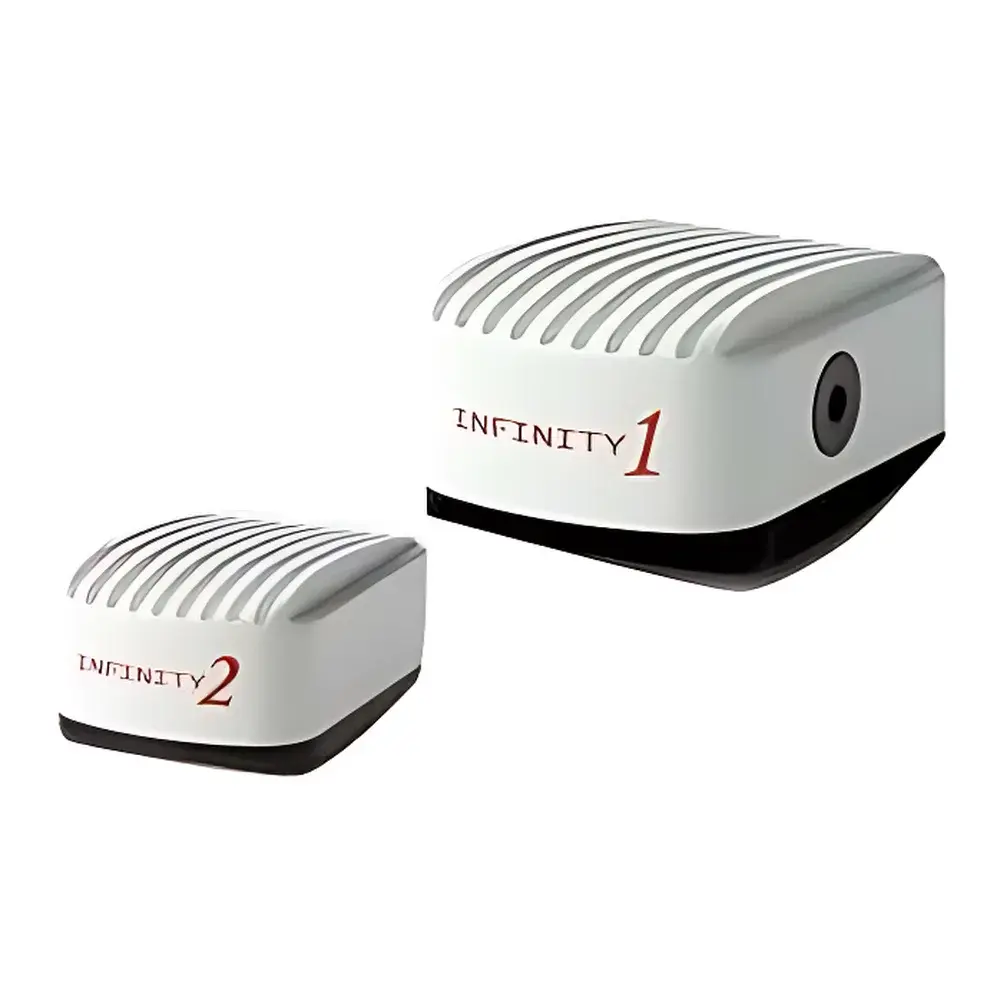
Lumenera INFINITY 1 & INFINITY 2 USB 2.0 Microscopy Imaging Cameras
| Brand | Lumenera |
|---|---|
| Origin | Canada |
| Model Series | INFINITY 1 (CMOS), INFINITY 2 (CCD) |
| Interface | USB 2.0 |
| Sensor Types | CMOS (INFINITY 1), Interline CCD (INFINITY 2) |
| Resolution Range | 1.3–5.0 MP (INFINITY 1), 1.4–3.3 MP (INFINITY 2) |
| Pixel Sizes | 2.2–4.65 µm |
| Full-Frame Frame Rates | 5–20 fps (INFINITY 1), 5–15 fps (INFINITY 2) |
| ROI & Binning Support | Yes |
| Dynamic Range | >60 dB (CMOS), >66 dB (CCD) |
| Bit Depth | 8/10-bit (CMOS), 8/12-bit (CCD) |
| Compliance | RoHS, CE, FCC Class B |
Overview
The Lumenera INFINITY 1 and INFINITY 2 series are high-performance, USB 2.0–based digital imaging cameras engineered specifically for demanding microscopy applications in life sciences, clinical pathology, materials inspection, and industrial quality control. The INFINITY 1 series utilizes modern CMOS sensor architecture—offering high sensitivity, low power consumption, and rapid readout speeds—while the INFINITY 2 series employs progressive-scan interline transfer CCD sensors (including Sony ICX205, ICX262, and ICX274) optimized for superior quantum efficiency, minimal smear, and excellent linearity across a wide illumination range. Both platforms deliver calibrated, stable analog-to-digital conversion with hardware-level synchronization support (via TTL trigger input/output), enabling precise temporal alignment in time-lapse, multi-channel fluorescence, or stage-synchronized acquisition workflows. Designed for integration into OEM systems and standalone laboratory setups alike, these cameras operate without external frame grabbers and maintain consistent exposure timing and gain control under variable host CPU load—critical for GLP-compliant documentation and long-duration experiments.
Key Features
- USB 2.0 plug-and-play interface with integrated power delivery—no external power supply or frame grabber required
- Dual-platform architecture: INFINITY 1 (global-shutter CMOS) for speed-sensitive applications; INFINITY 2 (interline CCD) for high-fidelity photometric accuracy and low-noise quantitative imaging
- Hardware-supported region-of-interest (ROI) selection and pixel binning to maximize frame rate and signal-to-noise ratio without software overhead
- On-sensor anti-blooming and electronic shuttering for artifact-free imaging of high-contrast specimens (e.g., fluorescent beads, stained tissue sections)
- Firmware-upgradable architecture with persistent camera configuration storage—retains user-defined settings across reboots and host changes
- Temperature-stable design with passive thermal management, minimizing dark current drift during extended acquisitions
- Comprehensive SDK support (C/C++, .NET, Python) and native drivers for Windows, Linux, and macOS—fully compatible with major third-party microscopy platforms including MicroManager, NIS-Elements, and MetaMorph
Sample Compatibility & Compliance
These cameras are routinely deployed in brightfield, phase contrast, DIC, and epifluorescence microscopy configurations—including widefield, spinning-disk confocal, and structured illumination modalities. Their mechanical dimensions and C-mount threading (with optional adapters for F-mount or proprietary lens interfaces) ensure seamless integration with Olympus, Nikon, Leica, Zeiss, and Motic microscope stands. All models comply with ISO 13660 (image quality assessment), IEC 61000-6-3 (EMC emissions), and RoHS 2011/65/EU directives. Firmware and driver packages adhere to FDA 21 CFR Part 11 requirements for audit trail logging, electronic signature support, and configuration change tracking—enabling use in regulated environments governed by GLP, GMP, or CLIA standards.
Software & Data Management
Lumenera’s INFINITY Capture software provides intuitive, instrument-grade control over exposure, gain, gamma, white balance, and color matrix tuning—with real-time histogram overlay and live focus assist tools. Raw image data is saved in TIFF, BMP, or lossless JPEG2000 formats with embedded EXIF metadata (including timestamp, exposure parameters, and sensor temperature). For automated workflows, the Lumenera SDK supports multi-camera synchronization via hardware triggers, memory-mapped buffers for zero-copy acquisition, and direct integration with LabVIEW, MATLAB Image Acquisition Toolbox, and Python-based analysis pipelines (OpenCV, scikit-image, Dask). Audit logs record all parameter modifications with user ID, timestamp, and pre-/post-change values—satisfying traceability requirements in ISO/IEC 17025-accredited laboratories.
Applications
- Quantitative histopathology: digitization of H&E and immunohistochemical slides with reproducible color fidelity and dynamic range preservation
- Live-cell time-lapse imaging: sub-second temporal resolution for mitosis tracking, organelle dynamics, and calcium flux monitoring
- Industrial metrology: high-contrast edge detection in PCB inspection, semiconductor wafer defect mapping, and precision component measurement
- Educational microscopy labs: robust, low-maintenance imaging solution supporting curriculum-aligned image annotation, measurement, and export workflows
- OEM integration: compact form factor and SDK extensibility enable embedding into custom diagnostic instruments, endoscopic systems, and automated cell sorters
FAQ
Are INFINITY 1 and INFINITY 2 cameras compatible with USB 3.0 hosts?
Yes—both series operate in backward-compatible USB 2.0 mode on USB 3.0 ports. No performance degradation occurs; however, bandwidth remains limited to USB 2.0 specifications (480 Mbps).
What is the maximum cable length supported for reliable operation?
Standard passive USB 2.0 cables up to 3 meters ensure full-speed operation. For longer distances, active extension solutions (e.g., optical USB extenders or powered hubs) are recommended to maintain signal integrity.
Do these cameras support cooling or thermoelectric stabilization?
No—these are ambient-temperature designs optimized for stability within 15–35°C operating ranges. For low-dark-current applications requiring sub-ambient operation, Lumenera offers separate cooled camera models (e.g., INFINITY X series).
Can I perform real-time image processing onboard the camera?
No—processing is host-based. The cameras provide raw, unprocessed pixel data to preserve quantitative integrity; all corrections (flat-field, shading, color interpolation) are applied in software per application requirements.
Is firmware update capability available to end users?
Yes—Lumenera provides signed firmware updates through the INFINITY Capture utility or command-line tools, with version rollback support and checksum validation to ensure system reliability.




