
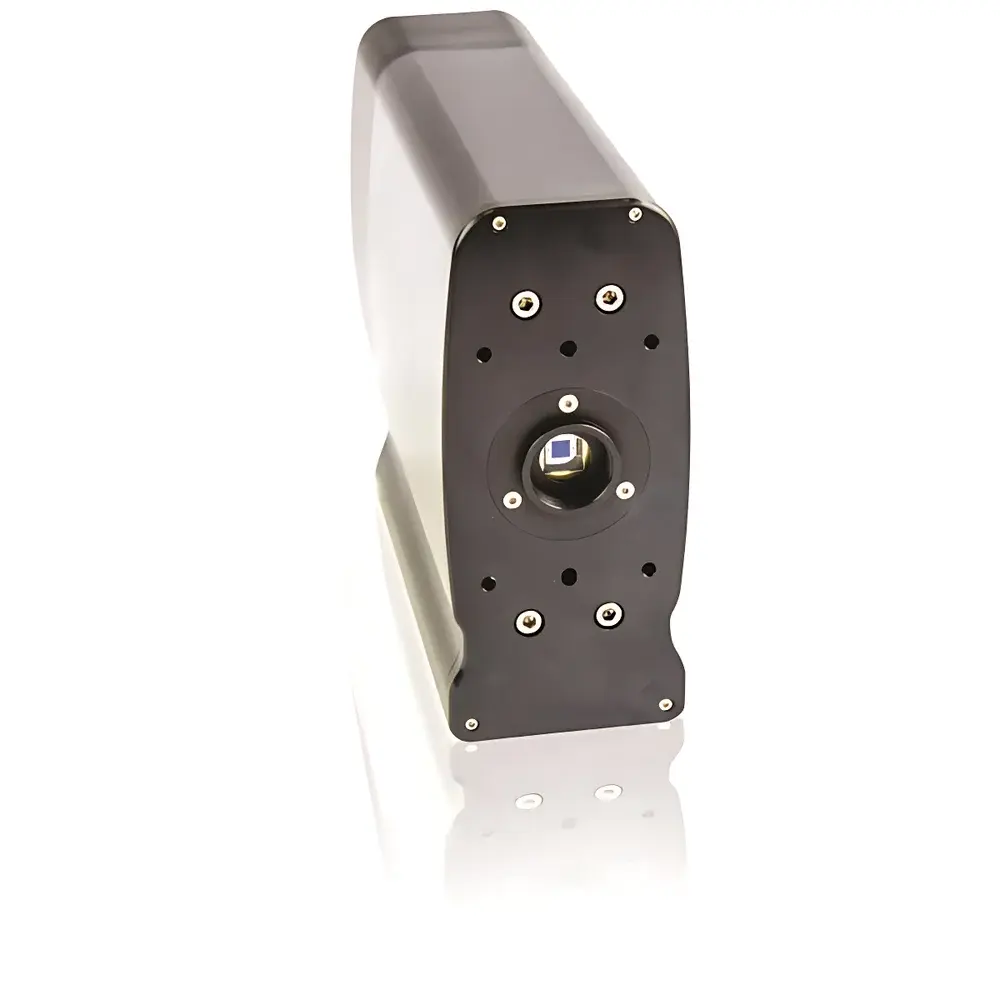
First Light Imaging OCAM2S-WFS and OCAM2K-WFS High-Speed Electron-Multiplying CCD Wavefront Sensors
| Origin | France |
|---|---|
| Manufacturer Type | Authorized Distributor |
| Origin Category | Imported |
| Model | OCAM2S-WFS / OCAM2K-WFS |
| Price | USD 135,000 (FOB) |
Overview
The First Light Imaging OCAM2S-WFS and OCAM2K-WFS are purpose-built, high-speed electron-multiplying charge-coupled device (EMCCD) wavefront sensors engineered for real-time adaptive optics (AO) systems in astronomical observatories, high-resolution microscopy, and laser beam control applications. Based on the OCAM2 imaging core—the world’s fastest full-frame EMCCD—the sensors deliver 2067 frames per second (fps) at 240 × 240 resolution with sub-electron read noise (0.3 e⁻ RMS at full speed and gain ~600), enabling photon-starved wavefront sensing under ultra-low-light conditions. The devices operate on the principle of Shack–Hartmann wavefront reconstruction: incident light passes through a microlens array (20 × 20 or 40 × 40 configurations), generating a focal spot pattern on the EMCCD sensor; centroid displacement of each spot is computed to quantify local wavefront slope. With peak quantum efficiency of 95% at 650 nm and an effective pixel size of 24 µm, these sensors achieve exceptional sensitivity across the visible to near-IR spectrum (400–900 nm), while their deep-cooled operation at −45 °C suppresses dark current to <0.001 e⁻/pix/s—critical for long-exposure AO loop stability.
Key Features
- World-record frame rate: 2067 fps at full 240 × 240 resolution—enabling closed-loop AO correction at >1 kHz bandwidth
- Sub-electron read noise (0.3 e⁻ RMS) at maximum speed, achieved via optimized clocking and on-chip electron multiplication gain (up to ×1000)
- E2V CCD219 (OCAM2S-WFS) and CCD220 (OCAM2K-WFS) back-illuminated sensors with >95% QE at 650 nm and >98% microlens fill factor
- Integrated 22 mm focal length lenslet array optimized for 630 nm; configurable microlens pitch (288 µm) and layout (20 × 20 or 40 × 40)
- Hardware-level electronic shutter (OCAM2S-WFS only); 14-bit Camera Link interface for deterministic, low-latency data transfer
- Hermetically sealed, thermoelectrically cooled housing maintaining stable −45 °C sensor temperature—no liquid nitrogen required
Sample Compatibility & Compliance
The OCAM2-WFS series is compatible with standard Shack–Hartmann optical benches, including commercial AO testbeds (e.g., ALPAO, Imagine Optic) and custom telescope focal planes (e.g., VLT, Keck, Subaru). It supports both continuous-wave and pulsed laser sources (e.g., 532 nm, 633 nm, 785 nm) and low-flux fluorescent specimens in confocal or TIRF microscopy. All units comply with CE marking requirements for electromagnetic compatibility (EN 61326-1) and safety (EN 61010-1). Firmware and acquisition software support audit trails and user-access logging, facilitating alignment with GLP and ISO/IEC 17025 documentation standards for metrology-critical AO calibration workflows.
Software & Data Management
First Light Imaging provides the proprietary WFS Studio suite, a real-time wavefront processing platform supporting centroiding algorithms (center-of-gravity, Gaussian fit), Zernike mode decomposition, and closed-loop control integration via TCP/IP or shared memory APIs. Raw frame data is streamed in native 14-bit format with timestamp precision ≤1 µs. The software includes built-in compliance features: full parameter logging, operator ID tagging, and exportable XML-based configuration files traceable to ISO 10110-5 optical testing protocols. For regulated environments, optional FDA 21 CFR Part 11-compliant modules enable electronic signatures, role-based access control, and immutable audit logs—validated for use in GMP-aligned optical system qualification (IQ/OQ/PQ).
Applications
- Astronomical adaptive optics: Real-time correction of atmospheric turbulence on 8–10 m class telescopes; used in SPHERE (VLT), SCExAO (Subaru), and GMT Laser Tomography AO pathfinders
- High-speed fluorescence microscopy: Single-molecule tracking and Ca²⁺ imaging where photon budget limits conventional CMOS frame rates
- Laser beam diagnostics: Dynamic measurement of thermal lensing, M² evolution, and phase aberrations in high-power fiber and solid-state lasers
- Free-space optical communications: Wavefront monitoring and compensation in turbulent atmospheric links (C-band to L-band)
- Industrial metrology: In-process wavefront verification of aspheric lenses and EUV optics during polishing and coating
FAQ
What distinguishes OCAM2S-WFS from OCAM2K-WFS?
The OCAM2S-WFS integrates an electronic shutter for precise exposure synchronization in pulsed-laser applications; the OCAM2K-WFS omits this feature to maximize quantum efficiency uniformity across the sensor array—optimized for continuous-wave wavefront sensing.
Is camera calibration included with delivery?
Yes—each unit ships with factory-measured flat-field, dark-current, and microlens centroid maps, traceable to NIST-traceable photometric standards and documented per ISO 14132-3.
Can the sensor be integrated into existing AO control systems?
Absolutely: Native support for MATLAB, Python (via PyCameraLink), and LabVIEW drivers; real-time centroid data output via UDP or shared memory with ≤200 µs latency from exposure trigger to centroid vector.
What cooling method is used, and is maintenance required?
Two-stage thermoelectric (Peltier) cooling maintains −45 °C sensor temperature indefinitely; no consumables, vacuum pumps, or cryogens—only 24 V DC power and ambient airflow for heatsink dissipation.
Does the system support external triggering and synchronization?
Yes—TTL-compatible trigger input (rising-edge) with programmable delay (10 ns resolution) and sync-out signal for multi-sensor timing alignment in multi-conjugate AO systems.





