
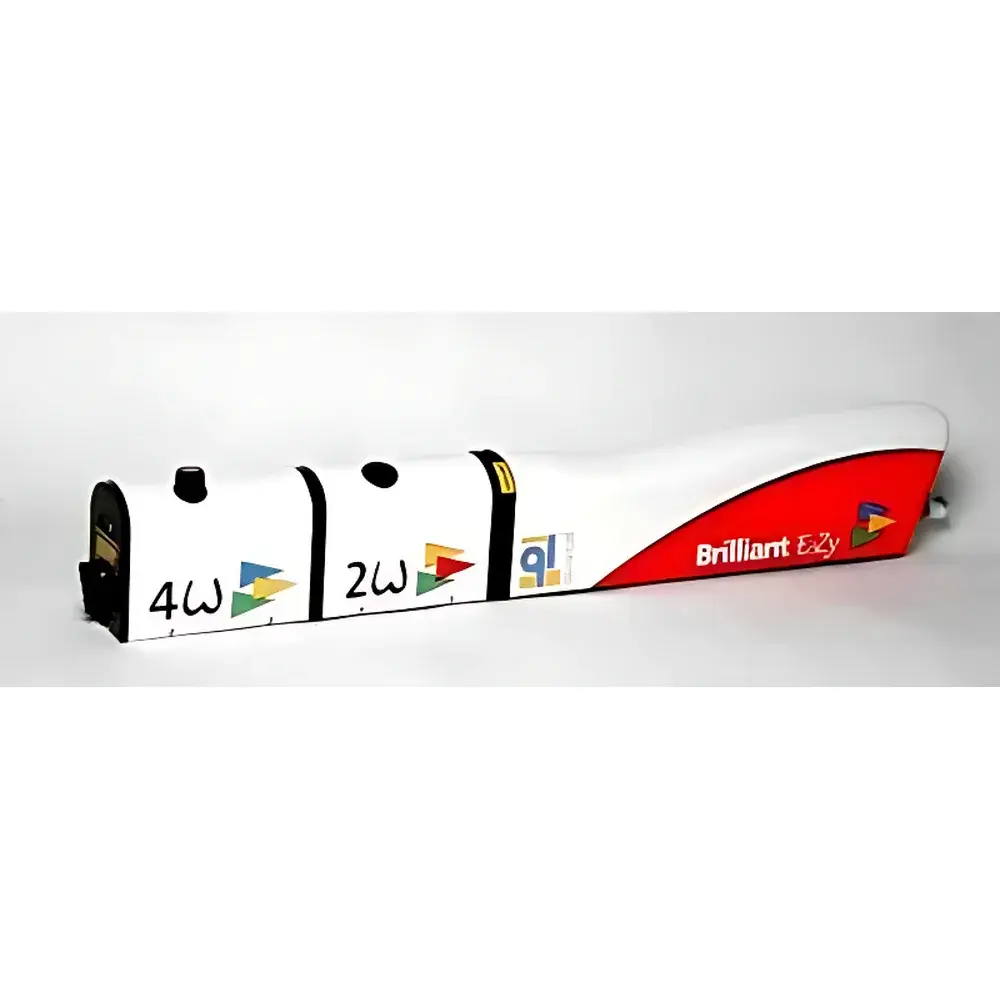
Quantel Brilliant Series Modular Nd:YAG Laser
| Brand | Quantel |
|---|---|
| Origin | France |
| Model | Brilliant Series |
| Laser Type | Flashlamp-Pumped Nd:YAG |
| Harmonic Generation | Integrated Modular Frequency-Doubling Modules |
| Cooling | Dual Independent Thermoelectric Temperature Control (Laser Head & Harmonic Module) |
| Construction | Hermetically Sealed Laser Head with Ceramic Flashlamp Housing |
| Compliance | CE, RoHS, IEC 60825-1:2014 Class 4 Laser Product |
Overview
The Quantel Brilliant Series Modular Nd:YAG Laser is a high-reliability, flashlamp-pumped solid-state laser system engineered for precision optical measurement, scientific research, and industrial metrology applications. Based on the fundamental 1064 nm emission of neodymium-doped yttrium aluminum garnet (Nd:YAG), the system incorporates modular harmonic generation architecture to deliver stable, user-selectable output at 532 nm (second harmonic), 355 nm (third harmonic), and 266 nm (fourth harmonic). Unlike conventional fixed-wavelength YAG lasers, the Brilliant platform employs a physically decoupled, plug-and-play frequency-doubling module design—each equipped with its own thermoelectric cooler (TEC) and temperature stabilization circuit—to ensure wavelength-specific thermal equilibrium and long-term power stability. The laser head features a hermetically sealed enclosure and a corrosion-resistant ceramic flashlamp housing, eliminating degradation from electrode sputtering or gas contamination—critical for multi-year operational integrity in cleanroom and laboratory environments.
Key Features
- True Modularity: Frequency-doubling modules are mechanically and electrically isolated from the main laser head; no disassembly or realignment is required for wavelength switching—modules mount via precision kinematic interfaces and auto-negotiate calibration parameters via embedded EEPROM.
- Ceramic Flashlamp Chamber: Constructed from high-purity alumina ceramic, the lamp housing resists thermal stress cracking and chemical erosion from halogenated fill gases, extending flashlamp service life beyond 10⁷ shots under nominal pulse repetition rates.
- Dual Independent Thermal Management: Separate TEC-controlled thermal regulation systems govern the Nd:YAG rod assembly (±0.1 °C stability) and each harmonic crystal module (±0.05 °C), minimizing thermal lensing drift and phase-matching angle deviation across ambient temperature fluctuations.
- Hermetic Laser Head Enclosure: Fully sealed optical cavity prevents particulate ingress and moisture absorption by nonlinear crystals—reducing risk of surface damage, gray tracking, and output power decay during extended duty cycles.
- Industrial-Grade Pulse Stability: Achieves ≤1.5% RMS pulse-to-pulse energy variation at 10 Hz (1064 nm), with jitter <5 ns (FWHM), meeting repeatability requirements for time-resolved spectroscopy, LIDAR calibration, and pump-probe experiments.
Sample Compatibility & Compliance
The Brilliant Series is compatible with standard optical tables, beam delivery optics (including UV-grade fused silica and BBO/KDP crystals), and synchronization interfaces (TTL, LVDS, analog trigger). It conforms to IEC 60825-1:2014 as a Class 4 laser product, with integrated interlock circuits compliant with EN 61511 for safety instrumented systems. All units undergo factory certification per ISO/IEC 17025-accredited procedures—including beam profile characterization (M² <1.3), spectral bandwidth verification (<0.1 nm FWHM for SHG), and long-term power drift assessment over 8-hour continuous operation. Documentation supports GLP/GMP audit readiness, including full traceability of calibration certificates, component lot numbers, and environmental test reports.
Software & Data Management
Control is executed via Quantel’s QSoft™ v5.2 platform—a Windows-based application supporting local USB/Ethernet connectivity and remote API access (TCP/IP, SCPI-compliant commands). The software provides real-time monitoring of diode current, cavity temperature, harmonic conversion efficiency, and pulse energy feedback. All operational logs—including timestamped parameter sets, fault events, and thermal history—are stored in HDF5 format with SHA-256 checksums, enabling FDA 21 CFR Part 11–compliant electronic record retention when deployed on validated IT infrastructure. Optional LabVIEW and Python SDKs facilitate integration into automated test benches and custom data acquisition workflows.
Applications
- Time-of-flight mass spectrometry (TOF-MS) ionization source
- Multi-wavelength Raman spectroscopy excitation (e.g., 532 nm for carbon nanotubes, 355 nm for resonance enhancement)
- Calibration of photodetectors and radiometric standards across UV–NIR spectrum
- Pump-probe transient absorption setups requiring synchronized dual-wavelength pulses
- Laser-induced breakdown spectroscopy (LIBS) for elemental analysis in metallurgy and geoscience
- Seed source for optical parametric amplifiers (OPAs) and chirped-pulse amplification (CPA) systems
FAQ
Can the Brilliant Series operate continuously at maximum repetition rate without thermal derating?
Yes—when installed with recommended forced-air or water cooling (≥2 L/min at 18–22 °C), the system maintains rated output energy up to 20 Hz at 1064 nm and 10 Hz at 266 nm with no duty-cycle limitation.
Is third-party harmonic module integration supported?
No—only Quantel-certified frequency-doubling modules are guaranteed to maintain beam quality, damage threshold, and thermal compensation performance; non-OEM modules void warranty and compromise compliance documentation.
What maintenance intervals are recommended for flashlamp replacement?
Under typical usage (10⁶ shots/year), ceramic-lamp replacement is advised every 24 months; full alignment verification and cavity purge are included in the biannual preventive maintenance service package.
Does the system include built-in energy monitoring?
Yes—a calibrated pyroelectric sensor is integrated into the beam dump path, providing real-time pulse energy readout with NIST-traceable uncertainty of ±2.5% (k=2) across all harmonics.




