
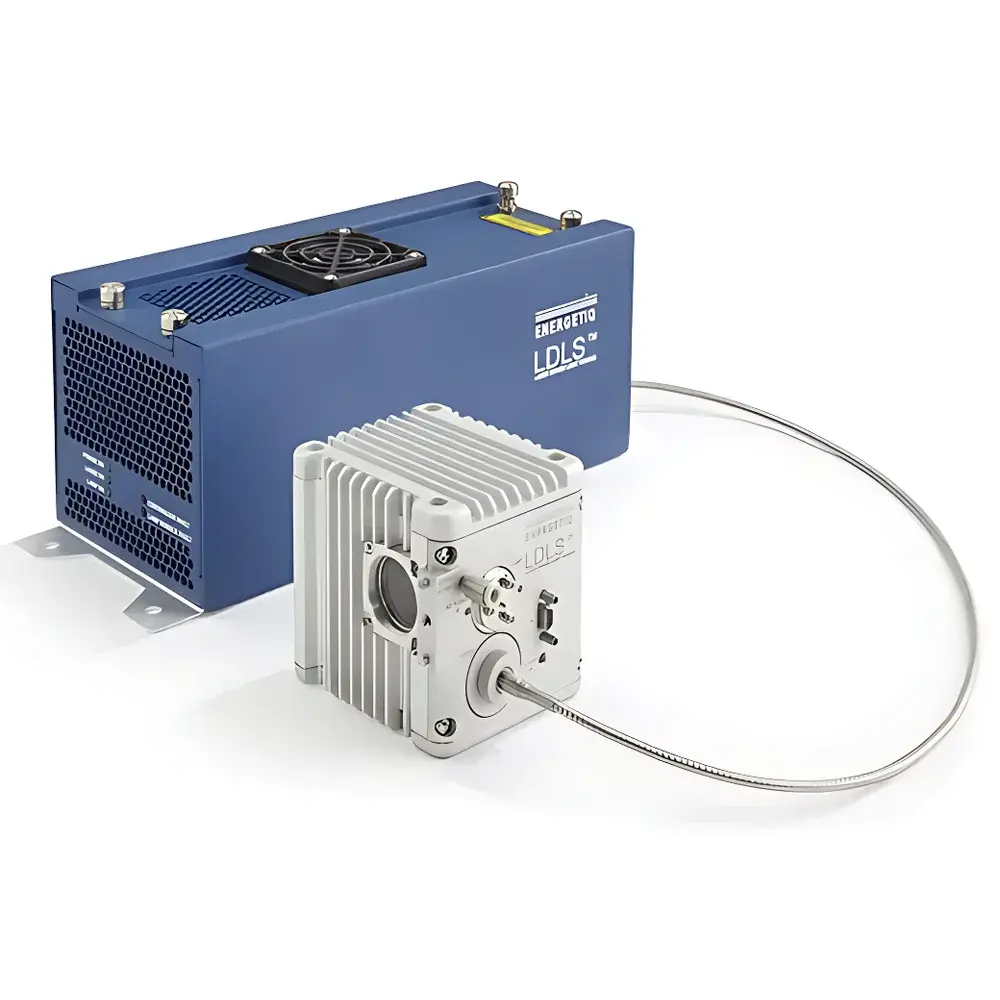
Energetiq EQ-99X Laser-Driven Broadband White Light Source
| Brand | Energetiq |
|---|---|
| Origin | USA |
| Manufacturer Type | Authorized Distributor |
| Import Status | Imported |
| Model | EQ-99X |
| Light Source Type | Laser-Driven Plasma Light Source |
| Illumination Mode | External Illumination |
| Spectral Range | 170–2100 nm |
| Numerical Aperture (NA) | up to 0.47 |
| Typical Lifetime | >9,000 hours |
| Output Interface | Free-space |
| Lamp Dimensions | 82.3 × 85.7 × 76.2 mm |
| Lamp Weight | 0.7 kg |
| Power Supply Dimensions | 107 × 111 × 254 mm (excl. feet) |
| Power Supply Weight | 1.4 kg |
Overview
The Energetiq EQ-99X Laser-Driven Broadband White Light Source is an engineered solid-state alternative to conventional arc lamps and filament-based sources. It operates on the principle of laser-driven plasma (LDP) technology: a high-repetition-rate pulsed laser is focused into a flowing xenon gas stream, generating a stable, electrode-free microplasma that emits intense, continuum radiation across the deep ultraviolet through near-infrared spectrum (170–2100 nm). Unlike traditional xenon or deuterium–tungsten halogen lamp combinations—whose spectral gaps, electrode erosion, intensity drift, and limited lifetime constrain system performance—the EQ-99X eliminates electrodes entirely, thereby removing cathode sputtering, gas contamination, and thermal fatigue as failure modes. This architecture delivers intrinsic spatial coherence, exceptional radiometric stability, and long-term repeatability critical for quantitative optical metrology and calibration-sensitive applications.
Key Features
- Laser-driven plasma emission with no electrodes—enabling >9,000 hours of operational lifetime and eliminating scheduled lamp replacement cycles
- Continuous broadband output spanning 170 nm (deep UV) to 2100 nm (NIR), covering spectral regions traditionally requiring multiple discrete sources (e.g., deuterium, tungsten-halogen, and xenon arcs)
- High numerical aperture output (NA ≤ 0.47), optimized for efficient coupling into monochromators, spectrometers, fiber optics, and imaging optics
- Free-space collimated output port compatible with standard kinematic mounts and optical breadboards
- Low spatial drift (<0.5 µrad RMS angular instability over 8 hours) and short-term power stability better than ±0.2% RMS over 1 hour (measured at 500 nm)
- Hermetically sealed, ultra-clean internal gas handling system minimizing particulate generation and oxidation pathways—critical for vacuum-compatible or cleanroom-integrated setups
- Compact lamp head (82.3 × 85.7 × 76.2 mm; 0.7 kg) with integrated thermal management and passive convection cooling
Sample Compatibility & Compliance
The EQ-99X is designed for integration into ISO/IEC 17025-accredited laboratories and regulated environments where source traceability and measurement integrity are mandatory. Its stable spectral irradiance profile supports compliance with ASTM E275 (describing UV–Vis spectrophotometer performance verification), ISO 17025 Clause 6.4.10 (reference standards and traceability), and USP (spectrophotometric absorbance measurements). While not intrinsically certified for FDA 21 CFR Part 11, its digital control interface (RS-232 and analog 0–10 V) permits integration into validated systems with full audit trail capability when paired with compliant data acquisition software. The absence of mercury or radioactive components ensures unrestricted international shipping and alignment with RoHS Directive 2011/65/EU and REACH Annex XVII restrictions.
Software & Data Management
The EQ-99X operates via a dedicated low-noise switching power supply with embedded firmware supporting remote control through ASCII command sets over RS-232 or TTL-level analog modulation. No proprietary drivers or OS-specific software are required. Integration with LabVIEW, Python (PySerial), MATLAB, or EPICS is straightforward using documented SCPI-like protocols. Real-time monitoring of lamp status (plasma ignition success, laser diode temperature, internal pressure feedback) is available via serial query commands. For GLP/GMP environments, users may log all operational parameters—including runtime hours, total ignition cycles, and thermal history—to external SQL or CSV databases using custom scripts, satisfying ALCOA+ data integrity requirements for source calibration records.
Applications
- UV–Vis–NIR absorption, reflectance, and transmission spectroscopy requiring single-source continuity across 170–2100 nm
- Calibration of array detectors (CCD, CMOS, InGaAs) and monochromator-based scanning spectrometers
- Optical component characterization—including transmittance/reflectance of filters, coatings, lenses, and optical fibers
- Confocal and widefield fluorescence microscopy illumination where uniformity and UV stability are essential
- Atomic absorption spectroscopy (AAS) background correction and continuum source AAS (CS-AAS) configurations
- In-situ environmental gas sensing systems utilizing differential optical absorption spectroscopy (DOAS)
- Material science applications including thin-film thickness mapping, bandgap determination, and photoluminescence excitation profiling
- Accelerated aging and solar simulation testing where spectral fidelity and temporal stability outweigh peak irradiance requirements
FAQ
What distinguishes laser-driven plasma technology from conventional arc lamps?
Laser-driven plasma replaces thermionic electrodes with a focused laser pulse to ionize xenon gas, eliminating electrode degradation, spectral line artifacts, and output decay mechanisms inherent in DC/AC arc lamps.
Can the EQ-99X replace both deuterium and tungsten-halogen lamps in a dual-beam spectrophotometer?
Yes—its seamless 170–2100 nm output covers the combined spectral ranges of both sources, enabling optical path simplification and reduced alignment complexity.
Is the EQ-99X suitable for vacuum chamber integration?
The lamp head is not vacuum-rated; however, it interfaces seamlessly with vacuum feedthroughs via standard CF or KF flanges using optional collimating lens tubes and differential pumping stages.
Does the system require water cooling or forced air?
No—thermal management relies on passive convection and optimized aluminum alloy housing; ambient airflow ≥0.5 m/s is recommended for continuous operation above 40 °C ambient.
How is spectral irradiance calibrated and traceable?
Energetiq provides NIST-traceable spectral irradiance calibration certificates (optional add-on) measured at the output window using a double-monochromator transfer standard referenced to NIST SRM 2065.



