
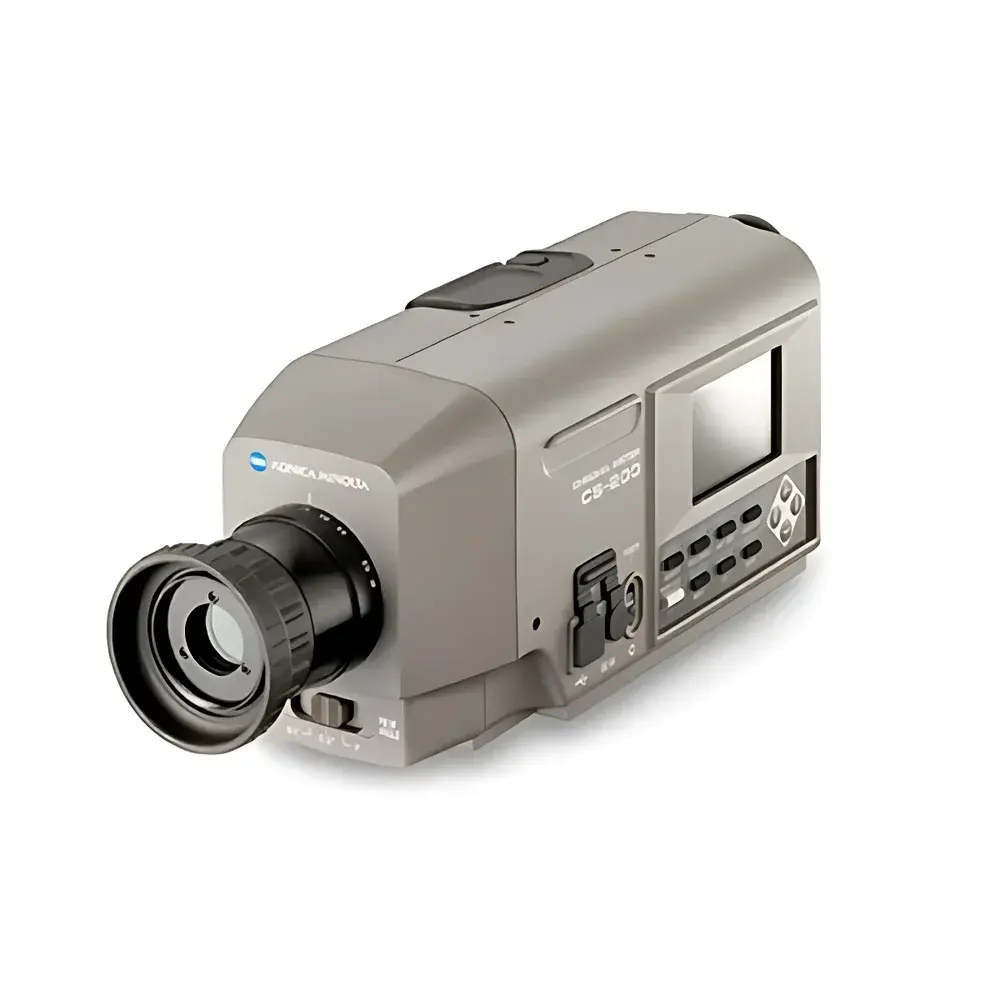
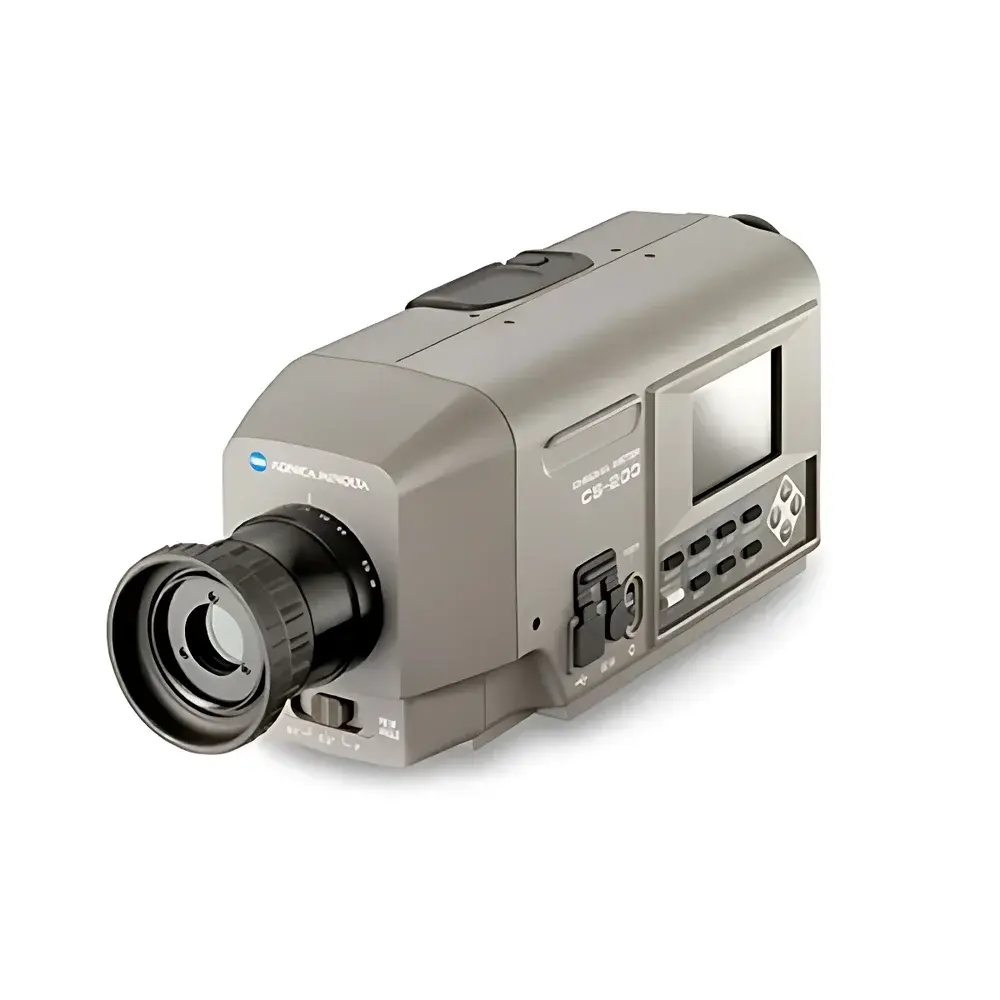
ZOLIX CS-200 Chroma Luminance Meter
| Brand | ZOLIX |
|---|---|
| Origin | Japan |
| Model | CS-200 |
| Measurement Principle | Grating-based spectral radiometry with linear photodiode array |
| Luminance Range | 0.01–20,000,000 cd/m² (angle-dependent) |
| Measurement Angles | 1°, 0.2°, 0.1° |
| Spectral Matching | CIE 1931 2° standard observer (V(λ), x(λ), y(λ), z(λ)) |
| Accuracy (Lv, 1°) | ±2% ±1 digit |
| Chromaticity Accuracy (xy, 1°) | ±0.002–±0.007 (luminance-dependent) |
| Repeatability (Lv, 1°) | ±0.1% +1 digit to ±0.5% +1 digit |
| Minimum Measured Area | 0.1 mm (with close-up lens) |
| Minimum Working Distance | 296 mm |
| Measurement Modes | Lv xy, Lv u'v', Lv TΔuv, XYZ, Dominant Wavelength |
| Synchronization | Vertical sync input (40.00–200.00 Hz) |
| Interface | USB 1.1 |
| Power | AA alkaline batteries (≈3 h continuous operation) |
| Dimensions | 95 × 127 × 334 mm |
| Weight | 1.8 kg (body only) |
| Operating Environment | 0–40°C, ≤85% RH (non-condensing) |
Overview
The ZOLIX CS-200 Chroma Luminance Meter is a high-precision, spectrally calibrated optical instrument engineered for absolute luminance and chromaticity measurement of self-luminous devices across an exceptionally wide dynamic range—from ultra-low-brightness OLED pixels (0.01 cd/m²) to high-intensity outdoor LED displays (up to 20,000,000 cd/m²). Unlike conventional tristimulus colorimeters that rely on analog filter-based RGB sensors—whose spectral response inevitably deviates from the CIE standard observer functions—the CS-200 employs a grating-dispersive optical architecture coupled with a linear photodiode array. This enables true spectral radiance acquisition across the visible spectrum (380–780 nm), followed by digital convolution with the CIE 1931 2° standard observer spectral sensitivity curves (x̄(λ), ȳ(λ), z̄(λ)) and photopic luminosity function V(λ). The result is metrologically traceable XYZ tristimulus values and chromaticity coordinates (x, y or u′, v′) with significantly reduced metamerism error, particularly critical for narrow-band emitters such as monochromatic LEDs, quantum-dot-enhanced LCDs, and micro-LED arrays.
Key Features
- Spectral Radiometric Core: Utilizes a compact diffraction grating and 40-pixel linear photodiode array to resolve spectral power distribution (SPD), eliminating reliance on imperfect physical filter matching.
- Triple-Angle Interchangeable Optics: Field-of-view selection via 1°, 0.2°, and 0.1° apertures—enabling precise targeting of large-area displays (e.g., PDP panels) or sub-millimeter features (e.g., automotive instrument cluster indicators).
- Sub-Millimeter Spatial Resolution: With optional close-up lens, achieves a minimum measurable spot diameter of 0.1 mm at 296 mm working distance—essential for pixel-level uniformity mapping in microdisplay R&D.
- High-Dynamic-Range Luminance Capability: Validated accuracy across seven orders of magnitude (0.01–2×10⁷ cd/m²), with luminance-dependent uncertainty specifications aligned to CIE TN 005 and ISO/CIE 19898:2022 guidelines.
- Real-Time Synchronization Support: Integrated vertical sync input (40.00–200.00 Hz) enables frame-locked measurements on flickering or pulsed sources—including PWM-driven LEDs and video-synchronized displays—ensuring temporal stability in time-resolved luminance analysis.
- Robust Environmental Operation: Designed for laboratory, production line, and field use; operates reliably within 0–40°C and ≤85% RH (non-condensing), with thermal drift compensation algorithms embedded in firmware.
Sample Compatibility & Compliance
The CS-200 is validated for measurement of all major emissive technologies: OLED, AMOLED, LCD (with LED/mini-LED/QD backlight), micro-LED, PDP, CRT, incandescent, halogen, fluorescent, and high-power white/colored LEDs. Its spectral fidelity ensures conformance with international photometric standards including CIE S 014-2/E:2022 (colorimetry), CIE 127:2007 (LED measurement), and IEC 62341-6-3 (OLED display testing). For regulated environments, raw spectral data export supports GLP-compliant audit trails when integrated into validated QA workflows. While not inherently 21 CFR Part 11 compliant, the device’s deterministic output and timestamped measurement logs facilitate integration with validated LIMS or MES platforms requiring electronic record integrity.
Software & Data Management
ZOLIX provides dedicated PC software (Windows-compatible) enabling full instrument control, real-time waveform visualization, batch measurement scripting, and multi-parameter export (CSV, TXT). All spectral scans and derived photometric values are stored with metadata—including aperture angle, sync status, exposure time, ambient temperature, and calibration timestamp. The software supports user-defined pass/fail thresholds for automated conformance checking against specification limits (e.g., Δu′v′ < 0.003, luminance uniformity ≥ 90%). Exported datasets include full SPD matrices, facilitating third-party analysis in MATLAB, Python (using NumPy/SciPy), or industry-standard tools such as LightTools or ASAP for optical system modeling.
Applications
- Display R&D: Pixel-level luminance uniformity, white point stability under aging, viewing angle dependency (2° vs. 10° observer mode), and HDR tone mapping verification.
- Automotive Electronics: Instrument cluster backlight characterization, head-up display (HUD) brightness compliance, and exterior lighting photometry per ECE R149 or SAE J1383.
- LED Manufacturing: Binning consistency validation, CCT shift monitoring during thermal soak, and spatial chromaticity mapping of COB and MCOB modules.
- Regulatory Testing Labs: Pre-compliance assessment for ENERGY STAR, TÜV, CCC, and CE marking requirements related to visual comfort, glare, and photobiological safety (IEC 62471).
- Metrology Support: Transfer standard for calibrating secondary luminance meters; used in accredited labs for inter-laboratory comparison studies under ILAC-P10 protocols.
FAQ
What distinguishes the CS-200 from conventional tristimulus colorimeters?
The CS-200 acquires full spectral data via a grating + photodiode array, then computes CIE XYZ using digital convolution with standard observer functions—avoiding the inherent spectral mismatch errors of analog RGB filter systems.
Can the CS-200 measure pulsed or PWM-driven LEDs?
Yes—via its vertical sync input, it synchronizes acquisition to the source’s frame rate or modulation frequency, enabling accurate time-gated luminance and chromaticity capture.
Is NIST-traceable calibration included?
Each unit ships with a factory calibration certificate traceable to NMIJ (National Metrology Institute of Japan); optional annual recalibration services are available through ZOLIX-authorized metrology centers.
Does the instrument support 10° observer mode?
Yes—software-selectable between CIE 1931 2° and CIE 1964 10° standard observer functions, critical for large-field or peripheral vision applications.
How is measurement repeatability maintained across temperature fluctuations?
Internal thermal sensors feed real-time correction coefficients to the spectral processing engine, compensating for diode responsivity drift and grating alignment shifts per ISO 9241-307 Annex B recommendations.




