
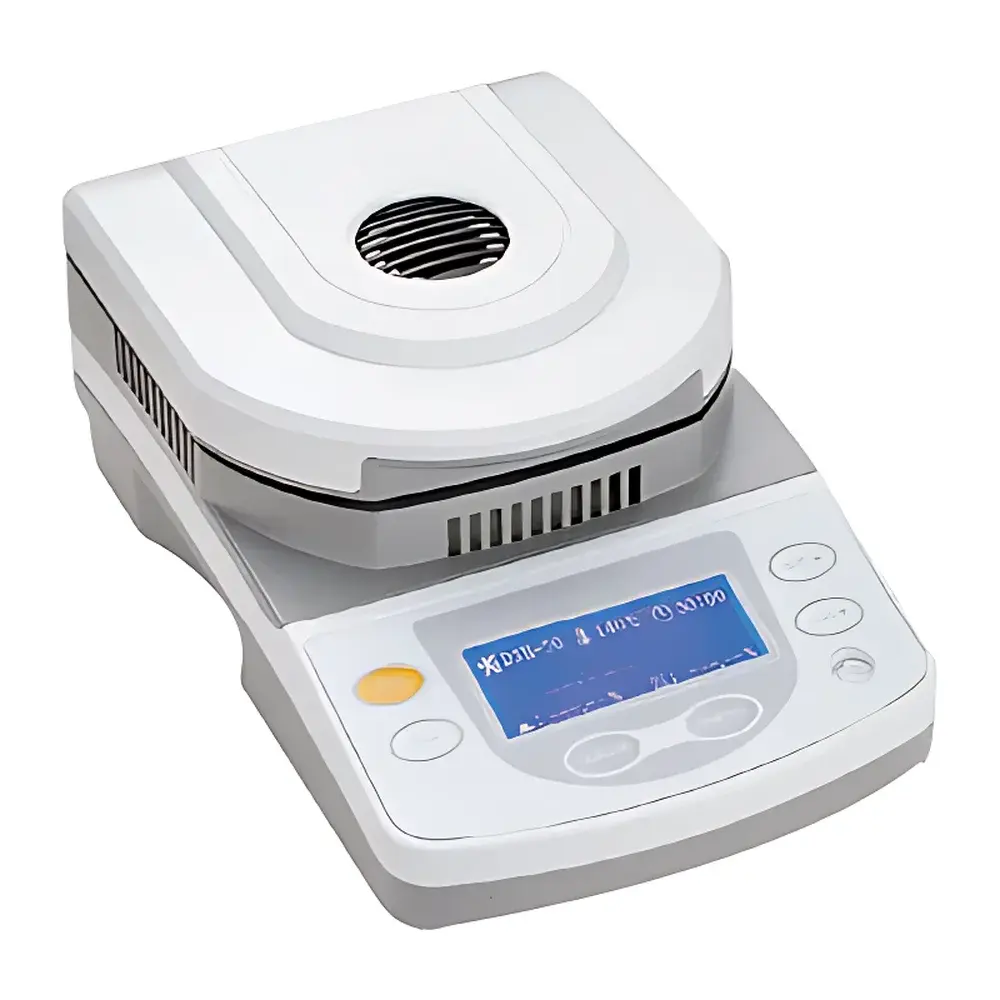
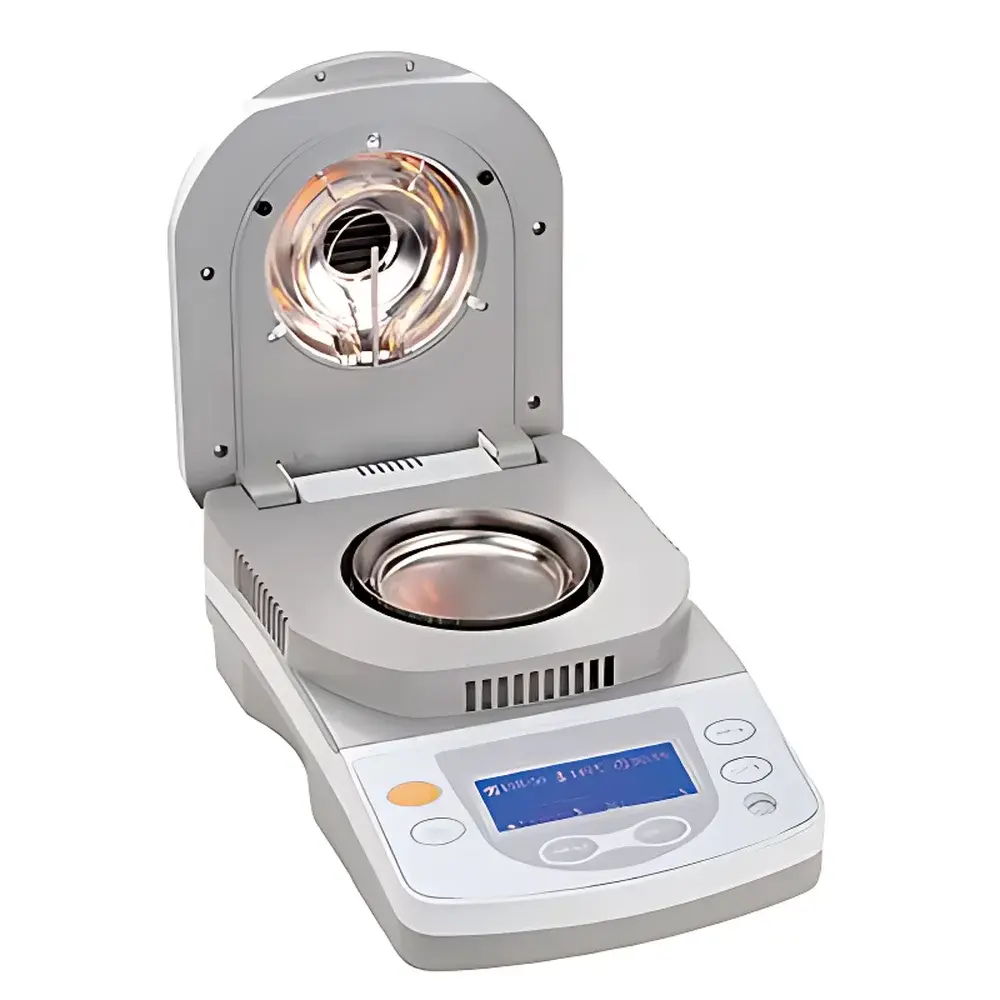
Yoke DSH-50A-5 Halogen Moisture Analyzer
| Max Capacity | 50 g |
|---|---|
| Readability | 5 mg |
| Repeatability (3 g sample) | ±0.3% |
| Minimum Sample Mass | 0.5 g |
| Recommended Sample Mass | 3–10 g |
| Heating Time Range | 1–99 min (1-min increments) |
| Temperature Range | 50–180 °C |
| Heating Source | Halogen Lamp |
| Pan Diameter | 100 mm |
| Dimensions (W×D×H) | 265 × 160 × 150 mm |
| Net Weight | 5 kg |
| Communication Interface | RS232 |
| End-point Modes | Timed & Automatic |
| Display Parameters | Moisture %, Solid %, Mass (g), Elapsed Time, Date |
Overview
The Yoke DSH-50A-5 Halogen Moisture Analyzer is a precision thermogravimetric instrument engineered for rapid, reliable moisture content determination in solid and semi-solid materials. It operates on the loss-on-drying (LOD) principle: a halogen lamp delivers uniform, controllable infrared radiation to heat the sample, driving off volatile components—primarily water—while an integrated high-stability weighing sensor continuously monitors mass loss in real time. Unlike traditional oven-drying methods requiring hours, this analyzer achieves full drying cycles in minutes due to the high thermal efficiency and rapid response of the halogen heating element. Its design conforms to standardized test protocols aligned with ASTM E1447, ISO 15512, and USP , making it suitable for routine QC testing in pharmaceutical, food, chemical, and polymer laboratories where speed, traceability, and method reproducibility are critical.
Key Features
- High-resolution backlit dot-matrix LCD display with optimized contrast for low-light environments—enhancing operator readability during extended shifts or in controlled lighting labs.
- Ergonomic membrane keypad with tactile feedback ensures intuitive navigation through setup menus, method selection, and calibration routines without reliance on touchscreens prone to fingerprint interference or ambient light glare.
- Thermally isolated load cell architecture minimizes drift induced by radiant heat transfer from the halogen source, delivering stable mass readings throughout dynamic heating profiles.
- Programmable heating ramp and dwell parameters—including adjustable temperature setpoints (50–180 °C in 1 °C increments) and timed drying durations (1–99 min)—enable method development for diverse sample matrices such as hygroscopic powders, granules, and viscous pastes.
- Dual end-point detection logic supports both fixed-duration assays and automatic termination based on mass change thresholds (e.g., ≤0.1 mg/30 s), reducing subjectivity and improving inter-operator consistency.
Sample Compatibility & Compliance
The DSH-50A-5 accommodates samples ranging from 0.5 g to 50 g across a wide spectrum of physical forms: free-flowing powders (e.g., lactose, sodium chloride), agglomerated granules (e.g., tablet excipients), and moderately viscous suspensions (e.g., slurries, wet filter cakes). The 100 mm diameter stainless-steel sample pan provides sufficient surface area for even heat distribution while minimizing edge effects during rapid drying. Instrument firmware supports user-defined method storage (up to 20 protocols), each retaining full metadata—including operator ID, date/time stamp, temperature profile, and final moisture result—for audit readiness. Data export via RS232 enables integration into LIMS or electronic lab notebooks compliant with FDA 21 CFR Part 11 requirements when paired with validated software solutions.
Software & Data Management
While the DSH-50A-5 operates autonomously via its embedded controller, its RS232 interface facilitates bidirectional communication with external PCs running dedicated moisture analysis software. This allows for automated report generation (PDF/CSV), statistical evaluation of repeatability and intermediate precision per ICH Q2(R2), and long-term trend analysis of moisture stability data. All measurement sessions are timestamped and logged locally; internal memory retains the last 100 test records with full parameter recall. Optional password-protected administrator mode restricts access to calibration functions and method editing—supporting GLP/GMP-aligned operational discipline.
Applications
- Pharmaceutical manufacturing: Moisture verification of active pharmaceutical ingredients (APIs), excipients, and finished dosage forms prior to compression or encapsulation.
- Food quality control: Determination of moisture in flour, coffee beans, dairy powders, and snack products to ensure shelf-life compliance and microbial safety limits.
- Polymer processing: Monitoring residual solvent or moisture in PET, nylon, and polycarbonate resins before extrusion or injection molding to prevent hydrolytic degradation.
- Chemical R&D: Quantification of hydrate water in inorganic salts or catalyst supports under controlled thermal conditions.
- Agricultural testing: Rapid assessment of grain moisture content for storage and trading specifications (e.g., ISO 712).
FAQ
What standards does the DSH-50A-5 comply with for moisture analysis?
It aligns with thermogravimetric principles referenced in ASTM E1447 (Standard Test Method for Moisture Content of Plastics), ISO 15512 (Plastics — Determination of Water Content), and USP (Water Determination), though formal certification requires method validation per application.
Can the instrument be calibrated for traceable mass measurements?
Yes—internal calibration uses certified weights traceable to NIST or equivalent national metrology institutes; external calibration is supported using Class M2 or better砝码 per OIML R76.
Is the halogen lamp replaceable by the user?
Yes—the lamp module is field-replaceable with no tools required; typical service life exceeds 5,000 hours under standard operating conditions.
Does the analyzer support multi-step heating programs?
No—the DSH-50A-5 implements single-stage heating only; multi-ramp protocols require higher-tier models with programmable temperature gradients.
How is data integrity ensured during RS232 transmission?
Transmission includes checksum verification and optional handshaking (RTS/CTS); raw data packets contain header metadata to prevent misattribution in batched transfers.




