
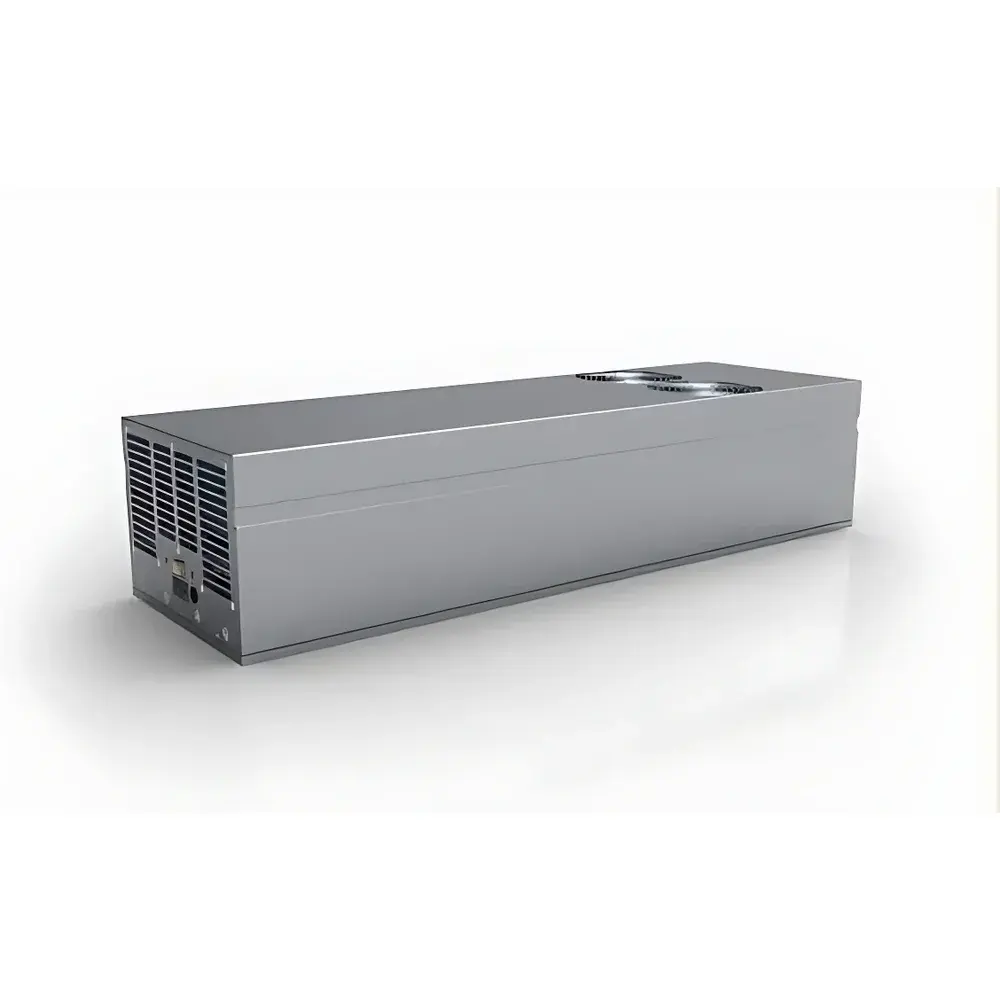
Universal ULCR-100 RF-Excited CO₂ Laser System
| Brand | Universal |
|---|---|
| Origin | USA |
| Manufacturer Type | Authorized Distributor |
| Origin Category | Imported |
| Model | ULCR-100 |
| Core Technology | Sealed-off RF-excited gas laser |
| Output Wavelength | 10.6 µm (standard), optional 9.3 µm |
| Output Power | 100 W (dual-resonator design) |
| Power Stability | ±5% |
| Beam Quality (M²) | 1.3 ± 0.2 |
| Beam Diameter | 4 ± 1 mm |
| Full Divergence Angle | 5 ± 1 mrad |
| Polarization | Linear (standard) |
| Beam Directional Stability | ≤200 µrad |
| Pulse Rise Time | 120 ± 40 µs |
| Max Pulse Frequency | 5 kHz (100% duty cycle capable) |
| Modulation Input | TTL-compatible |
| Cooling | Air-cooled or water-cooled |
| Operating Voltage | 48 VDC |
| Operating Current | 36 A |
| Enclosure Options | OEM Basic, OEM Standard, Class IV Safety-compliant |
| Compliance | IEC 60825-1:2014, FDA 21 CFR 1040.10/1040.11, CE marking (for Class IV variants) |
Overview
The Universal ULCR-100 is a sealed, radio-frequency (RF)-excited carbon dioxide laser system engineered for industrial material processing applications requiring high reliability, consistent beam quality, and seamless OEM integration. Operating at the fundamental vibrational–rotational transition of CO₂ gas (10.6 µm), with optional 9.3 µm emission for enhanced absorption in polyester and composite substrates, the ULCR-100 leverages a patented multi-pass slab cavity architecture to deliver stable, diffraction-limited output. Unlike traditional DC-excited CO₂ lasers, its solid-state RF excitation enables precise pulse control, elimination of high-voltage hazards, and compatibility with automated manufacturing environments governed by ISO 9001 and IATF 16949 quality systems. Designed for continuous-wave (CW) or modulated operation up to 5 kHz, the ULCR-100 meets the thermal and temporal stability requirements of laser marking, cutting, and surface treatment processes across aerospace, medical device, and electronics manufacturing sectors.
Key Features
- Patented multi-pass slab resonator design ensuring long-term power stability (±5%) and low beam pointing drift (≤200 µrad)
- Dual-resonator configuration optimized for 100 W nominal output at 10.6 µm, with M² ≤ 1.5 and near-diffraction-limited focusability
- Integrated RF power supply, internal TTL trigger circuitry, and safety interlock interface compliant with EN 61511 and IEC 61508 functional safety standards
- Compact footprint with dual cooling options: forced-air convection (OEM Basic/Standard) or closed-loop water cooling (Class IV variant)
- Configurable mechanical form factors: OEM Basic (no enclosure, direct-mount), OEM Standard (anodized aluminum housing with integrated fan), and Class IV Safety (IP54-rated enclosure with key switch, emergency stop, and interlocked access panels)
- Optional red pilot beam (635 nm) and 90° beam folding mirror kit for space-constrained integration
Sample Compatibility & Compliance
The ULCR-100 is validated for processing non-metallic and coated materials including polyimide, FR-4, PET, PTFE, acrylic, wood, leather, and anodized aluminum. Its 10.6 µm output couples efficiently with organic molecular vibrations, enabling clean ablation thresholds below 0.5 J/cm² for thin-film removal and high-speed vector engraving. For polyester-based textiles and laminated composites, the optional 9.3 µm wavelength improves absorption efficiency by >3× versus standard 10.6 µm emission—reducing thermal damage and improving edge definition. All variants comply with IEC 60825-1:2014 (Laser Product Safety), FDA 21 CFR 1040.10/1040.11 (U.S. laser product performance standard), and EU Directive 2014/30/EU (EMC). Class IV configurations include full audit trails for GLP/GMP environments per FDA 21 CFR Part 11 when paired with Universal’s certified control software.
Software & Data Management
The ULCR-100 interfaces via industry-standard TTL modulation signals and supports synchronization with motion controllers (e.g., Galvo scanners, CNC stages) using programmable delay timing (optical delay: 38 ± 10 µs). While the laser itself operates as a deterministic optical source without embedded firmware, it is fully compatible with third-party control platforms—including Cognex VisionPro, National Instruments LabVIEW, and Beckhoff TwinCAT—enabling traceable parameter logging, batch-level power calibration records, and SPC-compliant process monitoring. Universal provides a Windows-based diagnostic utility for real-time monitoring of RF drive current, cavity temperature, and interlock status—data exportable in CSV format for integration into MES/QMS systems such as Siemens Opcenter or ETQ Reliance.
Applications
- High-throughput laser marking of UID/2D Data Matrix codes on medical instrument trays (ISO/IEC 15415 compliant)
- Precision cutting of flexible printed circuits (FPCs) with kerf widths < 30 µm and minimal HAZ
- Surface texturing of polymer molds for microfluidic device replication
- Removal of conformal coatings from PCB assemblies without substrate damage
- Structured ablation of dielectric layers in semiconductor packaging substrates
- Edge trimming and perforation of battery separator films (polyolefin, ceramic-coated)
FAQ
What is the expected lifetime under continuous operation?
Mean time between failures (MTBF) exceeds 50,000 hours at rated output; field data from >30,000 installed units indicate median operational lifespan of 6.5 years under industrial 24/7 duty cycles.
Can the ULCR-100 be integrated into a Class 1 laser enclosure?
Yes—when paired with Universal’s certified Class 1 OEM integration kits (including beam shutter, interlocked access, and attenuated viewing port), the system achieves full Class 1 compliance per IEC 60825-1 Annex B.
Is factory recalibration required, and how often?
No scheduled recalibration is mandated; however, annual verification of output power (traceable to NIST SRM 2034) and beam alignment is recommended for ISO 17025-accredited labs.
Does the laser support analog modulation?
TTL digital modulation is standard; analog voltage input (0–5 V) for proportional power control is available as a factory-configured option on ULCR-series models.
What documentation is provided for regulatory submissions?
Universal supplies full Technical Construction File (TCF), EC Declaration of Conformity, laser hazard analysis report (per ANSI Z136.1), and risk assessment documentation aligned with ISO 14971 for medical device OEMs.






