
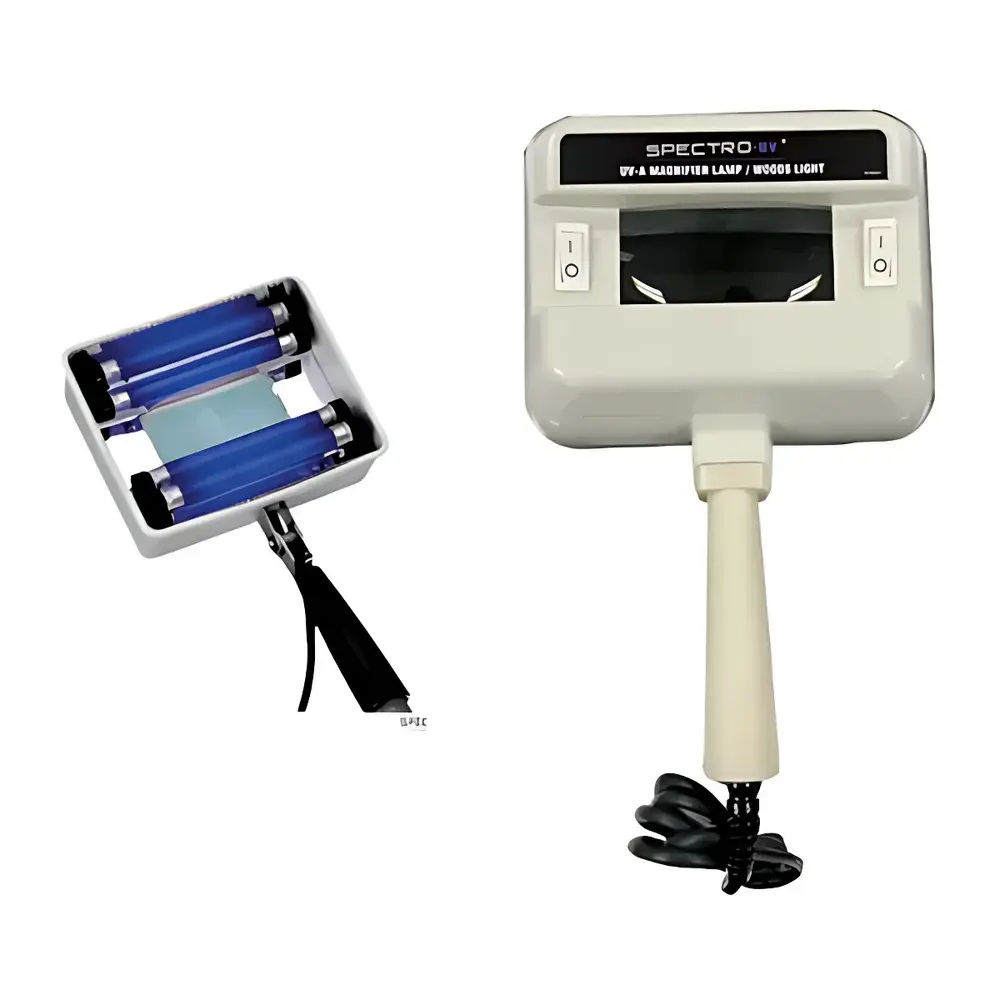
Spectro-UV Q-Series and QZ-Series UV Lamps
| Brand | Spectro-UV |
|---|---|
| Origin | USA |
| Model Variants | Q-12, Q-22, Q-22B, QZ-22B, QZ-22 |
| UV Peak Intensity (at 15 cm) | 700–1400 µW/cm² |
| Lamp Type | Integrated-filter UV-A fluorescent tubes (4 W each) |
| Dual-mode Option | UV-A + white light (Q-22, QZ-22) |
| Ballast & Housing | Lightweight phenolic resin construction |
| Handle | Ergonomic, fatigue-resistant phenolic grip |
| Dimensions (W × L × H) | 5.75 in × 7 in × 2.25 in (14.6 cm × 17.8 cm × 5.7 cm) |
| Weight | 0.9–1.2 kg |
| Input Current | 0.2–0.4 A |
| Illumination Mode | External irradiation (handheld or benchtop) |
Overview
The Spectro-UV Q-Series and QZ-Series UV lamps are precision-engineered handheld ultraviolet inspection tools designed for consistent, reliable UV-A (320–400 nm) excitation in controlled laboratory and field environments. These lamps operate on the principle of fluorescence induction—emitting narrow-band UV-A radiation through proprietary integrated-filter fluorescent tubes that suppress visible light leakage and eliminate hazardous UV-C/UV-B emissions. Unlike broadband mercury-vapor or LED-based alternatives, the Q/QZ platform utilizes thermally stabilized, low-pressure mercury discharge tubes with fused silica envelopes and custom interference-filtered glass—ensuring spectral purity, long-term radiometric stability, and compliance with IEC 62471 (Photobiological Safety) Class 1 requirements. Each lamp is calibrated for reproducible irradiance output at standardized measurement distance (15 cm), enabling quantitative comparison across instruments and longitudinal studies in regulated workflows.
Key Features
- Integrated-filter UV-A tubes: Four-watt, low-mercury fluorescent lamps with hermetically sealed, scratch-resistant filter glass—delivering >95% transmission at 365 nm and <0.1% visible light bleed.
- Ergonomic phenolic housing: Chemically inert, non-conductive, and flame-retardant (UL 94 V-0 rated); optimized weight distribution (0.9–1.2 kg) reduces operator fatigue during extended inspections.
- Dual-spectrum capability (Q-22 & QZ-22 models): Independent switching between UV-A and white-light modes using matched 4 W phosphor-coated tubes—enabling side-by-side visual comparison without repositioning samples.
- Stable electronic ballast: Constant-current regulation minimizes intensity drift over ambient temperature ranges (10–40 °C) and extends tube service life to ≥5,000 hours under typical duty cycles.
- Modular accessory compatibility: Supports optional UV-blocking safety goggles (ANSI Z87.1+), calibration reference cards (NIST-traceable), and adjustable stand mounts for hands-free operation in GLP-compliant labs.
Sample Compatibility & Compliance
The Q/QZ series is validated for use with a broad range of fluorescent materials—including forensic dyes (e.g., Rhodamine B, Basic Yellow 40), biological stains (DAPI, FITC), industrial penetrants (MIL-STD-2132 compliant), and cosmetic formulations containing optical brighteners. All units conform to ASTM E3022–18 (Standard Practice for Fluorescent Penetrant Testing Using UV-A Lamps), ISO 3059:2020 (Non-destructive testing — Penetrant testing — Viewing conditions), and FDA guidance for UV illumination in pharmaceutical cleanroom monitoring (21 CFR Part 211). The absence of ozone-generating wavelengths (<240 nm) and adherence to IEC 60598-1 (Luminaires) electrical safety standards ensures safe deployment in ISO Class 5–8 environments and forensic evidence processing suites.
Software & Data Management
While the Q/QZ series operates as a standalone optical source, its radiometric consistency supports integration into documented quality systems. Spectro-UV provides NIST-traceable irradiance certification reports (valid for 12 months) with each unit, including serial-number-matched spectral power distribution (SPD) curves measured via calibrated spectroradiometer (Ocean Insight QE Pro). For laboratories operating under 21 CFR Part 11 or EU Annex 11, these certificates may be archived within LIMS or ELN platforms as objective evidence of illumination validation. Optional annual recalibration services include full spectral recharacterization and updated compliance documentation aligned with current ISO/IEC 17025-accredited procedures.
Applications
- Life Sciences & Diagnostics: Visualization of nucleic acid gels stained with SYBR Safe, verification of GFP-expressing cell cultures, and validation of UV-transilluminator alignment in molecular biology workflows.
- Forensic Analysis: Detection of latent fingerprints treated with cyanoacrylate fuming, bodily fluid residues (urine, semen), and counterfeit document security features under standardized 365 nm excitation.
- Materials Inspection: Non-destructive evaluation of aerospace composites for resin-rich areas, detection of coating defects in automotive OEM parts, and assessment of UV-curable adhesive cure uniformity.
- Cosmetic & Dermatological Research: In vitro assessment of sunscreen SPF efficacy via UV-induced fluorescence quenching assays; photostability testing of active ingredients under controlled UV-A exposure.
- Museum Conservation: Identification of restoration interventions in paintings and manuscripts using differential fluorescence response of aged vs. modern pigments and varnishes.
FAQ
Are the Q/QZ lamps suitable for GMP-regulated environments?
Yes—each unit ships with a certificate of conformance listing compliance with ISO 3059, ASTM E3022, and IEC 62471. Irradiance stability data and recalibration protocols support inclusion in equipment qualification (IQ/OQ/PQ) packages.
What is the expected lifetime of the UV tubes?
Rated for ≥5,000 hours at nominal voltage and ambient temperatures ≤35 °C. Tube replacement kits (including filter glass and electrodes) are available with full traceability documentation.
Can these lamps be used for UV curing applications?
No—they are optimized for inspection and fluorescence excitation, not high-intensity photopolymerization. UV irradiance levels (≤1.4 mW/cm² at 15 cm) fall below thresholds required for most industrial curing processes.
Is eye protection required during operation?
Yes. ANSI Z87.1+ UV-blocking safety goggles with 365 nm OD4+ attenuation are mandatory for continuous exposure exceeding 15 minutes per session, per ACGIH TLV® guidelines.
Do QZ-series models offer any functional advantage over Q-series?
The QZ variants feature enhanced thermal management and reinforced internal wiring harnesses for sustained duty cycles in mobile forensic deployments; otherwise, optical and electrical specifications are identical to corresponding Q-series models.




