
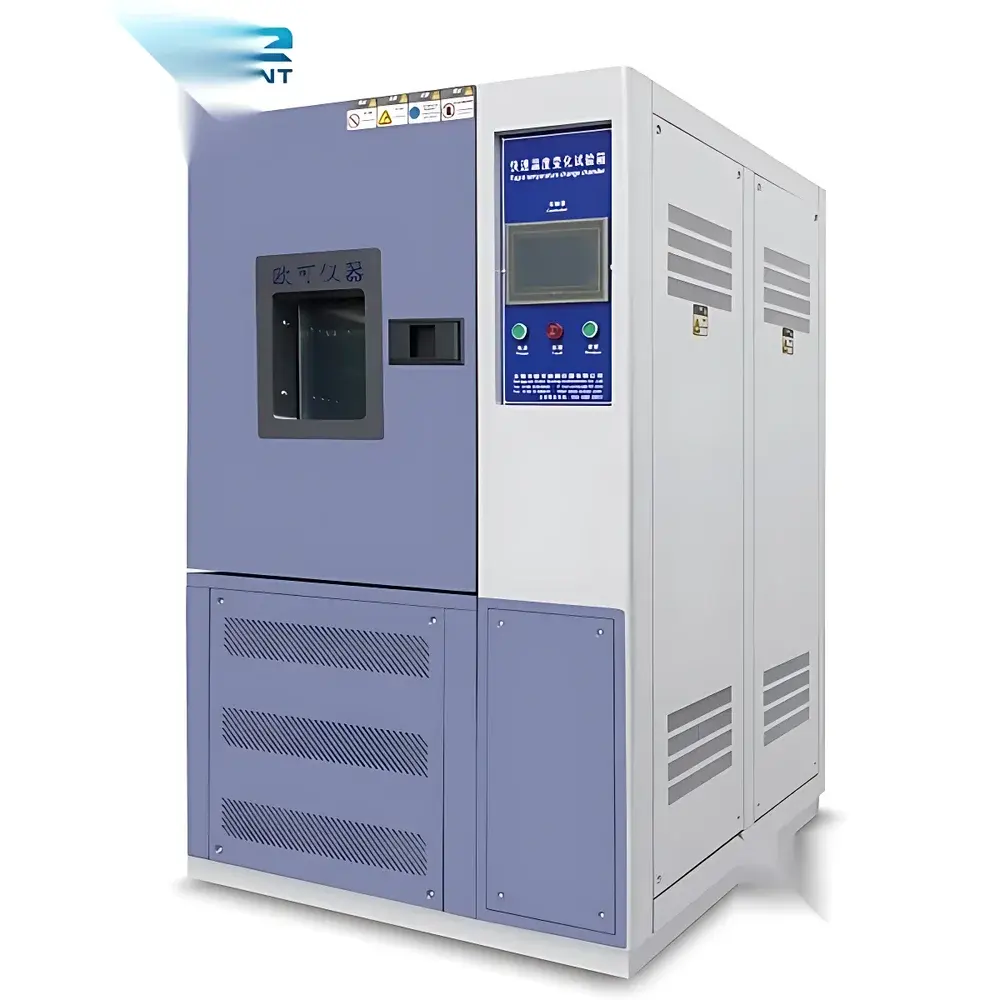
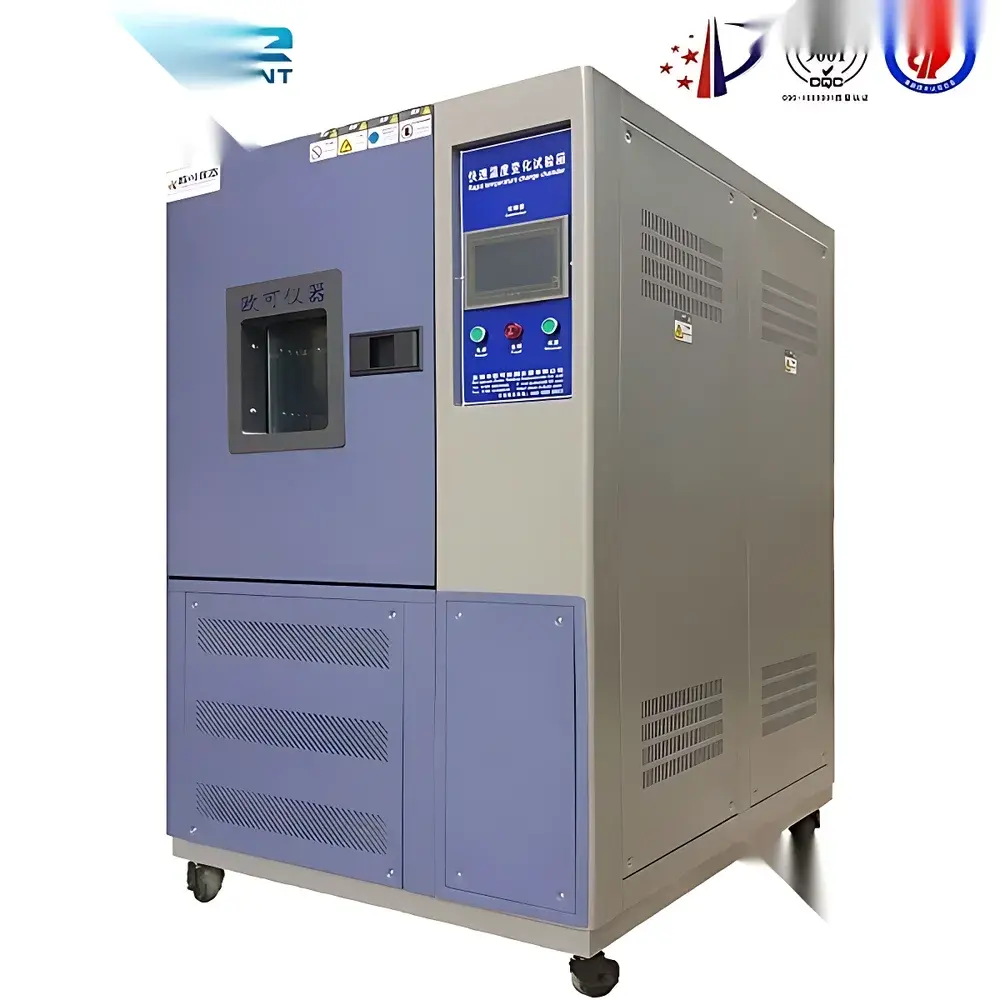
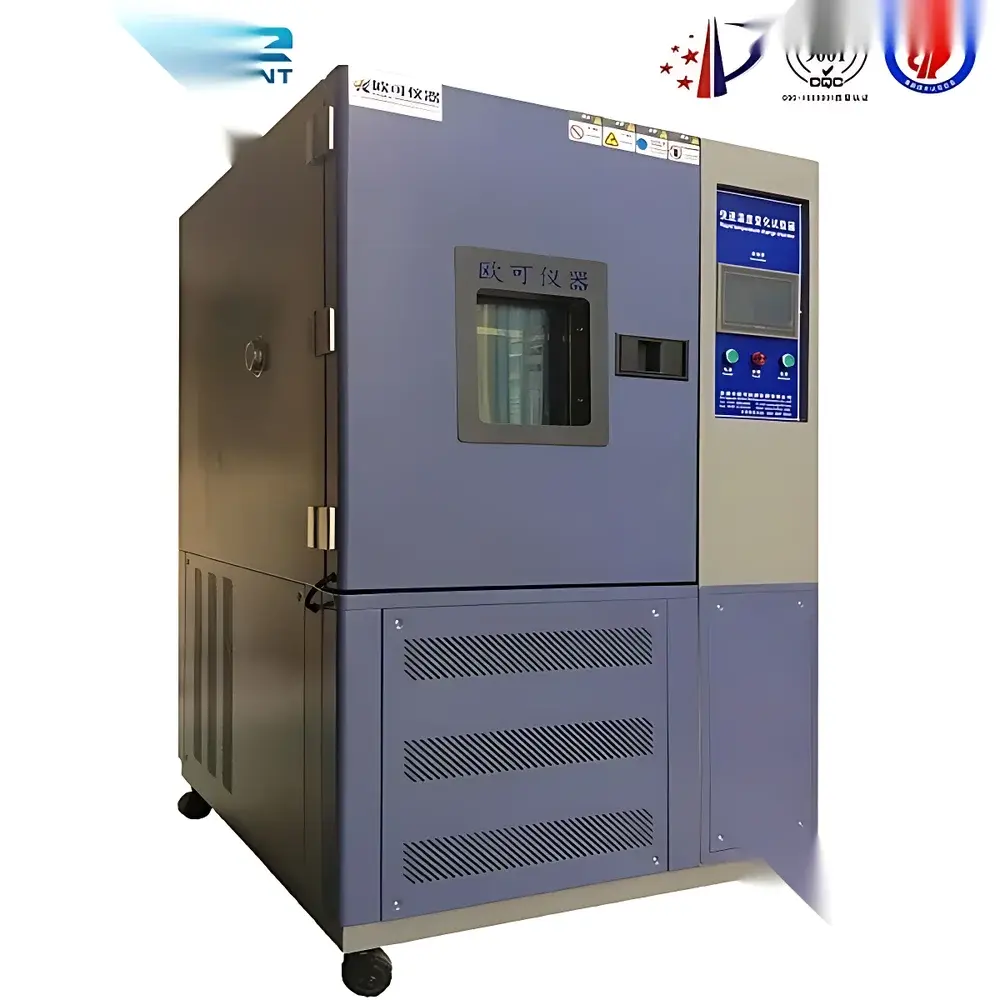
Other Brands HL-1000 Series Rapid Temperature Change Low-Temperature Environmental Test Chamber
| Brand | Other Brands |
|---|---|
| Origin | Imported |
| Manufacturer Type | Authorized Distributor |
| Price | USD 2,650 (FOB) |
| Internal Dimensions (W×H×D) | 1000 × 1000 × 1000 mm |
| External Dimensions (W×H×D) | 1450 × 1900 × 1550 mm |
| Power Consumption | 6.0–8.5 kW (Model-Dependent) |
| Voltage/Frequency | AC 380 V, 50/60 Hz |
| Compliance | GB/T 2423.1–2008, GB/T 2423.2–2008 |
| Operating Ambient | 5–30 °C, ≤85% RH |
| Control System | PID-Based Digital Temperature Controller |
| Insulation | High-Density Polyurethane Foam + Ultra-Fine Glass Fiber |
| Inner Chamber Material | SUS304 Stainless Steel |
| Outer Casing | Powder-Coated A3 Steel |
| Door Seal | High-Performance Silicone Rubber |
| Air Circulation | Multi-Vane Forced Convection with Balanced Inlet/Exhaust Design |
| Cooling System | Automatic Controlled Refrigeration Circuit with Safety Interlocks |
| Heating System | Independent Sheathed Heater Assembly |
| Temperature Range | –70 °C to +150 °C (Typical for HL-1000 series |
Overview
The Other Brands HL-1000 Series Rapid Temperature Change Low-Temperature Environmental Test Chamber is an engineered thermal stress testing system designed for evaluating the functional integrity and material stability of electronic components, optoelectronic devices, PCB assemblies, lithium-ion batteries, and precision instrumentation under dynamically varying thermal conditions. Based on forced-air convection thermodynamics and dual-mode (heating/cooling) thermal energy management, the chamber delivers controlled, repeatable temperature transitions across a typical operational range of –70 °C to +150 °C—subject to model-specific refrigeration capacity and insulation performance. Its architecture adheres to fundamental principles of environmental simulation: uniform thermal distribution, minimal thermal lag, and low thermal inertia in chamber walls and air mass. The system is not intended for cryogenic storage or ultra-low dew point conditioning but serves as a validated platform for accelerated reliability assessment per IEC 60068-2-14 (change of temperature), JEDEC JESD22-A104, and MIL-STD-810G Method 503.4.
Key Features
- Structural integrity ensured by CNC-machined stainless steel inner chamber (SUS304) and powder-coated carbon steel outer enclosure (A3 grade), minimizing galvanic corrosion and mechanical deformation.
- High-efficiency thermal insulation comprising layered polyurethane foam (≥100 mm thickness) and ultra-fine glass fiber, achieving thermal leakage <0.8 K/h at steady-state extremes.
- Dual-independent thermal actuation: sheathed resistive heating elements and a fully automatic refrigeration circuit with pressure monitoring, high/low-pressure cutouts, and oil return safeguards.
- PID-based digital temperature controller with auto-tuning capability, supporting ramp-soak profiles, programmable dwell times, and real-time deviation logging.
- Multi-vane centrifugal blower system generating ≥1.2 m/s airflow velocity across test volume, ensuring temperature uniformity ≤±1.5 °C (at 100 L load, per GB/T 2423.1–2008 Annex B).
- Ergonomic access design featuring counterbalanced door, non-reactive silicone gasket (rated for –70 °C to +200 °C), and recessed handle to prevent accidental seal compression.
Sample Compatibility & Compliance
The HL-1000 accommodates standard industrial test specimens up to 600 mm × 600 mm × 600 mm (max footprint within 1 m³ working volume), including populated PCBs, LED modules, optical transceivers, cylindrical or prismatic battery cells, and sealed sensor housings. It supports static and dynamic thermal cycling protocols compliant with GB/T 2423.1–2008 (cold testing), GB/T 2423.2–2008 (dry heat), and IEC 60068-2-14 (temperature change). While not certified to UL 1604 or ATEX for hazardous locations, its electrical architecture conforms to IEC 61000-6-2 (immunity) and IEC 61000-6-4 (emission) standards. The chamber is suitable for GLP-aligned laboratories where traceable calibration (per ISO/IEC 17025) and audit-ready operation logs are maintained.
Software & Data Management
The integrated controller provides local parameter configuration via touchscreen interface and supports RS-485 Modbus RTU communication for integration into centralized MES or LIMS environments. Optional Ethernet module enables remote monitoring, alarm forwarding (SMTP/SNMP), and CSV-formatted data export at user-defined intervals (1–60 s resolution). All temperature setpoints, actual readings, alarm events, and system status flags are timestamped with millisecond precision and stored internally for ≥30 days. Data integrity complies with basic ALCOA+ principles—attributable, legible, contemporaneous, original, accurate—and may be extended to meet FDA 21 CFR Part 11 requirements when paired with validated third-party software and electronic signature workflows.
Applications
- Thermal shock screening of solder joints and wire bonds in automotive ECUs prior to AEC-Q200 qualification.
- Pre-conditioning of optical isolators and laser diodes for wavelength stability analysis across operational temperature bands.
- Accelerated life testing of electrolytic capacitors and solid-state relays under repeated low-temperature exposure.
- Verification of thermal expansion mismatch between FR-4 substrates and embedded passive components during reflow simulation.
- Environmental stress screening (ESS) of medical-grade PCBAs used in portable diagnostic instruments operating in field-deployed climates.
FAQ
What is the minimum achievable temperature for the HL-1000 series, and how does it vary across models?
The base configuration achieves –70 °C; models with enhanced compressor staging or cascade refrigeration (e.g., HL-1000E) may extend to –80 °C—subject to ambient cooling water supply and room ventilation.
Can this chamber perform thermal cycling with defined ramp rates (e.g., 10 °C/min)?
Yes—ramp rate is programmable from 1 °C/min to 15 °C/min depending on load mass, setpoint delta, and selected model’s thermal capacity. Actual rate is verified per IEC 60068-2-14 Clause 6.2.
Is the internal chamber volume truly 1000 L, and how is usable volume affected by airflow ducting?
Nominal volume is 1000 L (1000 × 1000 × 1000 mm); net usable volume remains ≥850 L after accounting for duct clearance, sensor mounting, and air baffle geometry.
Does the system include NIST-traceable calibration documentation?
Factory calibration certificates (temperature uniformity and accuracy at three points) are provided. Full NIST-traceable recalibration requires engagement with an ISO/IEC 17025-accredited service provider.
What maintenance intervals are recommended for the refrigeration system?
Compressor oil and filter replacement every 12 months or 4,000 operating hours; condenser coil cleaning every 3 months in dusty environments; annual leak check using helium mass spectrometry per ASHRAE Standard 15.



