
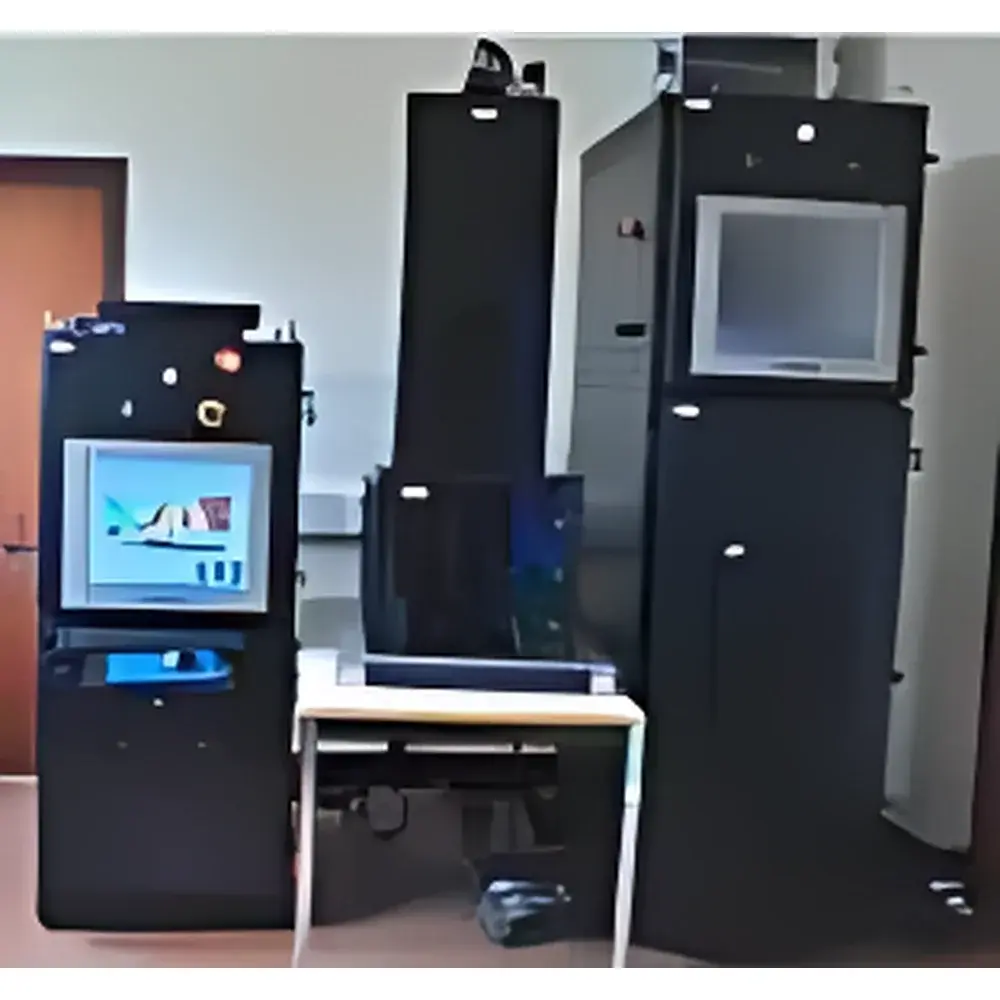
IVEA MobiLIBS Mobile Laser-Induced Breakdown Spectroscopy System
| Brand | IVEA |
|---|---|
| Origin | France |
| Model | YAG 266 nm, 20 Hz |
| Form Factor | Benchtop |
| Integration | Fully Integrated |
| Laser Type | Q-switched Nd:YAG (4th harmonic) |
| Wavelength | 266 nm |
| Repetition Rate | 20 Hz |
| System Architecture | Modular (4 units, ~30 kg each) |
| Sample Compatibility | Solids, Liquids, Gases, Opaque & Transparent Materials |
| Optical Path | Motorized Focus Adjustment |
| Detection Range | Typically 190–850 nm (configurable per spectrometer module) |
| Compliance | CE-marked, RoHS-compliant |
Overview
The IVEA MobiLIBS is a fully integrated, field-deployable Laser-Induced Breakdown Spectroscopy (LIBS) system engineered for quantitative and qualitative elemental analysis across diverse sample matrices. Based on the fundamental principle of laser-induced plasma generation—where a high-energy, nanosecond-duration 266 nm pulsed laser ablates a micro-volume of material to form a transient plasma—the system captures time-resolved atomic and ionic emission spectra via high-resolution spectrometers. Unlike conventional laboratory-bound LIBS platforms, MobiLIBS adopts a modular benchtop architecture comprising four independently transportable units (~30 kg each), enabling rapid reconfiguration for both controlled lab environments and uncontrolled field conditions—including industrial floors, geological outcrops, nuclear containment zones, and cultural heritage sites. Its design prioritizes analytical robustness over portability compromises: the 20 Hz repetition rate supports statistically significant signal averaging, while the motorized, software-controlled focusing optics ensure consistent ablation crater geometry across heterogeneous surfaces.
Key Features
- Q-switched Nd:YAG laser operating at the fourth harmonic (266 nm), delivering stable pulse energy and beam profile essential for reproducible plasma initiation.
- Motorized optical path with software-adjustable focal length—enabling precise optimization of laser fluence for varied sample types (e.g., low-ablation-threshold polymers vs. high-melting-point alloys).
- Multi-environment sample chamber accommodating solids (flat, irregular, curved), liquids (in sealed cuvettes or open pools), gases (via flow-through cell), and optically transparent or opaque media—without hardware modification.
- Integrated high-precision XYZ translation stage (sub-10 µm resolution) with programmable rastering and single-spot positioning for spatially resolved mapping and depth profiling.
- Modular mechanical design compliant with ISO 14001 and IEC 61000-6-2/6-4 electromagnetic compatibility standards; each unit features shock-absorbing casters, IP54-rated enclosures, and thermal stabilization for operation in ambient temperatures from 5 °C to 40 °C.
- Pre-aligned optical train with fiber-coupled spectrometer interfaces—minimizing alignment drift during transport and reducing recalibration frequency in multi-day campaigns.
Sample Compatibility & Compliance
MobiLIBS supports direct analysis of conductive and non-conductive materials without vacuum requirements or conductive coating—eliminating preparation artifacts common in SEM-EDS or XRF workflows. The sample chamber includes interchangeable fixtures: a universal clamp for irregular solids, a magnetic holder for ferrous metals, a liquid reservoir with gas purge capability for volatile samples, and a gas inlet/outlet manifold compatible with certified calibration gas mixtures (e.g., NIST SRM 2685a). All optical components comply with EN 60825-1:2014 for Class 4 laser safety; interlocked access doors and real-time beam shutter control meet IEC 61511 functional safety requirements for industrial deployment. The system is CE-marked and RoHS-compliant, with documentation supporting GLP/GMP audit readiness—including full traceability of calibration certificates, maintenance logs, and firmware version history.
Software & Data Management
Acquisition and analysis are managed through IVEA’s proprietary LIBS Studio v4.x platform, a Windows-based application validated under FDA 21 CFR Part 11 for electronic records and signatures. The software provides synchronized control of laser timing, spectrometer integration gates, stage motion, and environmental sensors (temperature, humidity, pressure). Spectral data are stored in HDF5 format with embedded metadata (laser energy, focus position, ambient conditions), ensuring FAIR (Findable, Accessible, Interoperable, Reusable) compliance. Quantitative analysis leverages internal standardization, matrix-matched calibration curves, and optional PLS regression models trained on certified reference materials (CRMs) such as USGS rock powders or BAM metal alloys. Audit trails record all user actions, parameter changes, and report generations—retained for ≥36 months per configurable retention policy.
Applications
- On-site alloy grade identification and positive material identification (PMI) in petrochemical piping and power generation infrastructure.
- Depth-resolved analysis of corrosion layers, paint stratigraphy, and battery electrode cross-sections for failure analysis.
- In-field geochemical screening of soil, sediment, and ore samples—supporting ASTM D7574-22 (Standard Practice for Field Screening of Metals in Soils Using Portable XRF and LIBS).
- Real-time monitoring of slag composition in metallurgical furnaces via fiber-optic remote probe integration.
- Cultural heritage applications including pigment identification in frescoes and provenance studies of archaeological ceramics—per ISO 18562-2 guidelines for non-invasive analysis.
- Environmental monitoring of heavy metals (Pb, Cd, As, Hg) in contaminated water and particulate matter—validated against EPA Method 6010D criteria.
FAQ
Is MobiLIBS suitable for regulatory-compliant reporting in pharmaceutical or food-grade facilities?
Yes—when operated under documented SOPs and calibrated using CRMs traceable to NIST or BAM, MobiLIBS meets data integrity requirements for GMP Annex 11 and ICH Q2(R2) method validation frameworks.
Can the system perform isotopic ratio analysis?
No—MobiLIBS is optimized for elemental concentration determination, not isotopic resolution. High-resolution mass spectrometry (e.g., MC-ICP-MS) remains required for δ13C or 87Sr/86Sr measurements.
What maintenance intervals are recommended for field-deployed units?
Laser optics cleaning every 200,000 shots; spectrometer wavelength calibration quarterly; full system performance verification annually using IVEA-certified reference tiles (SRM 2782, SRM 1262).
Does MobiLIBS support third-party spectral libraries?
Yes—LIBS Studio accepts .csv and .jdx spectral libraries; users may import and validate custom libraries against in-house CRMs using built-in statistical outlier detection.
How is plasma stability ensured across varying ambient temperatures?
The laser cavity and spectrometer detectors incorporate thermoelectric coolers (TECs) regulated to ±0.1 °C; real-time plasma emission intensity feedback adjusts laser energy output to maintain constant line-to-background ratios.




