
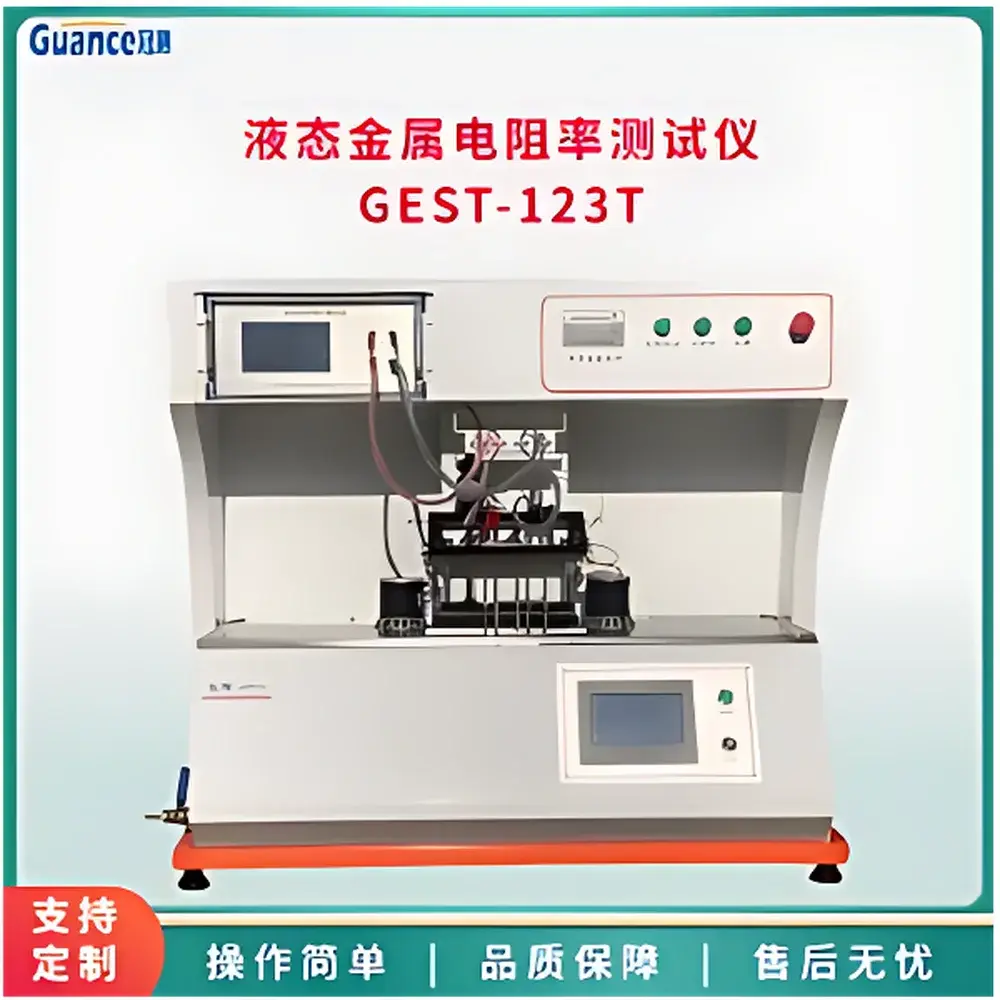
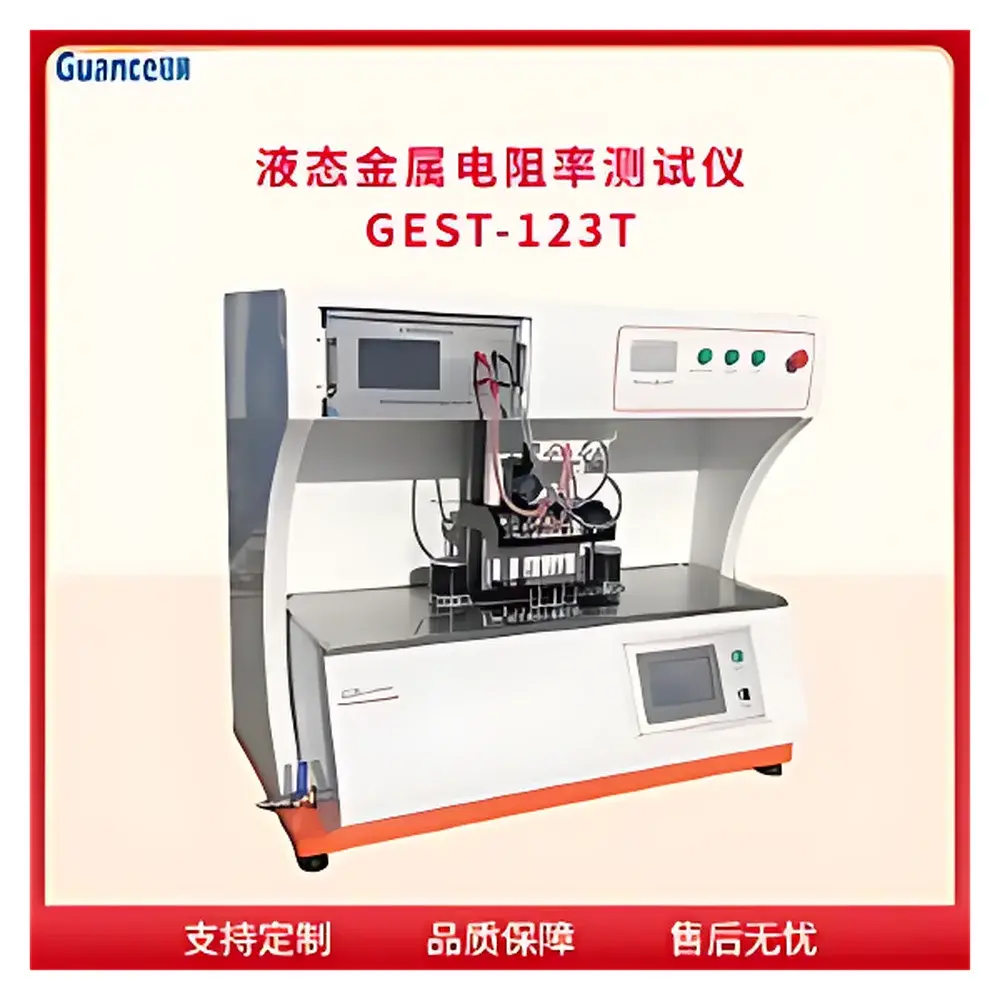
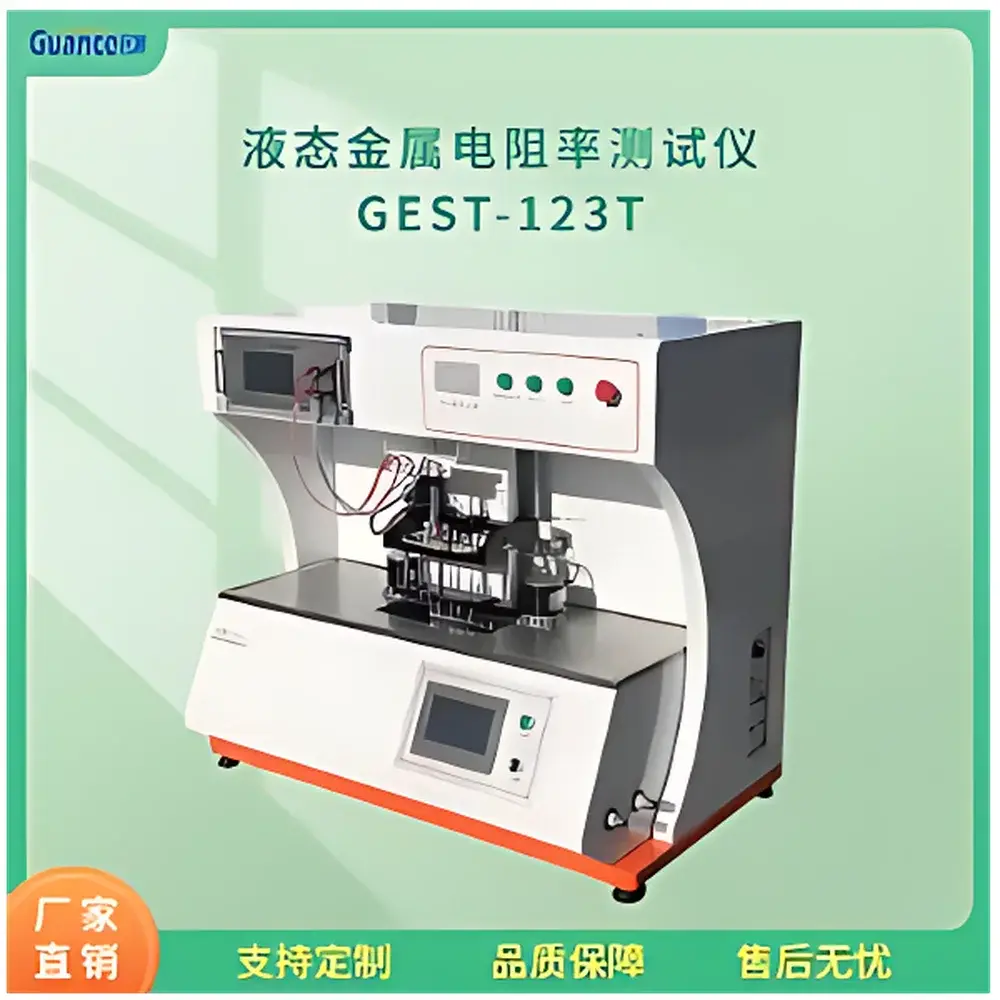
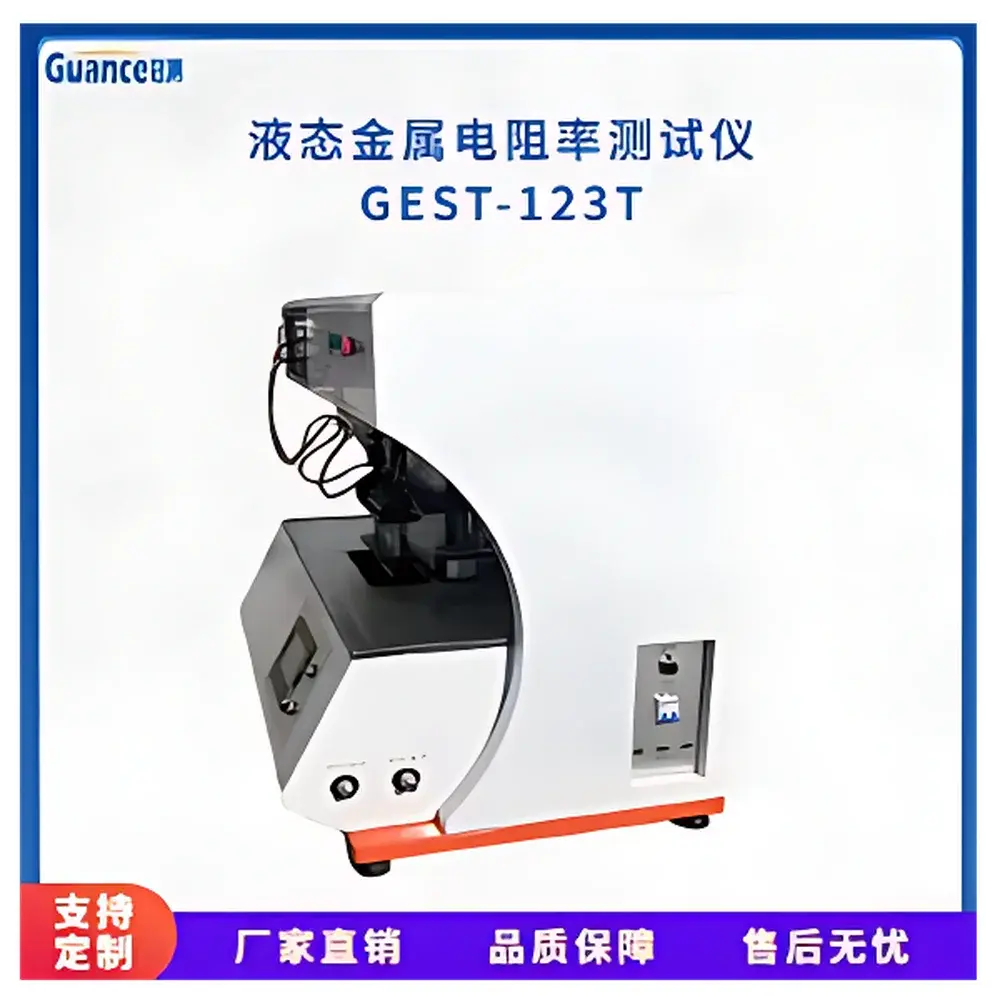
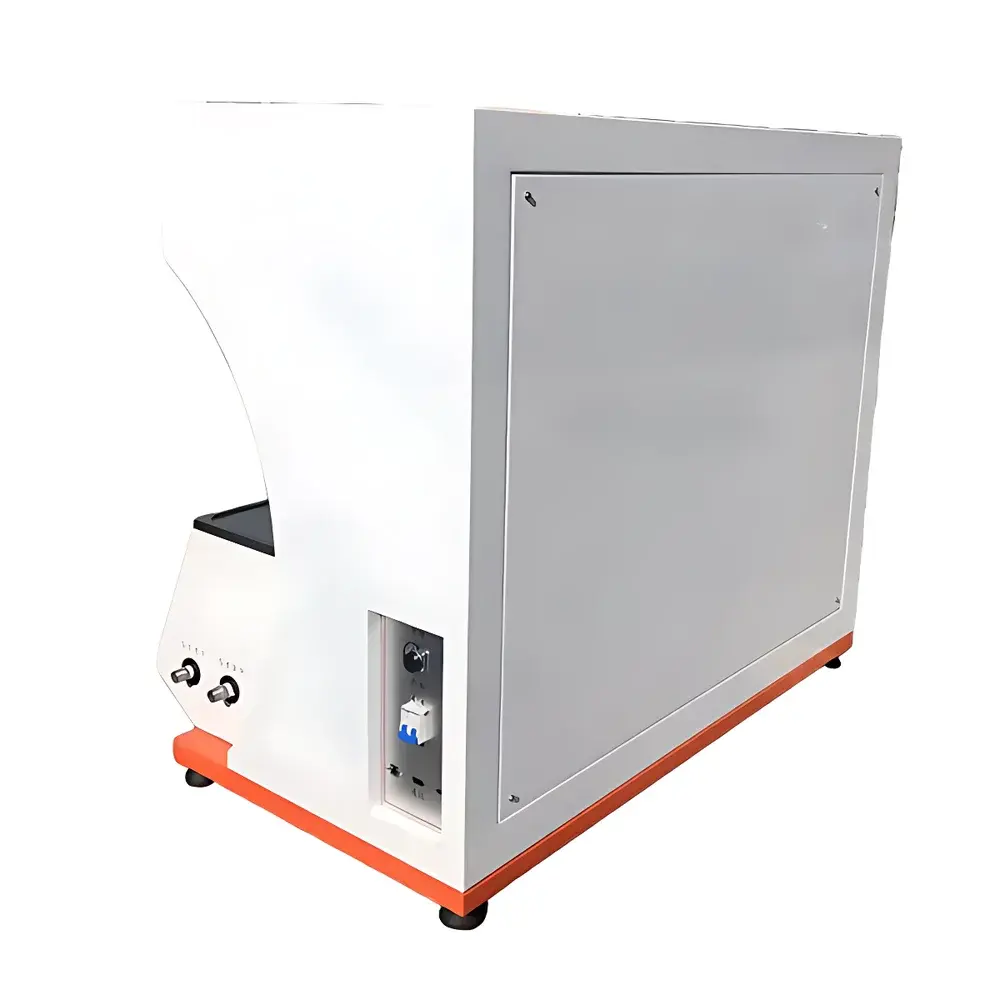
GuanCe GEST-123T Liquid Metal Resistivity Tester
| Brand | GuanCe Instruments |
|---|---|
| Origin | Beijing, China |
| Manufacturer Type | Authorized Distributor |
| Region of Manufacture | Domestic (China) |
| Model | GEST-123T |
| Price | USD 2,100 (approx.) |
| Temperature Range | Ambient to 300 °C |
| Max Heating Rate | ≤30 min from ambient to 300 °C |
| Electrode Travel Speed | 0–300 mm/min |
| Resistance Measurement Range | 10⁻⁴ – 10⁵ Ω·cm |
| Resolution | 10⁻⁶ Ω·cm |
| Current Sources | 10 μA, 100 μA, 1 mA, 10 mA, 100 mA, 1 A |
| Current Accuracy | ±(0.5% of reading + 2 digits) |
| Electrode Material | Tungsten Carbide |
| Cell Material | Fused Quartz |
| Temperature Control Algorithm | AI-enhanced PID |
| Data Logging | Real-time R, ρ, σ, T, I, V with statistical post-processing |
| Compliance | GB/T 41079.2–2022 |
Overview
The GuanCe GEST-123T Liquid Metal Resistivity Tester is a precision-engineered thermal-resistive characterization system designed for quantitative measurement of electrical resistivity (ρ) and derived conductivity (σ) in molten metallic alloys across controlled temperature gradients—from ambient up to 300 °C. Unlike conventional solid-state resistivity testers, the GEST-123T integrates thermally stable electrochemical cell architecture with synchronized thermal management and four-terminal (Kelvin) resistance metrology. Its core operational principle relies on Ohm’s law applied under isothermal or dynamic ramp conditions: ρ = R × A / L, where measured resistance (R) is acquired via dual-force/dual-sense current-voltage sourcing, while geometric constants (cross-sectional area A and electrode spacing L) are maintained invariant through rigid quartz cell design and real-time micrometric electrode positioning feedback. The system complies strictly with GB/T 41079.2–2022, the national standard governing electrical transport property determination in liquid metals—ensuring traceability, repeatability, and alignment with international practices for high-temperature metallurgical research and alloy development.
Key Features
- AI-optimized PID temperature control with dual-layer stainless steel oil bath vessel, 1.5 kW heating capacity, and asbestos-free high-efficiency insulation for thermal stability ≤±0.3 °C over 300 °C
- Fused quartz electrochemical cell—chemically inert, thermally shock-resistant (up to 800 °C short-term), and optically transparent for in situ process observation
- Tungsten carbide electrodes with sub-micron positional repeatability (0.001 mm resolution via PLC-synchronized dial indicator)
- Multi-range programmable constant-current sources (10 μA to 1 A) with auto-ranging and accuracy certified to ±(0.5% rdg + 2 digits)
- Servo-driven vertical electrode actuation (0–300 mm/min) with end-stop limit switches and programmable dwell logic for contact force optimization
- Dual independent high-torque stirring motors (45 W each, 1400 rpm) ensuring homogeneous thermal distribution (ΔT < ±0.5 °C across bath volume)
- Integrated data acquisition engine logging temperature, voltage, current, resistance, resistivity, and conductivity at ≥10 Hz sampling rate
- Real-time curve rendering: ρ vs. T, σ vs. T, dρ/dT slope analysis, and statistical reporting (mean, SD, confidence intervals per temperature segment)
Sample Compatibility & Compliance
The GEST-123T accommodates low-volatility liquid metals and eutectic alloys including Ga-based, Sn-Bi, Zn-Al, Mg-Zn, and Al-Si systems—provided operating temperatures remain within the 25–300 °C window and vapor pressure remains below 10 Pa at test conditions. Sample volume requirement is 8–15 mL. All wetted components—including electrodes, cell body, and stirrer shafts—are corrosion-resistant and non-reactive with oxidizing or mildly acidic melt environments. The instrument meets GB/T 41079.2–2022 requirements for electrode geometry tolerance (±0.5%), thermal gradient control (<1 °C/cm), and measurement uncertainty budgeting. While not CE- or UL-certified as shipped, its architecture supports validation under ISO/IEC 17025 laboratory accreditation frameworks and aligns with ASTM E1530 (thermal conductivity) and ASTM D257 (insulation resistance) metrological principles for cross-method verification.
Software & Data Management
Control and analysis are executed via Windows-based GUI software communicating with Siemens S7-1200 PLC over EtherNet/IP. The interface provides full programmatic control of temperature ramps (up to 16 segments), current source selection, electrode positioning sequences, and data export in CSV, XLSX, and PDF formats. Audit trails record operator ID, timestamp, parameter setpoints, calibration events, and raw sensor outputs—supporting GLP-compliant documentation. Calibration modules include two-point temperature sensor verification (using NIST-traceable Pt100 reference), current source linearity checks against certified shunt resistors (1 Ω, 10 Ω, 1 kΩ), and geometric factor validation using standard conductive liquids (e.g., KCl aqueous solutions at defined concentrations). Raw datasets retain full metadata (instrument ID, firmware version, environmental ambient log) for retrospective traceability.
Applications
- Temperature-dependent resistivity mapping of liquid-phase metallurgical processes (e.g., continuous casting, electromagnetic stirring, additive manufacturing feedstock qualification)
- Validation of theoretical models (e.g., Ziman formalism, Mott-Ioffe-Regel limit) for electron scattering mechanisms in disordered metallic melts
- Development and screening of low-melting-point functional alloys for soft electronics, thermal interface materials, and reconfigurable microfluidics
- Quality assurance of recycled aluminum or zinc alloys—correlating impurity content (Fe, Si, Cu) with anomalous ρ(T) inflection points
- Supporting DOE studies in nuclear material science, particularly for liquid-fueled molten salt reactor (MSR) coolant candidate evaluation
FAQ
Does the GEST-123T support automated temperature sweeps with simultaneous resistivity acquisition?
Yes—users define multi-segment temperature profiles (rate, hold time, target) and synchronize resistivity sampling at user-defined intervals (1 s to 60 s), with all data time-stamped and aligned to thermal transients.
Can the quartz cell be replaced with custom geometries for specialized alloys?
Standard cells are fixed-dimension fused quartz (ID 22 mm, height 60 mm); custom cells may be fabricated upon request, subject to dimensional compatibility with electrode travel range and thermal expansion matching.
Is the system compatible with external data acquisition platforms like LabVIEW or Python?
Yes—the PLC exposes Modbus TCP registers; API documentation and register maps are provided for third-party integration.
What maintenance is required for long-term operation above 250 °C?
Annual recalibration of Pt100 sensors and current sources is recommended; quartz cell inspection for microcracking and electrode surface wear (via optical profilometry) should occur after every 200 h of cumulative high-temperature exposure.
Does the instrument meet FDA 21 CFR Part 11 requirements for electronic records?
Out-of-the-box, it provides audit trail functionality and user access controls; full Part 11 compliance requires site-specific validation protocols and supplementary IT infrastructure (e.g., electronic signatures, secure backup).



