
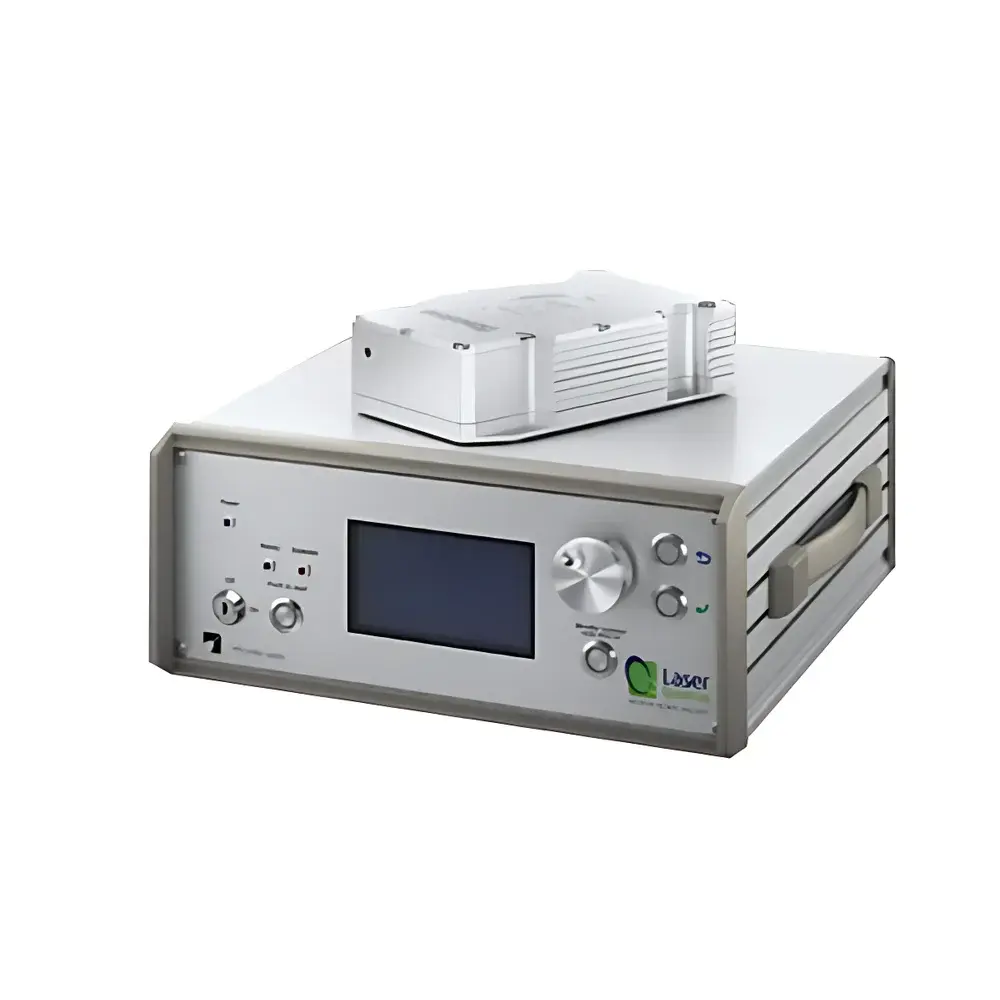
Laser Quantum Finesse Series High-Power Ultra-Low-Noise Single-Frequency Solid-State Laser
| Brand | Laser Quantum |
|---|---|
| Origin | United Kingdom |
| Manufacturer Type | Authorized Distributor |
| Import Status | Imported |
| Model | Finesse |
| Type | Diode-Pumped Solid-State (DPSS) Single-Frequency Laser |
| Wavelength | 532 nm |
| Output Power | 4–16 W |
| Beam Diameter | 2.25 ± 0.25 mm |
| Spatial Mode | TEM₀₀ |
| Beam Ellipticity | < 1:1.15 |
| Spectral Bandwidth | < 50 GHz |
| Beam Divergence | < 0.4 mrad |
| M² Factor | < 1.1 |
| Power Stability | < 0.1% RMS (<10 W), < 0.05% RMS (≥10 W) |
| Beam Pointing Stability | < 2 μrad/°C RMS |
| Intensity Noise | < 0.1% (10 Hz–100 MHz), < 0.03% (<10 W), < 0.02% (≥10 W) |
| Polarization Ratio | > 100:1 (horizontal) |
| Coherence Length | ~6 mm |
| Beam Angular Deviation | < 1 mrad |
| Operating Temperature | 20–40 °C |
| Warm-up Time | 10 min |
| CEP Control | f-2f interferometer-based feedback loop |
| Optional Fiber Delivery | Yes |
| Warranty | 5 years / 15,000 operating hours (for research institutions) |
Overview
The Laser Quantum Finesse Series is a high-performance, diode-pumped solid-state (DPSS) single-frequency laser engineered for applications demanding exceptional spectral purity, ultra-low intensity noise, and long-term frequency stability. Operating at the fundamental wavelength of 532 nm, the Finesse leverages intracavity frequency-doubling of a Nd:YVO4 gain medium to deliver continuous-wave (CW) output power ranging from 4 W to 16 W. Its design centers on minimizing amplitude and phase fluctuations through active cavity-length stabilization and optimized thermal management—enabling sub-0.02% RMS intensity noise (measured over 10 Hz–100 MHz) and coherence lengths exceeding 6 mm. Critically, the system integrates an f-2f self-referenced interferometric setup for carrier-envelope phase (CEP) feedback control—a capability essential for attosecond science, optical frequency comb stabilization, and precision metrology. The laser’s TEM00 spatial profile, M² < 1.1, and beam pointing stability below 2 μrad/°C RMS ensure diffraction-limited focusability and compatibility with high-numerical-aperture optics in demanding experimental configurations.
Key Features
- Ultra-low intensity noise: < 0.02% RMS (≥10 W output, 10 Hz–100 MHz bandwidth)
- Active CEP stabilization via integrated f-2f interferometer and real-time feedback electronics
- High spectral purity with linewidth 100:1 (horizontal)
- Robust thermal architecture enabling < 0.05% RMS power stability at ≥10 W output
- Beam quality certified: M² < 1.1, ellipticity < 1:1.15, divergence < 0.4 mrad
- Optional fiber-coupled output (SM or PM fiber) with collimated free-space alternative
- Comprehensive industrial-grade enclosure with integrated cooling, EMI shielding, and interlock safety compliance (IEC 60825-1 Class 4)
- Extended warranty coverage: 5 years or 15,000 operational hours for academic and governmental research users
Sample Compatibility & Compliance
The Finesse laser is designed for integration into vacuum-compatible, vibration-isolated optical tables and OEM laser systems requiring ISO 10110-compliant beam delivery. Its mechanical footprint, mounting interface (standard kinematic baseplate), and electrical specifications (24 V DC input, RS-232/Ethernet control) align with international laboratory infrastructure standards. The system conforms to CE marking requirements under the EU Machinery Directive and Electromagnetic Compatibility (EMC) Directive. Safety compliance includes full adherence to IEC 60825-1:2014 (Edition 3) for Class 4 laser products, incorporating redundant hardware interlocks, key-switch enablement, and emission indicator LEDs. For regulated environments—including GLP/GMP-compliant semiconductor metrology labs—the laser supports audit-ready operation logs and timestamped performance records when paired with optional Laser Quantum ControlSuite software.
Software & Data Management
Laser Quantum ControlSuite provides native Windows/Linux drivers and a GUI for real-time monitoring of output power, cavity temperature, pump diode current, and noise spectrum (via optional external photodiode + FFT analyzer integration). The software enables remote configuration of modulation parameters (analog/digital TTL inputs up to 1 MHz), automated warm-up sequencing, and scheduled calibration routines. All operational data—including timestamps, error codes, and environmental sensor readings—are exportable in CSV or HDF5 format for traceability. When deployed in FDA-regulated settings (e.g., laser-based wafer inspection tools), ControlSuite can be configured to meet 21 CFR Part 11 requirements through optional electronic signature modules, audit trail logging, and user-access role definitions.
Applications
- Pumping Ti:sapphire ultrafast amplifier systems requiring high average power and low-noise seed sources
- Carrier-envelope phase stabilization in optical frequency combs for optical atomic clocks and spectroscopic calibration
- High-resolution interferometry in gravitational wave detector prototype systems (e.g., LIGO R&D)
- ITO thin-film ablation and micropatterning in display manufacturing, where beam stability directly impacts feature edge fidelity
- Photoluminescence excitation spectroscopy of quantum dots and 2D materials under low-noise illumination conditions
- Military-grade directed-energy testbeds and coherent lidar transmitter modules requiring ruggedized single-frequency CW sources
- Ellipsometry and scatterometry platforms used in advanced node semiconductor process control (e.g., EUV mask inspection)
FAQ
What is the typical coherence length of the Finesse laser at 532 nm?
The measured coherence length is approximately 6 mm, derived from its spectral bandwidth (< 50 GHz) and consistent with transform-limited TEM00 operation.
Does the Finesse support analog modulation for lock-in detection applications?
Yes—it accepts analog voltage inputs (0–5 V) with modulation bandwidth up to 1 MHz and depth linearity within ±1% across the specified range.
Is fiber coupling available as a factory option or field retrofit?
Fiber coupling (single-mode or polarization-maintaining) is offered as a factory-configured option with AR-coated connectors and guaranteed mode-matching efficiency; field retrofits are not supported due to alignment-critical internal optics.
How does the CEP feedback system interface with external femtosecond oscillator chains?
The f-2f interferometer output is accessible via SMA connector for synchronization with external pulse train triggers; full protocol documentation and timing jitter specifications (< 100 fs RMS) are provided in the technical appendix.
What maintenance is required during the 5-year warranty period?
No user-serviceable parts exist; preventive maintenance consists solely of periodic verification of cooling airflow and ambient temperature compliance—no optical realignment or consumable replacement is necessary under normal operating conditions.



