
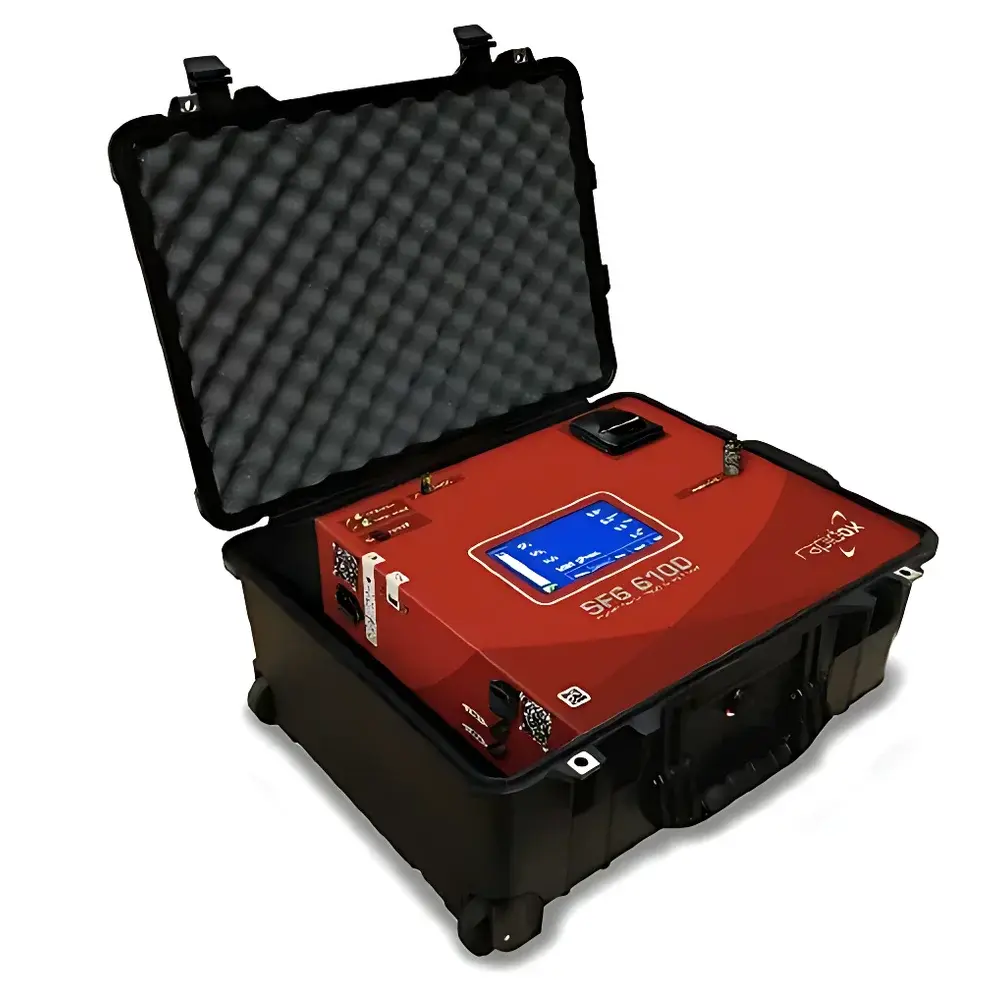
Cambridge Sensotec Rapidox 6100 SF6 Pump-Back Gas Analyzer
| Brand | Cambridge Sensotec |
|---|---|
| Origin | United Kingdom |
| Model | Rapidox 6100 |
| Gas Measurement Range | SF₆ 0–100% (±0.5% FS), H₂O −60 to +20 °C dew point (±2 °C), SO₂ 0–100 ppm (±2%), HF 0–25 ppm (±1 ppm), CF₄ 0–80% (±1%), O₂ 0–100% (±1%) |
| Analysis Time | 3–5 minutes per sample |
| Enclosure | IP66-rated Peli™ carry case |
| Weight | 17 kg |
| Internal Compressor Output | 10 bar |
| Battery Life | Up to 8 hours (Li-ion) |
| Display | 7-inch full-color touchscreen |
| Data Export | USB flash drive (Excel-compatible .csv format) |
| Onboard Thermal Printer | Yes |
| Language Options | Multi-language UI with password-protected access |
Overview
The Cambridge Sensotec Rapidox 6100 SF6 Pump-Back Gas Analyzer is a field-deployable, fully automated multi-gas analyzer engineered for in-situ condition monitoring and quality assurance of sulfur hexafluoride (SF₆) within high- and medium-voltage gas-insulated switchgear (GIS), circuit breakers, current transformers, voltage transformers, and gas-insulated lines (GIL). Unlike conventional sampling analyzers that require gas extraction and external laboratory analysis, the Rapidox 6100 integrates real-time electrochemical, infrared (IR), and chilled-mirror dew point sensing technologies—enabling simultaneous quantification of SF₆ purity, moisture content (H₂O), and key decomposition by-products including SO₂, HF, CF₄, and O₂. Its integrated 10 bar oil-free compressor enables direct pump-back functionality: after measurement, conditioned SF₆ is returned to the equipment under test without venting or loss—ensuring zero emissions, regulatory compliance with F-Gas Regulation (EU No. 517/2014), and preservation of gas inventory integrity. Designed for routine maintenance, predictive diagnostics, and post-fault investigation, the instrument supports condition-based maintenance (CBM) strategies aligned with IEC 60480, IEC 62271-1, and CIGRE TB 597 guidelines.
Key Features
- True pump-back operation: Measures and returns SF₆ to GIS/GIL systems at up to 10 bar without release to atmosphere
- Simultaneous six-parameter analysis: SF₆ %, H₂O (dew point), SO₂ (ppm), HF (ppm), CF₄ %, and O₂ % in a single 3–5 minute cycle
- Ruggedized field platform: Housed in an IP66-certified Peli™ Storm™ case with shock-absorbing foam; total system mass: 17 kg
- Autonomous operation: Integrated rechargeable Li-ion battery supports ≥8 hours of continuous field use without AC power
- On-device data management: 7-inch capacitive touchscreen with intuitive menu navigation, configurable user profiles, and password-protected settings
- Integrated thermal printer: Generates immediate hard-copy reports compliant with ISO/IEC 17025 documentation requirements
- Export-ready output: Raw and processed data saved to USB memory stick in comma-separated (.csv) format compatible with Excel, LIMS, and CMMS platforms
- Multi-language interface: Supports English, French, German, Spanish, Italian, and Chinese—configurable per user session
Sample Compatibility & Compliance
The Rapidox 6100 is validated for direct connection to standard SF₆ service ports on HV/MV equipment per IEC 62271-1 Annex D and IEEE C37.122.1. It accepts gas samples at pressures from atmospheric to 10 bar (gauge), accommodating both sealed and pressure-regulated compartments. All sensor modules undergo factory calibration traceable to NPL (UK) and NIST standards. The analyzer meets EMC Directive 2014/30/EU, Low Voltage Directive 2014/35/EU, and RoHS 2011/65/EU. Its zero-emission operation satisfies EU F-Gas Regulation reporting thresholds and supports adherence to ISO 50001 energy management systems where SF₆ conservation is a KPI. Data audit trails—including operator ID, timestamp, GPS coordinates (optional external module), and calibration history—are retained locally and exportable for GLP/GMP-aligned QA records.
Software & Data Management
Firmware v4.2+ includes embedded firmware-level logging with automatic time/date stamping, cyclic buffer storage (≥10,000 test records), and tamper-evident file hashing. USB exports include metadata headers specifying instrument serial number, calibration expiry dates, sensor health flags, and measurement uncertainty bands per parameter. Optional PC software (Rapidox Connect™) enables remote firmware updates, custom report templating (PDF/CSV), trend analysis across multiple instruments, and integration with enterprise CMMS via RESTful API. All configuration changes and test executions generate immutable log entries—meeting FDA 21 CFR Part 11 requirements for electronic records and signatures when deployed in regulated utility environments.
Applications
- Pre-commissioning verification of SF₆ purity and moisture levels prior to energization
- Routine maintenance checks per IEC 60480 limits for SO₂ & HF as indicators of arcing or overheating
- Post-fault forensic analysis following internal discharge events or dielectric failure
- Leak detection support via quantitative O₂ ingress assessment and CF₄/SF₆ ratio trending
- Life extension assessments for re-used SF₆ under CIGRE TB 597 regeneration criteria
- Regulatory compliance reporting for national grid operators subject to EPA GHG Reporting Program (Subpart DD) or UK ESOS
FAQ
Does the Rapidox 6100 require external gas cylinders or carrier gases?
No. It operates entirely on the sampled SF₆ gas stream and requires no consumables, purge gases, or calibration gases during routine analysis.
Can it analyze decomposed SF₆ from a faulted circuit breaker?
Yes. Its HF and SO₂ sensors are optimized for low-concentration detection (LOD: 0.5 ppm HF, 1 ppm SO₂) and remain stable in the presence of arc-byproduct matrices.
Is pump-back functionality compatible with all GIS manufacturers’ service ports?
Yes. It interfaces via standard 1/4″ ISO-KF or CGA-670 fittings; optional adapters available for Siemens, ABB, GE, Mitsubishi, and Hitachi port geometries.
How is measurement uncertainty reported for each parameter?
Uncertainty values—derived from sensor repeatability, temperature drift coefficients, and calibration reference standard uncertainties—are appended to every exported CSV row per ISO/IEC Guide 98-3 (GUM).
What is the recommended calibration interval?
Annual calibration is advised; however, built-in performance verification checks (using internal reference cells) can be executed daily or before critical measurements per ISO/IEC 17025 Clause 7.7.






