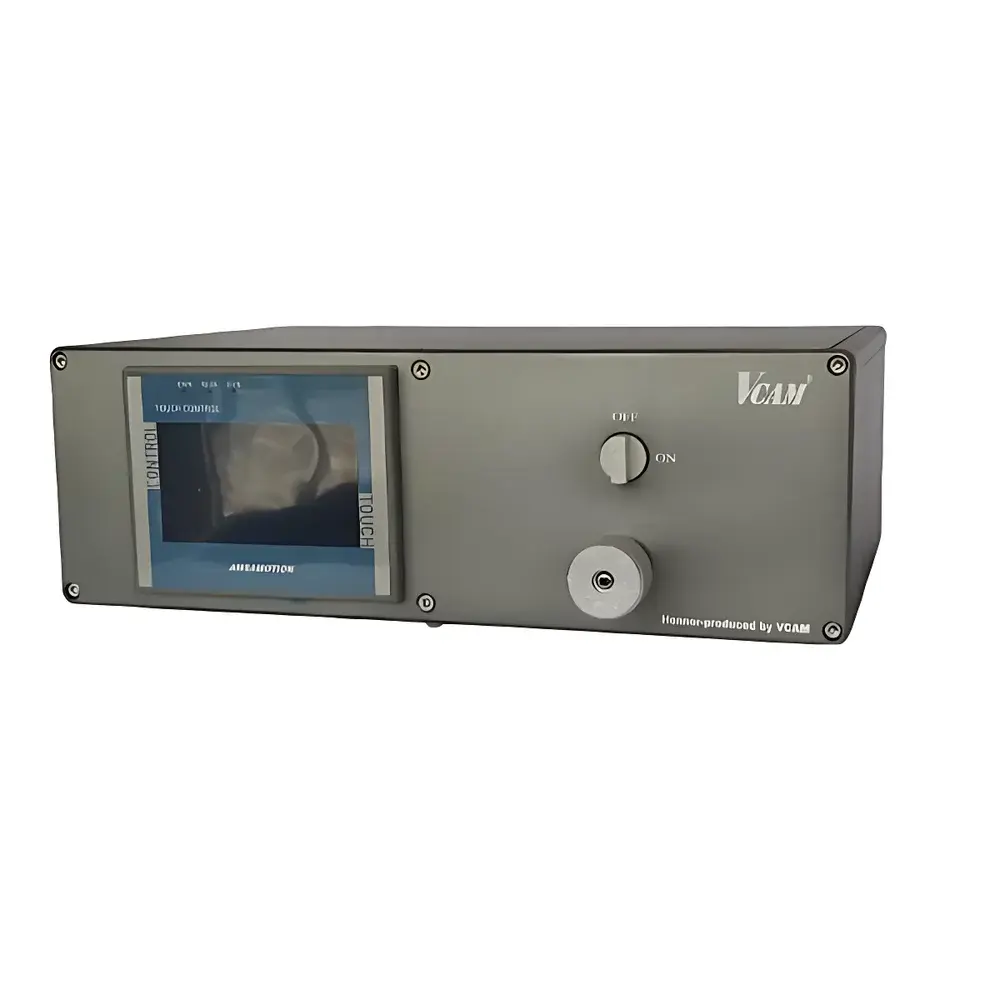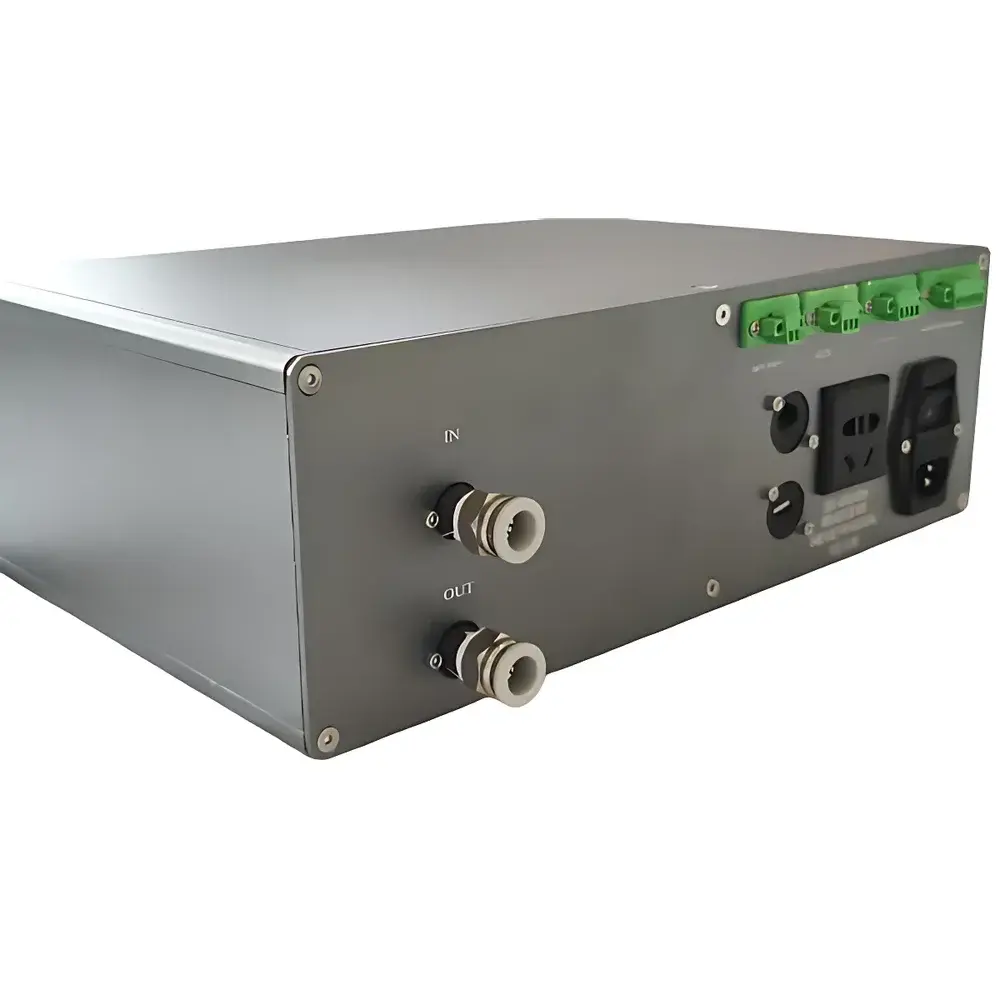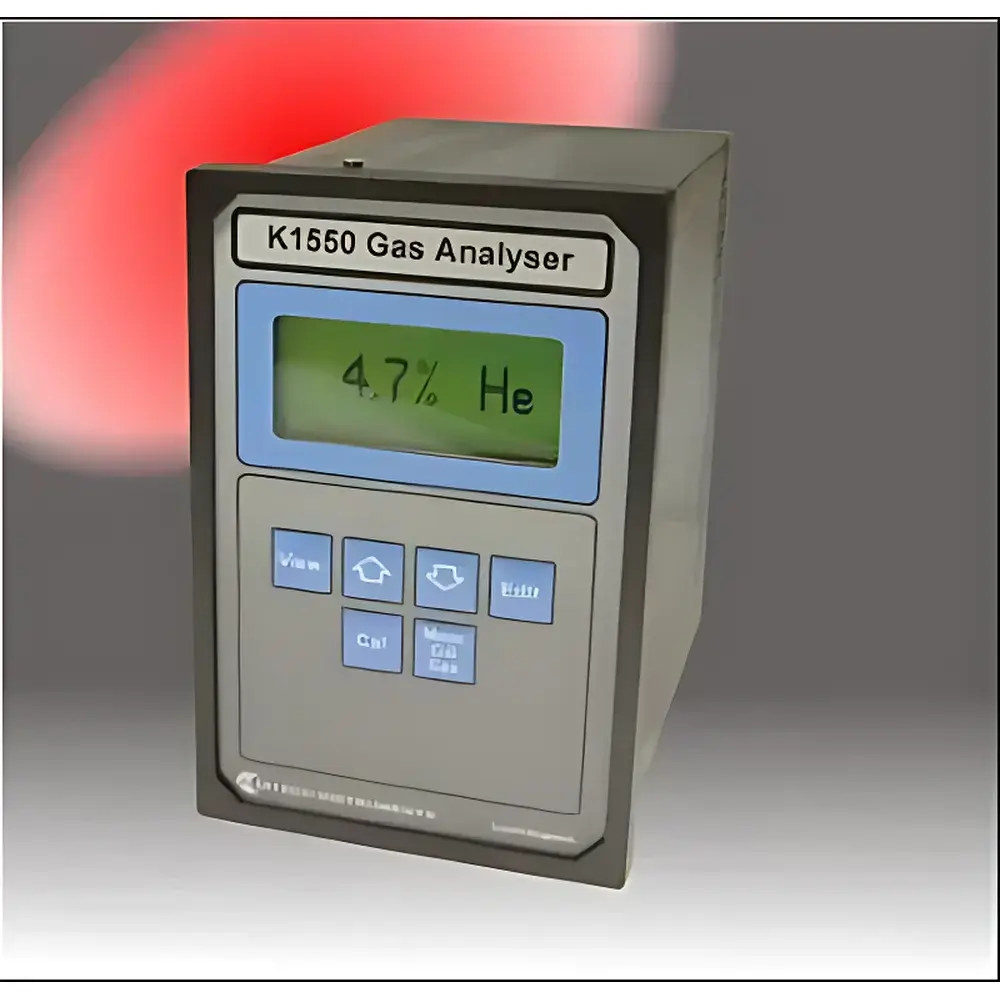
Hitech K1550 Hydrogen Purity Analyzer
| Brand | Hitech |
|---|---|
| Origin | United Kingdom |
| Model | K1550 |
| Detection Principle | Thermal Conductivity (TC) |
| Measurable Gases | H₂, CO₂, Ar, He, Ne, CH₄, CFCs (e.g., Freon) |
| Range | 0–0.5% to 0–100% (H₂, He) |
| Accuracy | ±1% or ±2% of full scale (gas-dependent) |
| Stability | Better than ±1% FS/month |
| Response Time (T90) | 20 s |
| Sample Flow Rate | 100–300 mL/min |
| Sample Temperature | –10 °C to +40 °C (non-condensing) |
| Sample Pressure | Ambient (vented to atmosphere) |
| Display | Dot-matrix LCD (2- or 4-line) |
| Output | 4–20 mA (user-programmable), two configurable alarm relays (0.5 A / 48 V AC/DC), LED status indicators |
| Environmental Operating Temp | –5 °C to +40 °C |
| Power Supply | 110/120 V or 220/240 V AC, 50/60 Hz, 12 VA |
| Enclosure | IP40 Noryl fiberglass-reinforced housing (IP54 lockable door optional) |
| Mounting | DIN panel-mount secondary unit (96 × 144 mm) |
| Compliance | Designed for industrial process environments |
Overview
The Hitech K1550 Hydrogen Purity Analyzer is a precision thermal conductivity (TC)-based gas analyzer engineered for continuous, real-time monitoring of hydrogen concentration in binary or quasi-binary gas mixtures—where only one component varies significantly. It leverages the fundamental physical property of thermal conductivity, which differs markedly between hydrogen (λ ≈ 180 mW/m·K at 25 °C) and common background gases such as nitrogen, argon, carbon dioxide, or methane. This differential enables high-sensitivity detection without chemical reaction or consumables. The instrument is especially suited for applications demanding long-term stability and minimal intervention, including on-stream purity verification in hydrogen production (e.g., PEM electrolysis, steam methane reforming), purge gas validation in metallurgical atmospheres, leak detection in refrigeration systems using H₂-based tracer blends, and quality assurance in food-grade inerting processes.
Key Features
- High-stability, maintenance-free TC sensor with low-thermal-mass, non-degrading sensing element—no catalytic surfaces, no filament burnout risk, no periodic replacement required.
- Integrated microprocessor delivering real-time temperature compensation, linearization, and digital signal conditioning—enabling accuracy of ±1% or ±2% FS across calibrated ranges, and stability better than ±1% FS per month.
- Dual-line or quad-line dot-matrix LCD display with intuitive menu navigation for setup, calibration verification, and diagnostic feedback—supports both local operation and remote configuration via front-panel interface.
- Two fully programmable alarm outputs: each relay can be configured as HIGH, LOW, or OFF, with user-defined hysteresis; visual LED indication provided for immediate status recognition.
- Standard 4–20 mA analog output scaled to full measurement range; output mapping and scaling are field-configurable via menu-driven interface—compatible with DCS, PLC, and SCADA systems without external signal conditioners.
- Modular architecture: sensor head may be mounted remotely (e.g., in hazardous zones) via intrinsically safe MTL barrier interface, while the secondary unit remains in safe-area control rooms—conforming to IEC 60079-11 requirements when specified.
Sample Compatibility & Compliance
The K1550 is validated for use with dry, non-corrosive, non-condensing gas streams containing H₂, He, CO₂, Ar, Ne, CH₄, or halogenated hydrocarbons (e.g., R-12, R-22). It is not suitable for corrosive, particulate-laden, or high-humidity samples without upstream conditioning (e.g., coalescing filters, desiccant dryers, or sample pumps—available as system options). While not certified to ATEX or IECEx out-of-the-box, configurations with remote TC sensors and approved barriers meet Zone 1/2 requirements for Group IIA/IIB applications. The analyzer’s design supports traceability and operational integrity in regulated environments: all calibration events, parameter changes, and alarm activations are timestamped and retained in non-volatile memory—facilitating compliance with GLP, GMP, and internal QA protocols requiring audit-ready logs.
Software & Data Management
The K1550 operates autonomously without host software; however, its embedded firmware provides comprehensive local data governance. All configuration parameters—including span gas values, alarm thresholds, hysteresis settings, and output scaling—are stored with write protection and change logging. The device maintains a rolling history of up to 100 calibration verifications and 200 alarm events, each tagged with date/time stamp and operator ID (if enabled via optional password-protected access levels). For integration into centralized asset management platforms, the 4–20 mA output may be digitized and archived alongside process variables in historian systems compliant with ISA-95 or OPC UA standards. No proprietary drivers or cloud connectivity are required—ensuring deterministic response and cybersecurity resilience in air-gapped industrial networks.
Applications
- Hydrogen Production & Distribution: Real-time monitoring of H₂ purity downstream of PSA units, membrane separators, or electrolyzers—ensuring compliance with ISO 8573-8 Class 1 or CGA G-5.4 Grade A specifications.
- Power Generation: Verification of hydrogen coolant purity in turbine generators—preventing insulation degradation and maintaining dielectric integrity.
- Food & Beverage Packaging: Validation of H₂/N₂ blends used in modified-atmosphere packaging (MAP) lines to inhibit microbial growth without oxidation.
- Metallurgy & Heat Treatment: Control of reducing atmospheres in annealing furnaces where precise H₂ partial pressure governs surface oxide reduction kinetics.
- Refrigeration & HVAC: Leak detection and charge verification in emerging low-GWP refrigerant blends containing hydrogen or helium as carrier gases.
- Brewing & Fermentation: Monitoring of CO₂/H₂ ratios in fermentation off-gas for metabolic activity assessment and yeast health diagnostics.
FAQ
What gases can the K1550 measure besides hydrogen?
The analyzer is capable of quantifying any binary mixture where the two components exhibit sufficiently divergent thermal conductivities—including CO₂, Ar, He, Ne, CH₄, and chlorofluorocarbons (e.g., Freon-12, Freon-22)—provided the background gas composition remains stable.
Is the sensor affected by ambient temperature fluctuations?
No—the integrated microprocessor performs continuous, dynamic temperature compensation using a dedicated reference thermistor, ensuring measurement stability across the full operating range of –5 °C to +40 °C.
Can the K1550 be used in explosive atmospheres?
Yes, when configured with a remotely mounted TC sensor and an approved intrinsically safe barrier (e.g., MTL5042), the system complies with IEC 60079-11 for use in Zone 1 and Zone 2 hazardous locations.
Does the instrument require zero/span calibration gas?
Calibration is performed using certified reference gases matching the target application (e.g., 5% H₂ in N₂); no zero gas is required for thermal conductivity measurement, though span verification is recommended quarterly or after major maintenance.
What sample conditioning is necessary for reliable operation?
The sample must be free of condensable vapors, particulates, and reactive contaminants. Optional accessories include stainless-steel particulate filters (0.5 µm), sintered metal coalescers, and diaphragm sample pumps—configured based on line pressure, flow dynamics, and installation distance.