
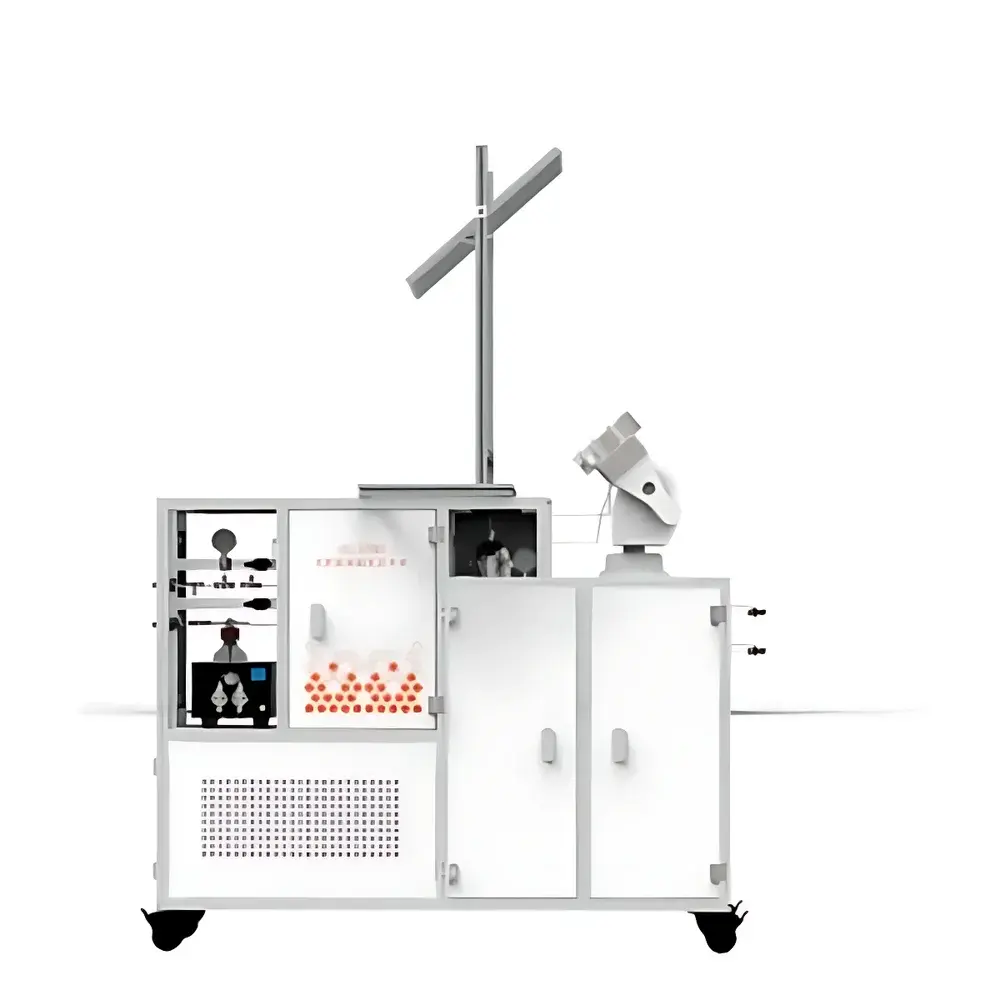
CEL-TCRD100 Miniature Automated Solar-Tracking Photoreactor System
| Brand | CEAULIGHT (Zhongjiaojinyuan) |
|---|---|
| Origin | Beijing, China |
| Manufacturer Type | OEM/ODM Manufacturer |
| Country of Origin | China |
| Model | CEL-TCRD100 |
| Light Source Type | Broadband Simulated Solar / Xenon or Mercury Arc Lamp Compatible |
| Irradiation Mode | External Illumination |
| Reactor Window Diameter | 100 mm |
| Condensing Lens Dimensions | 0.5 m × 0.5 m |
| Focal Length | 0.5 m (customizable) |
| Tracking Range | Horizontal 0–350°, Vertical −70° to +20° |
| Max Payload Capacity | ≤10 kg |
| Liquid Feed Accuracy | <0.5% FS, Flow Range: 0–5 mL/min |
| Max Operating Temperature | 200 °C |
| Operating Pressure | Ambient (1 atm) |
| Mobility | Casters for Indoor/Outdoor Deployment |
Overview
The CEL-TCRD100 Miniature Automated Solar-Tracking Photoreactor System is an engineered platform for controlled, quantitative photocatalytic evaluation under simulated or natural solar irradiation. Designed around the principles of incident photon flux management and reaction-phase mass transfer optimization, it enables reproducible kinetic studies of heterogeneous photocatalysis—particularly for thin-film and immobilized catalysts. Its core architecture integrates a water-cooled quartz-windowed reactor (φ100 mm), external broadband illumination (compatible with xenon arc lamps, mercury vapor lamps, or concentrated natural sunlight), and real-time solar vector alignment via a dual-axis precision tracking mechanism. The system operates at ambient pressure up to 200 °C, supporting gas-phase, liquid-phase, or concurrent gas–liquid feed configurations—making it suitable for CO₂ reduction, H₂ evolution, VOC degradation, and selective organic transformations where light intensity, incidence angle, and phase contact dynamics are critical experimental variables.
Key Features
- Water-cooled borosilicate/quartz reactor with large-diameter optical window (φ100 mm) ensuring thermal stability and high UV–Vis transmission; quick-release flange design enables rapid catalyst loading and reactor maintenance.
- Modular condensing optics: detachable 0.5 m × 0.5 m plano-convex lens (f = 0.5 m) for solar concentration; optional lens kits support focal length customization and spectral tailoring via interchangeable bandpass filters or neutral density attenuators.
- Dual-axis automated solar tracker with ±0.2° pointing accuracy; horizontal rotation range 0–350°, vertical tilt −70° to +20°; integrated load capacity ≤10 kg accommodates lamp housings, collimators, and auxiliary optical components.
- In-line gas–liquid separation module at reactor outlet enables independent collection and real-time sampling of gaseous effluents (e.g., H₂, O₂, CH₄, CO) and condensed liquid products (e.g., methanol, formic acid, aldehydes) for downstream GC, GC–MS, or HPLC analysis.
- Integrated fluid delivery subsystem: high-precision syringe pump for liquid feed (0–5 mL/min, accuracy <0.5% FS); gas mass flow controllers (MFCs) configurable per user requirement for stoichiometric or dynamic gas dosing (N₂, Ar, O₂, H₂, CO₂, etc.).
- Mobile chassis with locking casters facilitates deployment in rooftop solar test beds, climate-controlled laboratories, or outdoor field trials—without requiring permanent installation or structural reinforcement.
Sample Compatibility & Compliance
The CEL-TCRD100 supports solid catalysts in membrane, coated-plate, or monolithic formats—including TiO₂, g-C₃N₄, perovskite oxides, MOF-derived photocatalysts, and plasmonic nanostructures. It accommodates slurry-based suspensions when paired with magnetic stirring or ultrasonic dispersion modules (optional). Reaction media include aqueous electrolytes, organic solvents (e.g., methanol/water mixtures), and humidified or dry gas streams. The system adheres to fundamental safety and operational conventions outlined in ASTM E2614–22 (Standard Practice for Solar Simulator Calibration) and ISO 10527:2021 (Photocatalytic Air Purification Materials). While not certified to IEC 61000 or UL 61010 by default, its electrical and thermal design complies with GLP-aligned engineering practices for lab-scale photoreactor validation and method development under non-GMP research conditions.
Software & Data Management
The system operates via embedded microcontroller logic with RS-485/USB interface for integration into centralized lab automation networks. Optional PC-based control software provides synchronized logging of irradiance (via calibrated Si/UV-enhanced photodiode input), temperature (PT100 sensor), liquid flow rate, and gas composition (when interfaced with external analyzers). Audit-trail functionality supports timestamped parameter recording compliant with basic 21 CFR Part 11 expectations for non-clinical research data integrity. Raw datasets export in CSV or HDF5 format for kinetic modeling (e.g., Langmuir–Hinshelwood fitting, quantum yield calculation) and inter-laboratory comparison.
Applications
- Quantitative screening of photocatalytic membrane efficiency under variable solar zenith angles and spectral distributions.
- Kinetic investigation of gas-phase photocatalytic oxidation (e.g., NOₓ, formaldehyde) and reduction (e.g., CO₂-to-fuels) pathways.
- Development and validation of wavelength-resolved action spectra using tunable filter wheels and reference actinometers.
- Long-term stability testing of photoelectrodes and hybrid photocatalyst–support systems under thermal–photonic stress cycling.
- Educational demonstration of solar energy conversion fundamentals, including photon flux normalization (Einstein/m²/s), incident photon-to-current efficiency (IPCE), and apparent quantum yield (AQY).
FAQ
Can the CEL-TCRD100 be used with pulsed laser sources?
No—it is engineered for continuous broadband illumination; pulsed operation may exceed thermal limits of the water-cooled window and destabilize tracking synchronization.
Is vacuum operation supported?
Not natively; the reactor is rated for ambient pressure only. Vacuum compatibility requires third-party retrofitting of sealing hardware and pressure-rated viewports.
What calibration standards are recommended for irradiance measurement?
NIST-traceable silicon photodiodes (e.g., Thorlabs S120VC) or chemical actinometers (e.g., potassium ferrioxalate) are advised for absolute photon flux quantification prior to kinetic experiments.
Does the system include gas chromatography coupling hardware?
No—GC interfacing requires user-supplied heated transfer lines, six-port valves, and compatible carrier gas manifolds; the reactor outlet is fitted with standard Swagelok 1/4″ compression fittings.
Can the tracking algorithm accommodate cloudy-sky conditions?
Yes—the system uses hybrid open-loop (ephemeris-based) and closed-loop (photodiode feedback) control; partial cloud cover reduces angular update frequency but maintains coarse sun vector estimation within ±5° accuracy.





