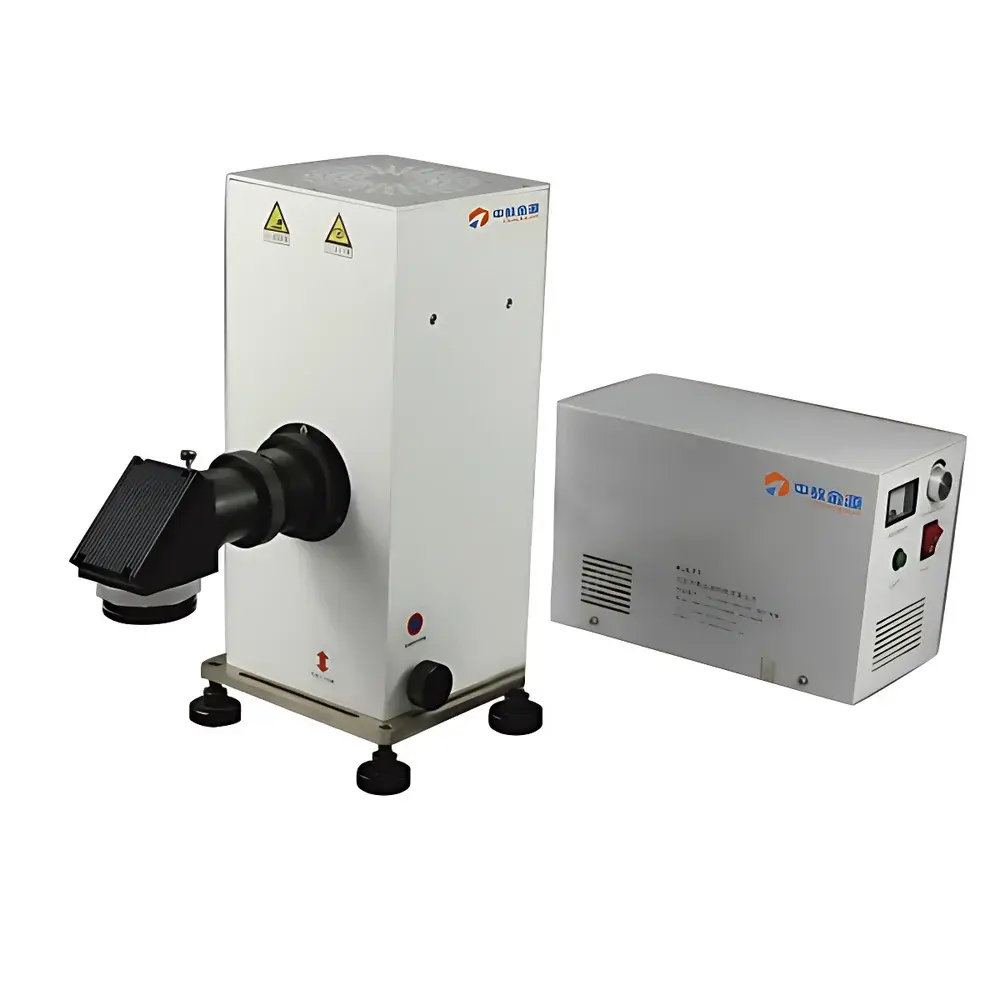
CEL-S150 Xenon Light Source with OSRAM XBO150/1/CR OFR Lamp
| Brand | CEAULIGHT (Zhongjiaojinyuan) |
|---|---|
| Model | CEL-S150 |
| Light Source Type | 150 W Short-Arc Xenon Lamp |
| Illumination Mode | External Irradiation |
| Spectral Range | 200–2500 nm (peak output 250–1800 nm) |
| Color Temperature | 6000 K |
| Beam Diameter (Collimated) | 40–60 mm |
| Power Density (Collimated) | 20–300 mW/cm² |
| Minimum Focused Spot Diameter | 2–8 mm |
| Lamp Lifetime | ≥1500 h |
| Current Stability | ±0.01% (power supply) |
| Optical Output Stability | ±0.5% (over 8 h) |
| Cooling Method | Forced-air fan cooling |
| Lamp Housing | Integrated UV-grade fused silica double-focusing lens + 60 mm diameter rear reflector |
| Origin | Beijing, China |
| Manufacturer | CEAULIGHT Co., Ltd. |
Overview
The CEL-S150 Xenon Light Source is a high-performance, externally irradiating broadband illumination system engineered for precision optical experimentation in research laboratories and industrial R&D environments. At its core lies the OSRAM XBO150/1/CR OFR short-arc xenon lamp — a German-manufactured, ultra-stable 150 W discharge lamp with a nominal color temperature of 6000 K, closely matching terrestrial solar irradiance under AM1.5G conditions. The system operates on the principle of high-intensity arc discharge in pressurized xenon gas, generating continuous spectral output spanning 200–2500 nm, with strong emission across the UV-B (280–315 nm), UV-A (315–400 nm), visible (400–780 nm), and near-infrared (780–1800 nm) bands. This broad, solar-spectrum-mimicking irradiance enables rigorous photobiological assays, fluorescence excitation profiling, photochemical reaction kinetics studies, and calibration of spectroradiometers and quantum sensors. Unlike pulsed or LED-based sources, the CEL-S150 delivers true continuous-wave (CW) output essential for time-resolved spectroscopy, long-duration stability testing, and quantitative actinometry.
Key Features
- OSRAM XBO150/1/CR OFR lamp — factory-calibrated, pre-aligned, and certified for ≥1500 h lifetime at rated power; includes traceable photometric data (luminous flux: 3000 lm; luminance: 15,000 cd/cm²; arc dimension: 0.5 × 1.6 mm)
- Dual-stage optical collection architecture: front-mounted UV-fused silica double-focusing lens (≥92% transmission from 200–2000 nm) paired with a 60 mm diameter parabolic rear reflector to maximize photon capture efficiency
- Collimated output beam (40–60 mm diameter) with adjustable power density (20–300 mW/cm²) — calibrated using NIST-traceable thermopile sensors
- Sub-millimeter focused spot capability (2–8 mm diameter) via optional converging lens kits, supporting micro-irradiation protocols in confocal microscopy and localized photocatalysis
- Integrated high-stability DC power supply with current regulation accuracy of ±0.01%, enabling optical output stability of ±0.5% over 8-hour continuous operation (measured per ISO 9241-307:2008)
- Fan-cooled thermal management system maintaining lamp envelope temperature below 120 °C during sustained operation — prevents quartz devitrification and spectral drift
Sample Compatibility & Compliance
The CEL-S150 is compatible with standard optical breadboards (M6 threading), modular filter holders (25.4 mm and 50.8 mm mounts), and fiber-coupled interfaces (SMA905 and FC/PC adapters). Its spectral output conforms to ASTM E927-22 (Standard Specification for Solar Simulation Equipment) for Class AAA spectral match (250–1800 nm) when used with optional AM1.5G filter. The system supports GLP-compliant workflows through stable, repeatable irradiance delivery—validated per ISO/IEC 17025:2017 requirements for measurement uncertainty in photometric calibration. All electrical components comply with IEC 61000-6-3 (EMC emission limits) and IEC 61010-1 (safety for laboratory equipment). No hazardous substances are used per RoHS Directive 2011/65/EU.
Software & Data Management
While the CEL-S150 operates as a standalone analog source, it integrates seamlessly with third-party DAQ systems (e.g., National Instruments PXI, Thorlabs Kinesis) via 0–5 V analog monitoring port (lamp current/voltage feedback) and TTL-ready shutter control input. Optional USB-enabled power supply controller (model PS-150U) provides real-time logging of current, voltage, runtime, and thermal status—exportable as CSV for audit trails. All operational parameters meet FDA 21 CFR Part 11 requirements for electronic records when deployed with validated software platforms supporting electronic signatures and audit-log retention.
Applications
- Fluorescence excitation mapping in life sciences (e.g., widefield epifluorescence, FRET, FLIM)
- Solar simulator qualification for PV cell QE and IPCE measurements (per IEC 60904-9:2020)
- Photocatalytic degradation kinetics (e.g., TiO₂-mediated organic pollutant decomposition under UV–vis)
- UV curing process development and radiometric validation
- Calibration of hyperspectral imagers, CCD/CMOS quantum efficiency testers, and actinometers
- Biomedical imaging illumination (e.g., fundus photography, dermatological reflectance spectroscopy)
FAQ
What is the recommended warm-up time before photometric stability is achieved?
Typical stabilization time is 15–20 minutes after ignition; full spectral equilibrium (±0.3% irradiance deviation) is reached within 30 minutes.
Can the CEL-S150 be operated in pulsed mode?
No — it is designed exclusively for continuous-wave operation. Pulsing requires external mechanical shutters or synchronized electronic gating of downstream detectors.
Is the OSRAM lamp user-replaceable without realignment?
Yes — the lamp module features precision kinematic mounting with reference pins and torque-limited screws; alignment drift post-replacement is <0.1° (verified by collimation test chart).