
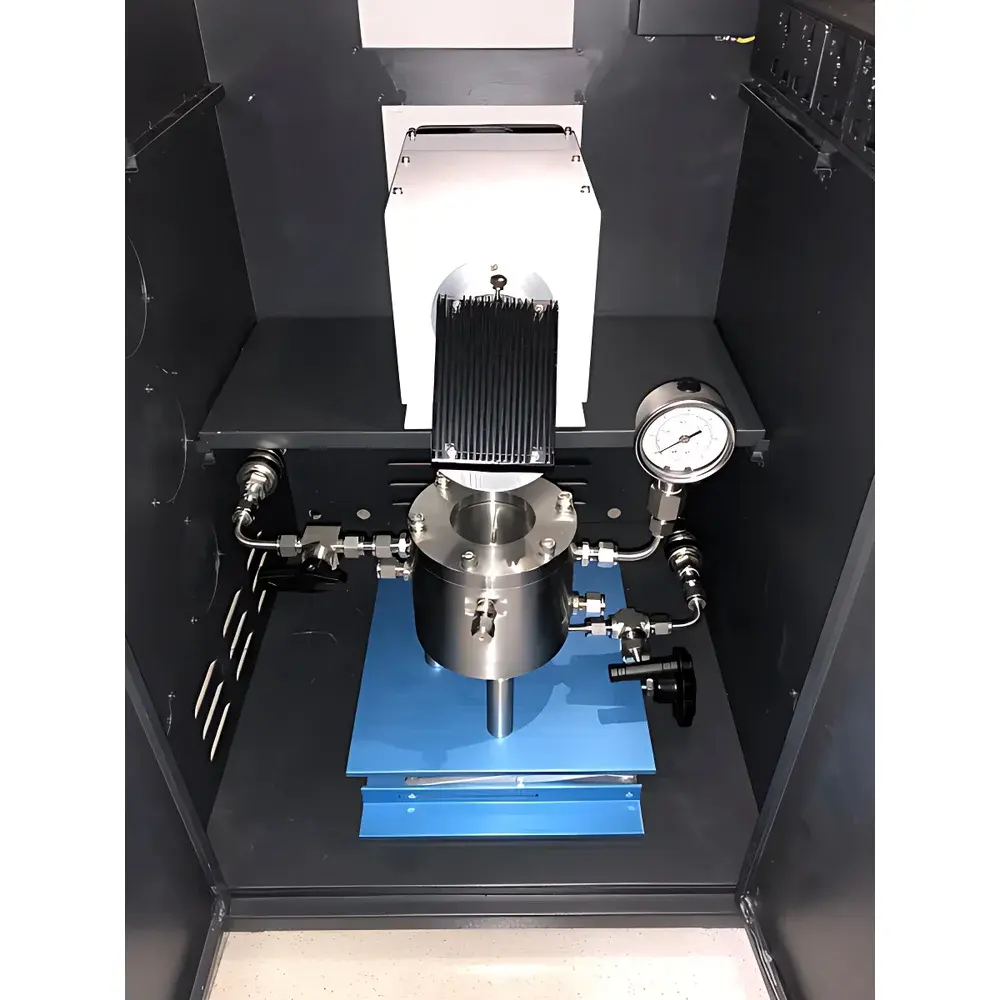
CEL-GPRT100 Ding-Type Photocatalytic Reactor by CEAULAB
| Brand | CEAULAB |
|---|---|
| Model | CEL-GPRT100 |
| Construction Material | 316L Stainless Steel |
| Maximum Operating Pressure | 2 MPa |
| Reaction Volume | 100 mL |
| Optical Window | Fused Silica (Ø52 mm, 200–2500 nm transmission >95%) |
| External Dimensions | Ø106 mm × 78 mm |
| Temperature Control | Integrated 10-mm-jacketed cooling/heating mantle with external circulator interface |
| Gas Inlets/Outlets | Three standard Swagelok-compatible ports (3 mm tubing) |
| Sealing | Dual O-ring flange seal |
| Regulatory Compliance | Designed for ISO/IEC 17025-compliant laboratory environments |
| Software Integration | Compatible with GC7920 gas chromatograph (via ASTM D6348-compliant sampling protocol) and CEL-GPPC series gas-phase catalytic control systems |
Overview
The CEL-GPRT100 Ding-Type Photocatalytic Reactor is an engineered stainless-steel reaction vessel designed for controlled heterogeneous and homogeneous photocatalytic processes under ambient to low-pressure gaseous or liquid-phase conditions. Its core operational principle relies on uniform irradiation of catalyst surfaces—whether powdered, immobilized films, monolithic substrates, or suspended colloids—through a high-transmittance fused silica optical window, enabling precise photon flux delivery across the UV–NIR spectrum (200–2500 nm). The reactor’s “ding-type” (tripod-inspired) geometry facilitates multi-directional gas flow patterns—vertical upflow/downflow or horizontal cross-flow—ensuring complete catalyst bed penetration and minimizing channeling effects. This architecture supports stoichiometric gas-phase reactions such as CO₂ photoreduction, VOC mineralization, NOₓ abatement, and photocatalytic nitrogen fixation, where mass transfer, light distribution, and thermal stability are critical performance determinants.
Key Features
- Monolithic 316L stainless-steel construction with CNC-machined body and integral thermal jacket (10 mm clearance), enabling stable temperature regulation via external water/oil circulation.
- Dual-sealed flange assembly with fluorocarbon O-rings rated for 2 MPa maximum pressure and compatible with aggressive reactive gases (e.g., NH₃, H₂S, Cl₂).
- Optical access via a 52 mm-diameter fused silica viewport offering ≥95% transmittance from 200 nm to 2500 nm—certified per ASTM E430 for spectral radiometry applications.
- Three standardized 3 mm Swagelok-compatible ports (two axial, one radial) configured for inlet, outlet, and sampling—each fitted with Anlok precision needle valves and ball valves for fine gas dosing and leak-tight isolation.
- Integrated catalyst support fixtures: two removable gas–solid reaction trays and two gas–liquid diffusion spacers, allowing rapid configuration switching without tooling.
- Real-time temperature monitoring via calibrated digital display head (±0.5 °C accuracy), directly interfaced with the jacket’s fluid loop.
- Rapid-connect fluid and gas interfaces using stainless-steel ferrule-based compression fittings, compliant with ASME B31.3 process piping standards for laboratory-scale systems.
Sample Compatibility & Compliance
The CEL-GPRT100 accommodates diverse catalyst morphologies—including nanopowders, slurry suspensions, sputtered thin films, ceramic monoliths, and freestanding membranes—without requiring substrate modification. Its design conforms to key international laboratory safety and quality frameworks: pressure containment meets PED 2014/68/EU Category I requirements; surface finish complies with ASME BPE-2022 for bioprocess equipment (Ra ≤ 0.8 µm); and material traceability documentation (MTR) is provided per EN 10204 3.1. For regulated environments, the reactor supports GLP-compliant workflows when paired with GC7920 gas chromatographs operating under USP and ASTM D6348 gas analysis protocols. All wetted parts are passivated per ASTM A967 and certified non-leaching per ISO 10993-12.
Software & Data Management
While the CEL-GPRT100 operates as a standalone hardware platform, it integrates natively with third-party analytical instrumentation via standardized pneumatic and electrical interfaces. When coupled with the CEL-GPPC gas-phase catalytic control system, users gain programmable gas sequencing (including timed injection, pulse dosing, and flow ramping) and synchronized data logging at 1 Hz resolution. Raw pressure, temperature, and valve status signals output analog 4–20 mA or digital RS485 Modbus RTU, enabling direct ingestion into LabVIEW, MATLAB, or Python-based acquisition pipelines. Full audit trails—including operator ID, timestamped parameter changes, and calibration logs—are retained when used with GC7920 systems configured for FDA 21 CFR Part 11 compliance.
Applications
This reactor serves as a primary testbed in academic and industrial photocatalysis research for: (1) Quantitative kinetic studies of CO₂-to-CH₄/CO conversion under simulated solar irradiation; (2) Accelerated aging tests of TiO₂-, g-C₃N₄-, or MOF-based air purification filters; (3) Mechanistic investigation of interfacial charge transfer in plasmonic photocatalysts via in situ DRIFTS coupling; (4) Screening of co-catalyst loading effects in N₂ photofixation using Ru-based complexes; and (5) Validation of reactor-scale scalability prior to pilot-plant deployment under ISO 22196 antimicrobial testing conditions.
FAQ
What light sources are compatible with the CEL-GPRT100?
The reactor is optimized for use with 300 W and 500 W xenon arc lamps (CEL-HXF300/Xe) and 100 W high-power LED arrays (CEL-LED100), all equipped with appropriate collimation and cooling interfaces.
Can the reactor be operated under vacuum?
Yes—the dual O-ring flange seal and 316L construction enable stable operation down to 10⁻² mbar, verified via helium leak testing per ISO 10648-2.
Is the quartz window replaceable in the field?
Yes—viewport replacement requires only standard Torx tools and a new certified fused silica disc; full requalification per ASTM E430 is recommended after each replacement.
Does the reactor support liquid-phase photocatalysis with solvent reflux?
It supports batch liquid-phase reactions up to 80 °C with inert atmosphere; for reflux applications, integration with a condenser manifold (not included) is required.
What maintenance intervals are recommended for the sealing system?
O-rings should be inspected and replaced every 200 operational hours or after exposure to halogenated or sulfur-containing gases, per manufacturer’s service bulletin SB-GPRT-2023-01.



