
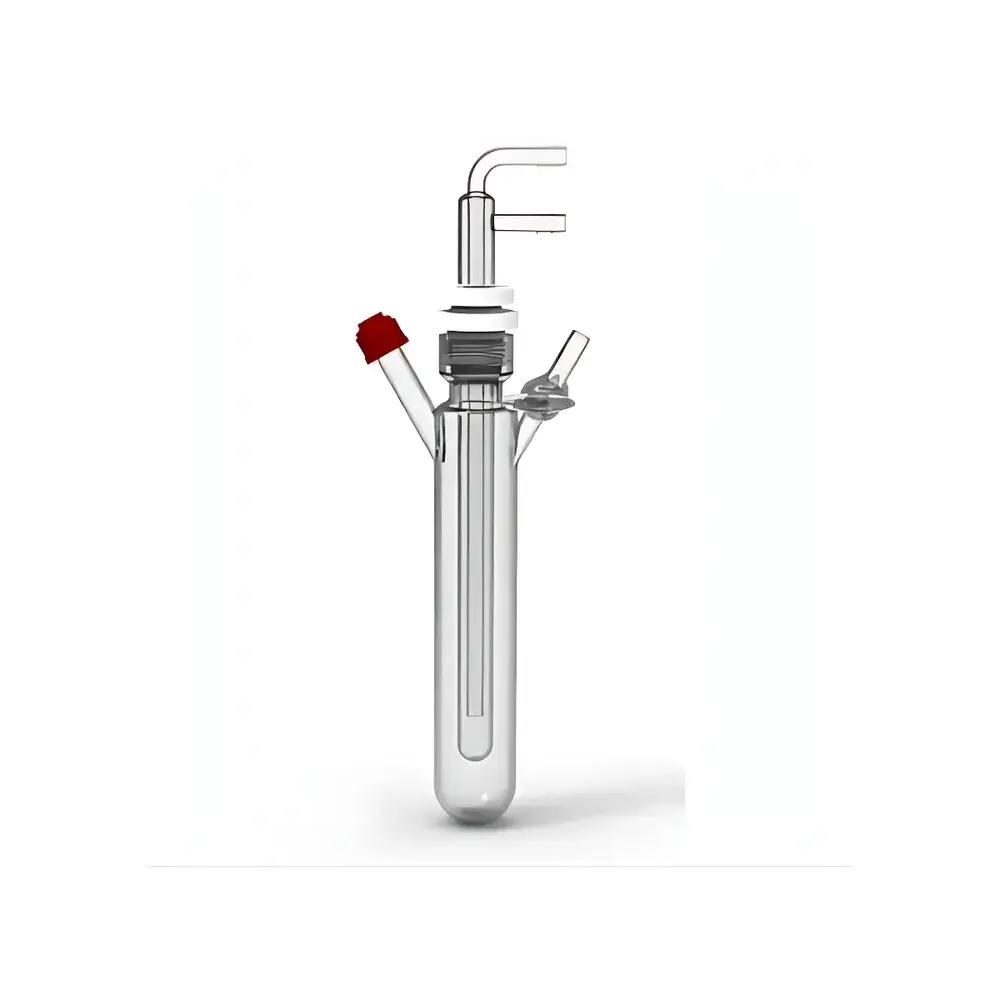
CEL-PCCR100 High-Pressure Photochemical Reaction Cell
| Brand | CEAULIGHT (Zhongjiao Jinyuan) |
|---|---|
| Model | CEL-PCCR100 |
| Construction Material | Borosilicate Glass (Duran-type) |
| Max. Liquid Volume | 100 mL |
| Pressure Range | −0.1 MPa to +0.15 MPa (−1 to +1.5 bar gauge) |
| Sealing System | Dual PTFE O-rings |
| Gas Inlet/Outlet | Straight-through stainless steel valve with leak-tight shut-off |
| Sampling Port | Septum-piercing port (compatible with 22–26 G needles) |
| Temperature Monitoring | Integrated thermocouple port (accepts probes ≤1.5 mm OD) |
| Illumination Mode | External irradiation (top- or side-illuminated) |
| Compatible Light Sources | Xenon arc lamps, mercury vapor lamps, and high-power LED arrays (365 nm–470 nm, UV–visible) |
| Compliance | Designed for ISO/IEC 17025-aligned photochemical testing environments |
| Accessories Included | 1 × CO₂ reduction reaction cell, 3 × corrosion-resistant PTFE O-rings, 5 × T-type silicone septa, 2 × 10 mL plastic syringes, 1 × stainless steel needle (22 G, 40 mm) |
Overview
The CEL-PCCR100 High-Pressure Photochemical Reaction Cell is an engineered borosilicate glass reactor system designed for controlled heterogeneous and homogeneous photocatalytic reactions under variable pressure and temperature conditions. Based on the Couette–Taylor flow principle adapted for static batch photochemistry, it enables precise gas–liquid and gas-phase photocatalytic processes—including CO₂ photoreduction, H₂ evolution, O₂ generation, and organic pollutant degradation—under externally incident radiation. Its dual-PTFE sealing architecture ensures long-term vacuum integrity and inert-gas compatibility up to +0.15 MPa (1.5 bar), while the integrated thermocouple port supports real-time in-situ thermal monitoring during irradiation. The reactor is not a standalone light source but a modular, pressure-rated reaction vessel intended for integration into standardized photochemical platforms such as the CEL-PCRD300-12 LED Photoreactor, CEL-LAB200E7 Parallel Photoreactor, and CEL-LAB500 Multi-position Photolysis System.
Key Features
- Borosilicate glass construction (≥93.5% SiO₂) compliant with DIN ISO 3585 standards, offering high UV transparency (down to 280 nm), thermal shock resistance (ΔT ≤ 120 °C), and chemical inertness toward acids, bases, and organic solvents.
- Dual concentric PTFE O-ring seal design certified to ASTM F2390 for static vacuum and low-pressure gas containment; validated leak rate <1×10⁻⁷ mbar·L/s under helium mass spectrometry.
- Integrated straight-through stainless steel isolation valve (316 SS body, Viton seat) enabling precise gas dosing, pressure stabilization, and inert-atmosphere purging without disassembly.
- Septum-piercing sampling port compatible with standard GC/MS syringes (22–26 gauge), supporting non-invasive liquid/gas phase sampling at defined time intervals under sealed operation.
- Thermocouple insertion port (1.5 mm ID) accommodating Type K or T probes for continuous temperature logging—critical for kinetic modeling and Arrhenius analysis in photoinduced reactions.
- Modular geometry optimized for uniform external illumination: cylindrical profile (Ø 50 mm × H 120 mm) maximizes photon flux density across catalyst beds while minimizing shadowing effects.
Sample Compatibility & Compliance
The CEL-PCCR100 accommodates solid photocatalysts (e.g., TiO₂, g-C₃N₄, MOFs), suspended colloids, and dissolved molecular complexes in aqueous or organic media (acetonitrile, methanol, DMF). It supports gas-phase reactants including CO₂, H₂O vapor, O₂, N₂, CH₄, and synthetic air mixtures. All wetted parts meet USP Class VI biocompatibility requirements. The system conforms to ISO 10527 (photocatalytic activity measurement), ASTM E2933 (standard practice for solar simulator calibration), and supports GLP-compliant workflows when paired with audit-trail-capable data loggers and validated light sources. Pressure operation falls within the ASME B31.3 Process Piping Code’s “low-pressure equipment” classification (<1 MPa).
Software & Data Management
While the CEL-PCCR100 itself contains no embedded electronics, it is fully interoperable with third-party instrumentation control software—such as LabVIEW-based photoreactor automation suites, MATLAB-driven kinetic fitting modules, and Python-controlled gas chromatography data acquisition systems (e.g., Agilent OpenLab CDS, Thermo Fisher Chromeleon). When used with CEL-LAB500 or CEL-PCRD300-12 platforms, real-time pressure, temperature, and irradiance data can be synchronized via RS-485 or analog 4–20 mA outputs. Full traceability is maintained through timestamped CSV exports aligned with ISO/IEC 17025 Clause 7.7 requirements for measurement uncertainty reporting.
Applications
- Quantitative CO₂ photoreduction to CH₄, CO, or CH₃OH using plasmonic Cu/TiO₂ or Ni-doped g-C₃N₄ under simulated solar irradiation.
- Kinetic studies of photocatalytic water splitting under controlled H₂/O₂ partial pressures to evaluate charge recombination rates.
- In situ DRIFTS-compatible gas-phase oxidation of VOCs (e.g., formaldehyde, toluene) on WO₃ or BiVO₄ under UV-A illumination.
- Photo-Fenton and persulfate activation assays requiring simultaneous O₂ supply and visible-light excitation (λ = 420–470 nm).
- Accelerated aging tests of photocatalytic coatings under cyclic pressurized humidity–irradiation stress per ISO 11507 Annex D.
FAQ
Can the CEL-PCCR100 be used under vacuum conditions?
Yes—it is rated for continuous operation down to −0.1 MPa (100 mbar abs) with verified sealing performance over 72-hour vacuum hold tests.
Is the reactor compatible with ozone-generating UV-C lamps?
No—borosilicate glass strongly absorbs below 280 nm; use fused silica quartz reactors (e.g., CEL-PCCR-QZ series) for 185/254 nm applications.
What is the maximum recommended operating temperature?
The glass body is rated to 150 °C for short-term exposure (≤2 h); sustained operation above 100 °C requires active cooling via the integrated cold trap interface.
How is calibration traceability ensured for pressure and temperature readings?
Calibration must be performed externally using NIST-traceable digital manometers (e.g., Druck DPI 610) and thermocouple calibrators (e.g., Fluke 724); documentation follows ISO/IEC 17025 Clause 6.6.
Does the system support automated gas injection and feedback control?
Not natively—but it integrates seamlessly with Brooks Instrument GFU-series mass flow controllers and Swagelok pneumatic actuators when mounted on custom manifold assemblies.



