
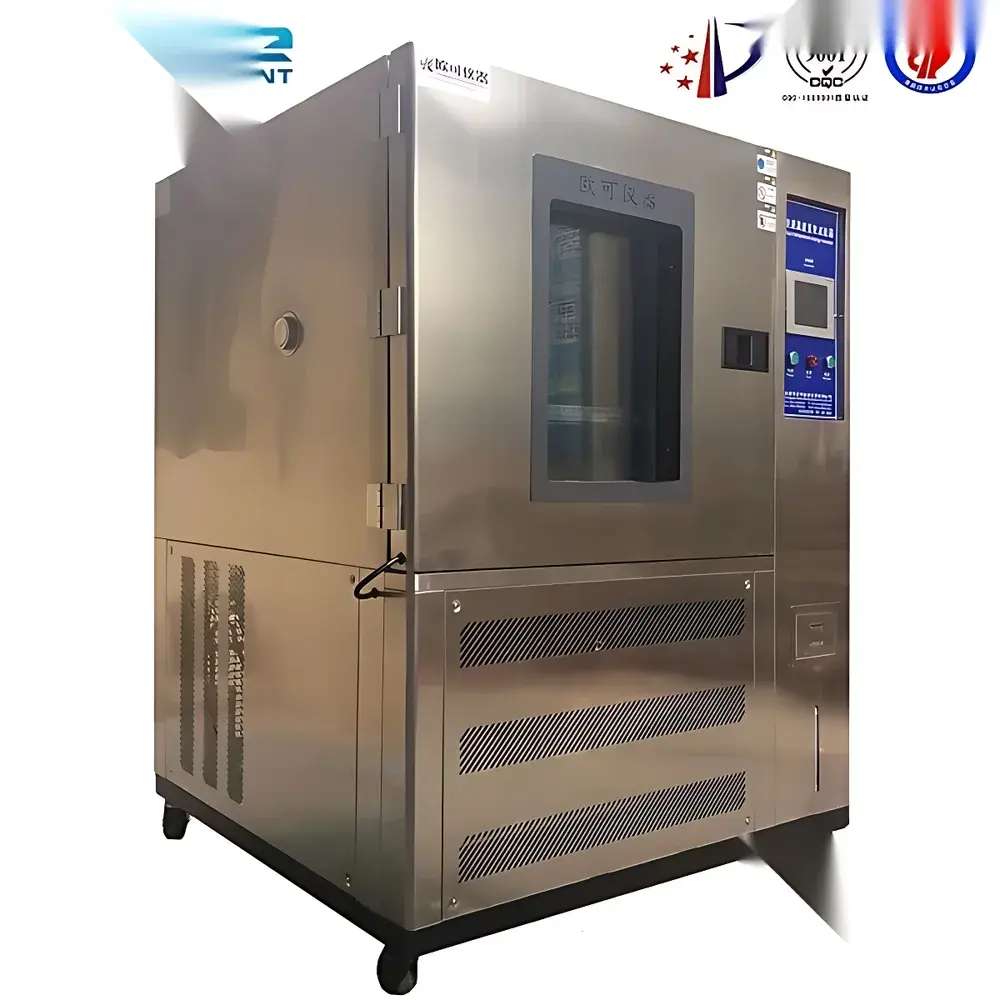
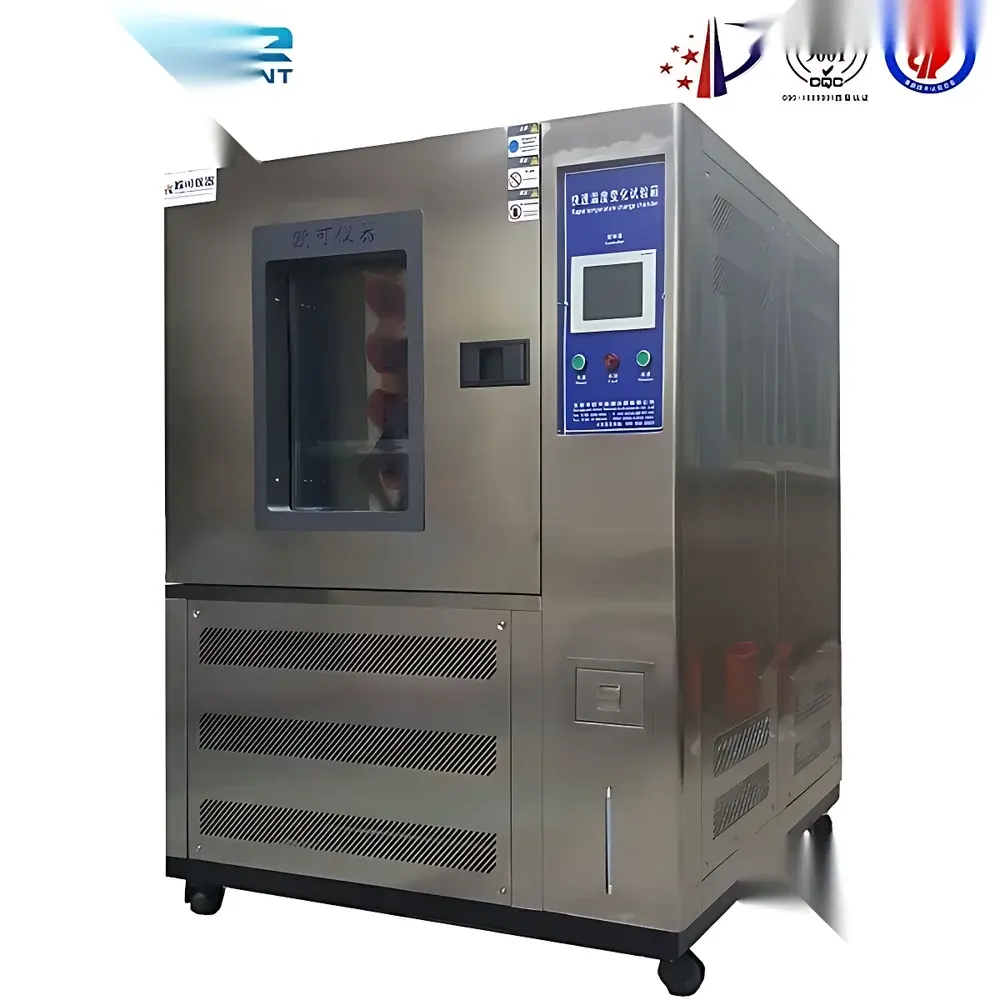
KS-TH-225A Rapid Temperature Change Aging Chamber
| Brand | Other Brands |
|---|---|
| Origin | Imported |
| Manufacturer Type | General Distributor |
| Price | USD 5,300 (FOB) |
| Internal Dimensions (W×H×D) | 500 × 750 × 600 mm |
| External Dimensions (W×H×D) | 1400 × 1870 × 1350 mm |
| Temperature Range | −40 °C to +150 °C |
| High-Temp Preheat Range | +60 °C to +200 °C |
| Low-Temp Precool Range | −55 °C to −10 °C |
| RT → +200 °C Ramp Time | ≈35 min |
| RT → −55 °C Ramp Time | ≈75 min |
| Temperature Uniformity | ±2.0 °C |
| Temperature Stability | ±0.5 °C |
| Thermal Shock Transition Time (Basket Transfer) | ≤10 s |
| Thermal Shock Recovery Time (−40 °C ↔ +150 °C) | ≤5 min |
| Dwell Time per Zone | ≥30 min |
| Heating Power (Hot Zone) | 3.5 kW |
| Cooling Power (Cold Zone) | 2.5 kW |
| Circulation Motor | 90 W |
| Inner Chamber Material | SUS#304 Stainless Steel |
| Insulation | Ceramic Fiber (Hot Zone), High-Density Polyurethane Foam (Cold Zone) |
| Compliance | GB/T 10592–2008, GB/T 10586–2012, GB/T 2423.1–2021, GB/T 2423.2–2021, GB/T 2423.3–2016, GB/T 2423.4–2016 |
Overview
The KS-TH-225A Rapid Temperature Change Aging Chamber is a dual-zone thermal shock test system engineered for accelerated reliability evaluation of electronic components, automotive modules, aerospace assemblies, and polymer-based materials under extreme and rapidly alternating thermal stresses. It operates on the principle of mechanical basket transfer between independently controlled high-temperature and low-temperature reservoirs—eliminating reliance on single-chamber ramping—and thereby achieving true thermal shock conditions defined by IEC 60068-2-14 and MIL-STD-810H Method 503. The system employs a balanced temperature control (BTC) architecture with PID-regulated SSR-driven heating and optimized refrigeration circuitry, ensuring stable setpoint maintenance during extended dwell periods and repeatable transition dynamics across thousands of cycles. Its design prioritizes long-term operational integrity in R&D labs, QA/QC environments, and third-party certification facilities where reproducible thermal stress profiling is mandated by internal reliability protocols or customer-specific qualification standards.
Key Features
- Dual independent thermal reservoirs: high-temperature chamber (up to +200 °C) and low-temperature chamber (down to −55 °C), each with dedicated heating/cooling systems and insulation optimized for thermal retention.
- High-speed horizontal basket transfer mechanism with ≤10-second transit time between zones, minimizing thermal lag and enabling precise dwell-time control per ISO 16750-4 and AEC-Q200 requirements.
- Stainless steel (SUS#304) inner chamber construction with seamless welding and passivated surface finish, resistant to oxidation and condensate corrosion during repeated thermal cycling.
- Robust thermal insulation: ceramic fiber blanket (high-temp zone) and closed-cell polyurethane foam (low-temp zone), minimizing heat leakage and improving energy efficiency over conventional single-chamber designs.
- Forced-air circulation via SIROCCO-type impeller and stainless steel extended-shaft motor (90 W), delivering uniform airflow distribution and meeting ±2.0 °C temperature uniformity per GB/T 10586–2012.
- Real-time temperature stability of ±0.5 °C maintained through adaptive PID algorithms and zero-cross SSR switching—critical for validating material hysteresis behavior and solder joint fatigue thresholds.
Sample Compatibility & Compliance
The KS-TH-225A accommodates samples up to 30 kg (distributed load) within its 225 L internal volume (500 × 750 × 600 mm). Its mechanical design supports standard test fixtures, PCB carriers, and encapsulated sensor housings without requiring custom mounting hardware. The chamber meets national and industry-level environmental test standards including GB/T 2423.1–2021 (Test A: High Temperature), GB/T 2423.2–2021 (Test B: Low Temperature), GB/T 2423.3–2016 (Test Ca: Damp Heat, Steady State), and GB/T 2423.4–2016 (Test Db: Damp Heat, Cyclic). While not intrinsically certified to IEC 61000-4-x or UL 61010-1, it is routinely deployed in GLP-compliant laboratories conducting pre-certification screening prior to formal EMC or safety testing. Its thermal performance profile aligns with the functional intent of JEDEC JESD22-A104 (Temperature Cycling) and IPC-9701 (Performance Classes for Printed Board Interconnect Reliability).
Software & Data Management
The system integrates a programmable touchscreen controller supporting up to 99 user-defined test profiles, each with configurable ramp rates, dwell durations, cycle counts, and alarm thresholds. All temperature data—including real-time readings from dual Pt100 sensors (one per zone), basket position status, and power consumption logs—are timestamped and exportable via USB to CSV format. Audit trails record operator login events, parameter modifications, and emergency stops—enabling traceability in regulated environments. Though native software does not include FDA 21 CFR Part 11-compliant electronic signatures or role-based access control, the data structure conforms to ASTM E2500-13 Annex A3 for raw instrument output, facilitating integration into validated LIMS or ELN platforms via standardized file ingestion protocols.
Applications
This chamber is routinely applied in failure mode analysis of solder interconnects under thermomechanical strain, validation of conformal coating adhesion after repeated expansion/contraction, assessment of sealant integrity in hermetic packages, and qualification of battery module thermal interface materials. Automotive suppliers use it for AEC-Q100 stress screening of power electronics; medical device manufacturers employ it to verify housing dimensional stability across sterilization-relevant thermal excursions; and academic researchers utilize its rapid transition capability to investigate glass transition kinetics in amorphous polymers. Its ability to sustain ≥30-minute dwell times at extremes ensures sufficient thermal equilibration for accurate coefficient of thermal expansion (CTE) mismatch modeling.
FAQ
What is the maximum sample weight the KS-TH-225A can accommodate without compromising thermal uniformity?
The chamber supports up to 30 kg of evenly distributed mass; exceeding this may reduce airflow efficiency and increase temperature deviation beyond ±2.0 °C.
Does the system support humidity control or combined temperature/humidity cycling?
No—this is a dry thermal shock system only. Humidity functionality requires a separate climatic chamber compliant with GB/T 2423.3–2016.
Can the controller log data continuously for 72 hours at 1-second intervals?
Yes, internal memory retains up to 100,000 data points; for longer logging, periodic USB export is required.
Is remote monitoring possible via Ethernet or Modbus protocol?
The standard configuration includes RS-485 Modbus RTU output; optional Ethernet gateway modules enable TCP/IP integration with SCADA or building management systems.
What maintenance intervals are recommended for sustained accuracy?
Calibration verification every 6 months using NIST-traceable Pt100 reference probes; refrigerant pressure checks and fan bearing inspection annually.



