
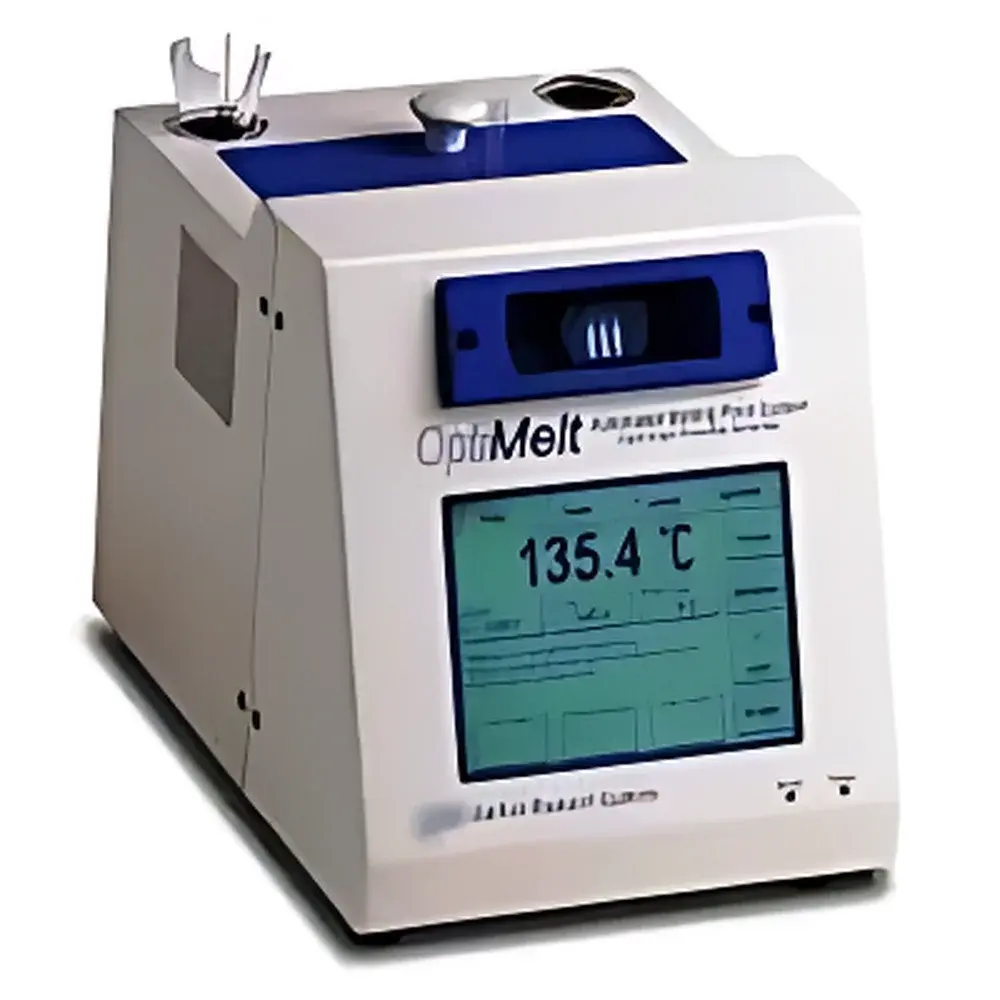
SRS OptiMelt MPA100 Automated Melting Point Apparatus
| Brand | SRS / Stanford Research Systems |
|---|---|
| Origin | USA |
| Model | OptiMelt MPA100 |
| Temperature Range | RT+10°C to 400°C |
| Heating Rate | 0.1–20.0°C/min (0.1°C/min increments) |
| Temperature Resolution | 0.1°C |
| Temperature Accuracy | ±0.3°C (≤100°C), ±0.5°C (≤250°C), ±0.8°C (≤400°C) |
| Temperature Repeatability | ±0.3°C |
| Capillary Dimensions | OD 1.4–2.0 mm, Length 100 mm |
| Sample Capacity | 3 channels simultaneously |
| Cooling Time | 10 min (350°C → 50°C) |
| Heating Time | 10 min (50°C → 350°C) |
| Display | Touchscreen LCD |
| Interface | USB, RS-232 |
| Software | MeltView™ for Windows |
| Power | 90–264 VAC |
| Weight | 4.1 kg |
| Dimensions | 20 × 25 × 21 cm |
Overview
The SRS OptiMelt MPA100 Automated Melting Point Apparatus is a precision thermal analysis instrument engineered for reliable, reproducible determination of solid-phase transition temperatures in pharmaceuticals, polymers, organic compounds, and reference standards. Based on optical detection of phase change via real-time digital imaging—combined with high-stability platinum resistance temperature detector (RTD) sensing—the MPA100 delivers quantitative melt onset, clear point, and range data in full compliance with pharmacopoeial requirements (USP <741>, EP 2.2.17, JP 2.60). Its triple-channel design enables concurrent analysis of three independent samples under identical thermal conditions, eliminating inter-run variability and enhancing throughput in regulated QC laboratories. The instrument operates on the principle of controlled heating of capillary-loaded specimens while continuously monitoring light transmission and reflection changes across the sample bed—a robust method insensitive to sample color, opacity, or crystallinity.
Key Features
- Triple-channel simultaneous measurement with independent thermal control per position
- High-resolution digital imaging system with integrated CMOS camera for real-time visualization and automated endpoint detection
- Precision aluminum heating block with microprocessor-controlled ramp profiles (0.1–20.0°C/min, adjustable in 0.1°C/min steps)
- Platinum RTD sensor with traceable calibration and onboard memory for last-calibration parameters
- Self-contained operation via front-panel touchscreen LCD—no PC required for basic measurements
- Acoustic and visual end-of-analysis alerts with dedicated capillary storage racks on instrument top panel
- Programmable annotation capability: up to six user-defined temperature markers per run
- Rapid thermal cycling: ≤10 minutes from 50°C to 350°C and back, minimizing downtime between analyses
Sample Compatibility & Compliance
The OptiMelt MPA100 accepts standard cylindrical glass capillaries (OD 1.4–2.0 mm, L = 100 mm), compatible with widely available USP/EP-compliant tubes. It supports both crystalline and semi-crystalline solids—including APIs, excipients, intermediates, and synthetic organics—without requiring derivatization or dilution. All hardware and firmware are designed to meet Good Laboratory Practice (GLP) and current Good Manufacturing Practice (cGMP) documentation requirements. Audit trail functionality, electronic signature support (via MeltView™ software), and secure method/data storage align with FDA 21 CFR Part 11 expectations when used in validated environments. Calibration is performed using NIST-traceable reference standards (e.g., caffeine, indomethacin, phenacetin), and the system retains calibration history with timestamped metadata.
Software & Data Management
MeltView™ software (included, Windows-compatible) provides full instrument control, real-time image streaming, and comprehensive reporting. Each analysis generates a time-stamped report containing thermogram, annotated images, melt onset/clear point/range values, and operator ID. Up to 24 customizable methods—including ramp rate, hold times, detection thresholds, and annotation presets—can be stored onboard and recalled via USB or touchscreen. Eight complete reports are retained in internal memory; additional data export is supported via USB mass storage mode or RS-232 serial printout (ESC/P-compatible printers). Image archives support frame-by-frame playback for forensic review of melting behavior—critical for polymorph screening and impurity profiling.
Applications
- Pharmaceutical QC release testing per USP <741> and ICH Q5A guidelines
- Polymorph identification and stability assessment during formulation development
- Raw material identity verification and supplier qualification
- Academic research in organic synthesis, crystallography, and thermal behavior modeling
- Regulatory submission support with ALCOA+ compliant data integrity
- Teaching laboratories requiring intuitive, safe, and repeatable thermal characterization tools
FAQ
Does the OptiMelt MPA100 require connection to a computer to operate?
No. All core functions—including method selection, start/stop control, result display, and annotation—are fully accessible via the built-in touchscreen LCD interface.
What calibration standards are recommended for routine verification?
NIST-traceable certified reference materials such as caffeine (135–136°C), acetanilide (113–114°C), and indomethacin (161–162°C) are recommended for daily system suitability checks.
Can the instrument detect partial melting or eutectic events?
Yes. High-temporal-resolution imaging allows observation of progressive softening, sintering, and localized melt fronts—enabling qualitative assessment of eutectic formation or polymorphic transitions.
Is the MeltView™ software validated for use in GxP environments?
MeltView™ includes configurable audit trail, electronic signature, and data export controls. Full validation documentation (IQ/OQ/PQ protocols) is available upon request for integration into regulated workflows.
What maintenance is required for long-term accuracy?
Annual verification of RTD calibration and optical path cleanliness is recommended. No consumables beyond capillaries are required; the heating block and imaging optics are sealed and maintenance-free under normal use.



