
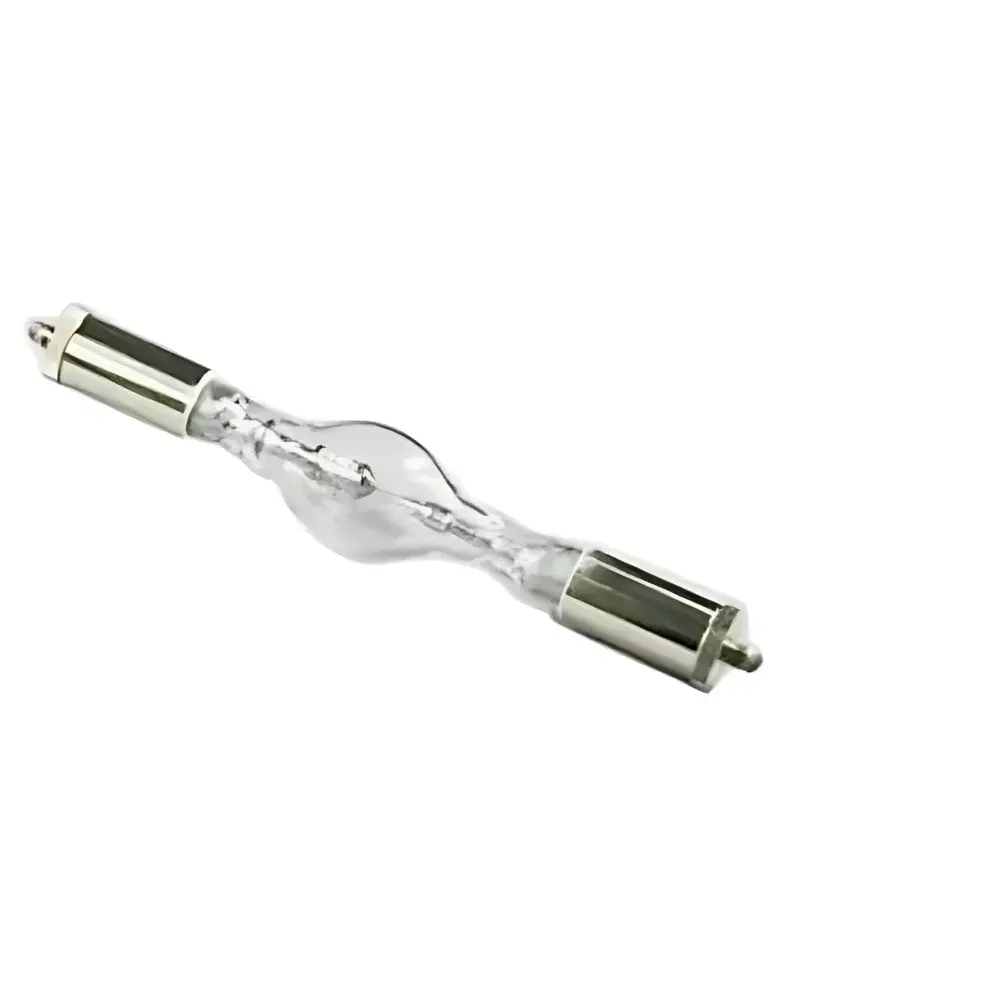
Xenon Arc Lamp Bulb, Spherical Type, CE-Approved for Photocatalytic Research
| Brand | CEL |
|---|---|
| Origin | Beijing, China |
| Manufacturer | CEA Light Co., Ltd. |
| Type | Spherical Xenon Arc Lamp |
| Component Category | Optical Element |
| Compliance | CE-marked, RoHS-compliant |
Overview
The Spherical Xenon Arc Lamp Bulb is a high-intensity, short-arc discharge light source engineered for precision optical applications in photocatalytic research, solar simulation, and spectral calibration. Operating on the principle of xenon gas ionization under high-voltage DC or pulsed excitation, this lamp delivers a continuous, near-daylight spectral output (200–2500 nm) with exceptional spatial stability and radiometric reproducibility. Its spherical envelope geometry—combined with precise electrode alignment and fused silica quartz construction—ensures minimal divergence, high luminance uniformity, and optimal coupling into monochromators, integrating spheres, and collimation optics. Designed to meet the stringent demands of laboratory-grade photoreactor systems, it serves as a primary irradiation source in ASTM E2687-compliant photocatalytic activity testing and ISO 10678:2010 UV–vis irradiance validation protocols.
Key Features
- Spherical quartz envelope (Ø 12–15 mm) with <1 µm electrode tip tolerance for stable arc anchoring and minimized flicker
- DC or pulsed operation compatible with standard 300–1000 W power supplies (e.g., CEL-PF300, OAI Series)
- UV-transmitting fused silica (Suprasil-grade) with >90% transmission at 254 nm and >85% at 185 nm
- Rated lifetime ≥ 1,000 hours at nominal current (±5% intensity drift over rated life)
- CE-marked and RoHS-compliant; designed for integration into Class I laser safety-compliant enclosures per IEC 60825-1
- Thermal management optimized for vertical or horizontal orientation; maximum ambient operating temperature: 40 °C
Sample Compatibility & Compliance
This lamp is fully compatible with standard optical mounts (SM1, SM2 threading), liquid light guides (600 µm–1000 µm core), and front-surface mirror couplers used in benchtop photoreactors (e.g., CEL-PCR, Newport 9119x). It meets key regulatory benchmarks for research instrumentation: compliance with IEC 62471 (Photobiological Safety), adherence to ISO/IEC 17025 calibration traceability requirements when paired with NIST-traceable radiometers, and suitability for GLP environments where instrument qualification (IQ/OQ/PQ) documentation is required. The bulb’s spectral stability enables direct use in USP and ISO 10993-12 photocatalytic biocompatibility studies.
Software & Data Management
While the lamp itself is a passive optical component, its performance is monitored and validated using industry-standard radiometric software suites—including Ocean Insight OceanView, Thorlabs ThorImage, and Labsphere SpectraSuite—when integrated with calibrated spectroradiometers (e.g., ILT950, CAS 140D). Intensity drift and spectral shift data are logged via timestamped spectral scans for audit-ready records compliant with FDA 21 CFR Part 11 when deployed within validated photoreactor control systems. All operational parameters (lamp voltage, current, cooling airflow, and accumulated runtime) are accessible through host system SCADA interfaces or analog/digital I/O modules.
Applications
- Quantitative photocatalytic degradation assays (e.g., methylene blue, rhodamine B under simulated solar irradiance)
- Photoelectrochemical cell (PEC) characterization under AM1.5G-equivalent spectra
- Accelerated aging tests per ISO 4892-2 for UV-stable material development
- Calibration reference for UV–vis–NIR spectrophotometers and hyperspectral imaging systems
- In situ time-resolved emission spectroscopy in transient absorption setups
- Light source for fluorescence lifetime imaging microscopy (FLIM) excitation channels
FAQ
What is the recommended warm-up time before spectral stabilization?
Typically 15–20 minutes under constant-current operation to achieve <±0.5% irradiance stability across the 300–800 nm band.
Can this lamp be used in ozone-generating configurations?
Yes—when operated below 200 nm cutoff (e.g., with MgF₂ windows), it supports ozone generation for advanced oxidation process (AOP) studies.
Is replacement lamp alignment required after installation?
Yes—precise centering and focal point adjustment relative to the reflector or collimator is essential; alignment fixtures and alignment lasers are recommended per manufacturer’s optical setup guide.
Does the lamp require forced-air or water cooling?
For continuous operation above 500 W, active air cooling (≥20 CFM) is mandatory; water cooling is advised for >750 W systems to maintain quartz envelope thermal gradient <15 °C/mm.
How is lamp lifetime defined and measured?
Lifetime is defined as the operating duration until luminous flux drops to 80% of initial value under specified electrical and thermal conditions, verified per IES LM-49 test methodology.



