
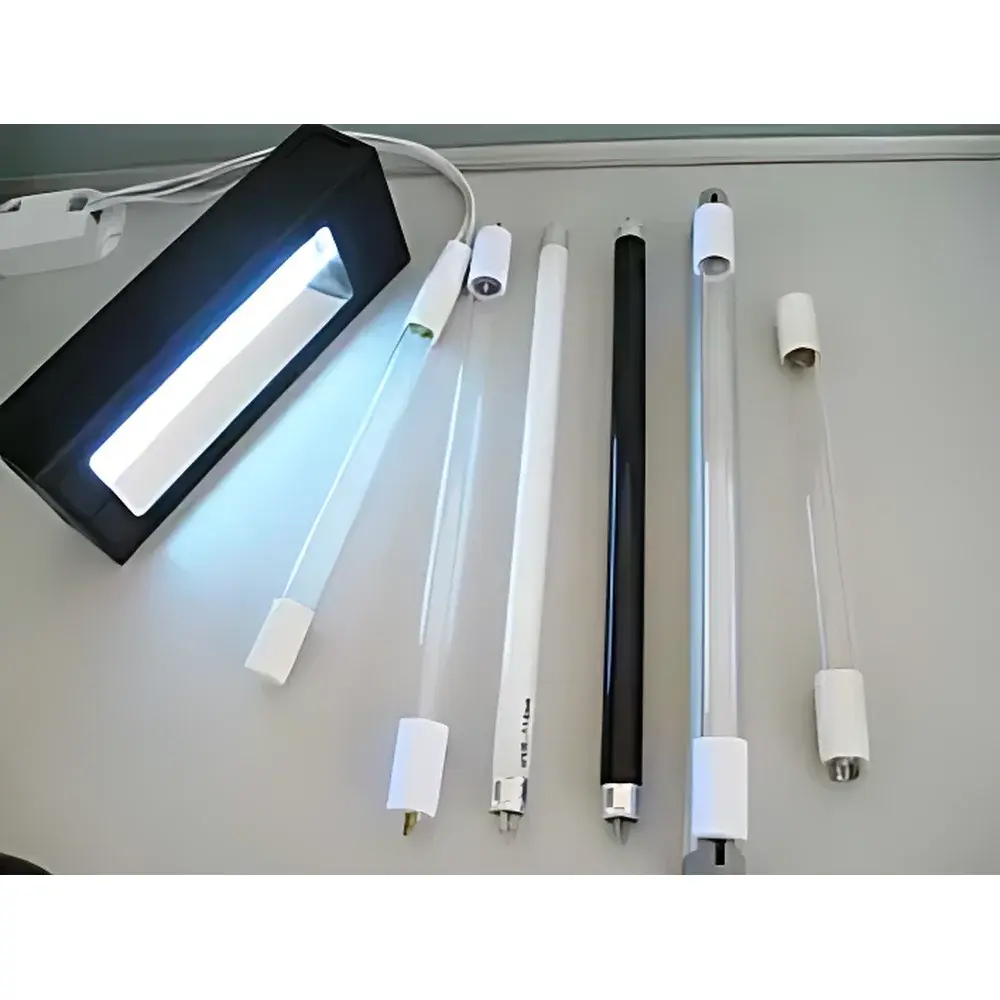
CME-10W/20W/120W Low-Pressure Mercury Lamp System
| Brand | CME (China Education Goldsource) |
|---|---|
| Origin | Beijing, China |
| Manufacturer Type | OEM Manufacturer |
| Product Origin | Domestic (PRC) |
| Model Options | 10W, 20W, 120W |
| Pricing | Available Upon Request |
Overview
The CME-10W/20W/120W Low-Pressure Mercury Lamp System is a precision-engineered ultraviolet (UV) light source designed for controlled photochemical, photobiological, and materials testing applications in research laboratories and quality control environments. Operating on the principle of low-pressure mercury vapor discharge, the system emits characteristic spectral lines—primarily at 253.7 nm (strongest UVC line), with secondary peaks at 184.9 nm, 365.0 nm (UVA), and 404.7 nm (visible)—enabling selective excitation across UV-C, UV-A, and visible ranges. Unlike broadband sources, this lamp delivers high-spectral-purity output with narrow emission bandwidths (<1 nm FWHM at 253.7 nm), ensuring reproducible irradiance profiles essential for standardized photolysis, polymerization initiation, UV curing validation, and germicidal efficacy studies. The system integrates a stabilized DC or AC power supply with current regulation to maintain consistent arc stability and spectral output over extended operational cycles—critical for time-resolved kinetic experiments and long-duration exposure protocols.
Key Features
- Three standardized power configurations (10W, 20W, 120W) enabling scalable irradiance output from 15 mW/cm² (at 10 cm working distance, depending on collimation and filter setup)
- Quartz envelope with optional MgF₂ windows for enhanced transmission below 190 nm (e.g., for 184.9 nm ozone generation)
- Integrated thermal management system—including aluminum heat sinks and forced-air cooling for 120W variant—to sustain stable lamp wall temperature (<40 °C) and minimize spectral drift
- Electromagnetic interference (EMI)-shielded housing compliant with IEC 61000-6-3 for use in electromagnetically sensitive instrumentation labs
- Modular mechanical design supporting interchangeable lamp housings, beam collimators, and optical filters (e.g., bandpass, longpass, or dichroic)
- CE-marked power supply with over-current, over-voltage, and short-circuit protection; meets EN 61000-3-2 harmonic current limits
Sample Compatibility & Compliance
The system accommodates standard 18 mm and 25 mm outer-diameter quartz or fused silica cuvettes, petri dishes (up to 100 mm diameter), and flat-panel substrates via adjustable sample stage mounts. It supports both static and dynamic exposure modes—ideal for UV aging tests per ISO 4892-3 (fluorescent UV lamps), ASTM G154 (UV condensation exposure), and ISO 11507 (UV exposure of plastics). Lamp spectral output is traceable to NIM (National Institute of Metrology, China) calibration standards. When configured with calibrated radiometers (e.g., ILT950UV), the system enables compliance with ISO/IEC 17025-accredited UV irradiance measurement workflows. Optional accessories include shutter controllers with TTL triggering for synchronization with spectrophotometers or time-resolved fluorescence detectors.
Software & Data Management
While the base lamp system operates as a stand-alone hardware unit, it is fully compatible with third-party data acquisition platforms including LabVIEW, MATLAB, and Python-based control frameworks via analog voltage input (0–5 V) for intensity modulation and digital I/O (TTL) for external triggering. For regulated environments, integration with LIMS or ELN systems is supported through RS-485 or USB-to-serial interfaces using Modbus RTU protocol. Audit trails—including lamp ignition count, cumulative operating hours, and thermal sensor logs—can be exported in CSV format. When deployed in GLP or GMP contexts, the system satisfies FDA 21 CFR Part 11 requirements when paired with validated electronic signature and access-control software layers.
Applications
- Photocatalytic degradation kinetics (e.g., TiO₂-mediated organic pollutant decomposition under UVC)
- UV crosslinking optimization for hydrogels, dental composites, and inkjet inks
- Germicidal validation studies (log-reduction assays against S. aureus, E. coli, and B. subtilis spores per ISO 15714)
- Photoresist sensitivity characterization in microfabrication R&D
- Accelerated weathering of polymer films and coatings per ASTM D4329
- Calibration reference source for UV radiometers and spectroradiometers
FAQ
What is the typical lifetime of the low-pressure mercury lamp under continuous operation?
Rated average life is 5,000 hours for 10W/20W models and 3,000 hours for the 120W model, based on IEC 60064 test conditions (3-hour ON / 20-minute OFF cycling). Lifetime decreases linearly with ambient temperature above 35 °C.
Can the system be operated in vacuum or inert gas environments?
Yes—quartz envelope variants are rated for operation under nitrogen or argon purge (≤0.1 MPa gauge pressure); vacuum-compatible versions with metal-sealed electrodes are available upon request.
Is spectral output data provided with each lamp unit?
Each lamp undergoes factory spectral verification using a calibrated CCD-based spectroradiometer; full spectral irradiance curves (200–450 nm, 0.5 nm resolution) are supplied digitally with shipment.
Does the system meet international safety standards for UV radiation exposure?
The enclosure includes interlocked UV-shielded viewing ports and automatic lamp cutoff upon door opening, conforming to IEC 62471 (Photobiological Safety of Lamps) Risk Group 3 classification for unfiltered output—requiring Class 3B laser safety protocols during open-beam use.



