
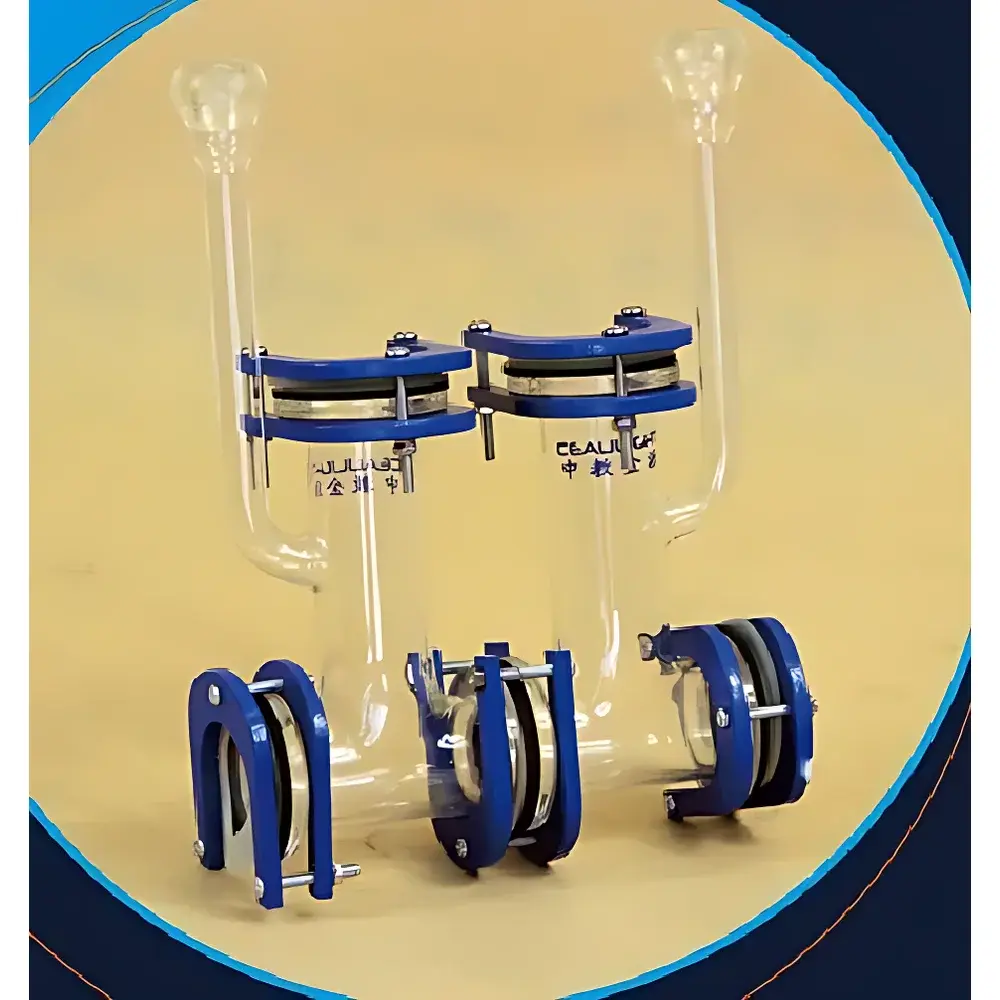
CEL-HT3 H-Type Photoelectrochemical Cell
| Brand | CEL (China Education Goldsource) |
|---|---|
| Model | CEL-HT3 / CEL-HT3L |
| Origin | Beijing, China |
| Manufacturer Type | Direct Manufacturer |
| Regional Classification | Domestic (PRC) |
| Interface Standard | Flanged Connection (CEL-HT3: Standard Ground Joint |
| CEL-HT3L | 19/26 Standard Tapered Joint) |
| Optical Window Material (Standard) | Fused Silica (Quartz) |
| Optional Window Materials | CaF₂, KBr |
| Ion-Exchange Membrane Compatible | Yes |
| Electrode Compatibility | External Diameter ≤ 6 mm |
| Customization Available | Yes |
| Pricing | USD 1,680 (FOB Beijing, ex. VAT & shipping) |
Overview
The CEL-HT3 H-Type Photoelectrochemical Cell is a precision-engineered dual-compartment electrochemical reactor designed for controlled, in situ photoelectrochemical (PEC) characterization under irradiation. Based on the classical H-cell configuration, it physically separates the anodic and cathodic compartments via a central frit or ion-exchange membrane—enabling independent control of electrolyte composition, pH, and redox environment while maintaining ionic continuity. The cell operates on the principle of photoinduced charge carrier generation and separation at semiconductor–electrolyte interfaces, making it essential for quantifying photocurrent density, incident photon-to-current efficiency (IPCE), applied bias photon-to-current efficiency (ABPE), and long-term stability under simulated solar illumination (AM 1.5G). Its flanged mechanical design ensures vacuum-tight and pressure-stable operation, supporting both potentiostatic and galvanostatic modes when integrated with standard bipotentiostats or source-measure units (SMUs).
Key Features
- Modular dual-chamber architecture with removable central partition—compatible with Nafion® 117, Fumasep® FKS, or custom-synthesized ion-selective membranes
- Optically transparent windows mounted on precision-machined stainless steel or PTFE-coated aluminum flanges—standard fused silica (UV-grade quartz, transmission >85% from 190–2500 nm)
- Interchangeable optical windows: CaF₂ (deep UV extension to 125 nm), KBr (IR-transmissive up to 25 µm), or MgF₂ for VUV applications
- Electrode ports engineered for 6 mm OD cylindrical electrodes (working, counter, reference)—with O-ring sealed feedthroughs ensuring electrolyte isolation
- CEL-HT3 variant features ground-glass spherical joints (e.g., 24/29 or 34/45) for direct coupling to optical fiber collimators or gas-circulation manifolds; CEL-HT3L substitutes these with ISO-KF 19 standard conical joints for compatibility with modular vacuum/gas-handling systems
- Full customization path available—including volume scaling (5–100 mL per chamber), inlet/outlet port repositioning, integrated temperature-jacketing, and inert-atmosphere glovebox integration
Sample Compatibility & Compliance
The CEL-HT3 series accommodates heterogeneous photocatalysts (e.g., TiO₂, g-C₃N₄, BiVO₄ thin films deposited on FTO/ITO substrates), suspended nanoparticle slurries (with optional magnetic stirring inserts), and molecular photosensitizers in aqueous or non-aqueous electrolytes (e.g., 0.1 M Na₂SO₄, LiClO₄ in acetonitrile). All wetted components comply with ASTM F838-22 (bacterial retention testing for filters) for membrane integrity validation and meet ISO 8573-1 Class 4 purity requirements when used with compressed gas purging. The cell’s construction avoids leachable metals—critical for trace-metal-sensitive reactions such as CO₂ reduction or N₂ fixation—and supports GLP-compliant experimental documentation when paired with validated data acquisition protocols.
Software & Data Management
While the CEL-HT3 is a hardware-only platform, it is fully interoperable with industry-standard electrochemical workstations (e.g., BioLogic SP-300, CHI 760E, PalmSens EmStat GO) and spectroscopic controllers (Ocean Insight USB4000, Hamamatsu C12880MA). When deployed within a full photoelectrochemical evaluation system (e.g., CEL-PECRS series), it integrates with proprietary software enabling synchronized light-source triggering, chronoamperometric stepping, wavelength-resolved IPCE mapping, and automated dark/light cycling with timestamped metadata logging. All raw current/voltage/time datasets are exported in IEEE 488.2-compliant ASCII or HDF5 format, supporting traceability per FDA 21 CFR Part 11 when audit trails and electronic signatures are enabled on host instrumentation.
Applications
- Quantitative assessment of photoanode/cathode materials for solar fuel generation (H₂ evolution, CO₂-to-CO conversion, NO₃⁻ reduction)
- Stability benchmarking under operational conditions—measuring Faradaic efficiency decay over ≥10 h via online GC-TCD/FID coupling
- Mechanistic studies of interfacial charge transfer kinetics using intensity-modulated photocurrent spectroscopy (IMPS) and intensity-modulated photovoltage spectroscopy (IMVS)
- Evaluation of co-catalyst loading effects on onset potential shift and charge recombination suppression
- Correlation of optical absorption edge (via in situ UV-Vis diffuse reflectance) with photoelectrochemical onset potential
- Education and method development in university-level physical electrochemistry laboratories
FAQ
What is the maximum operating temperature and pressure range for the CEL-HT3 cell?
The standard configuration is rated for continuous operation up to 80 °C and 1 bar (gauge); optional high-temp flange seals and borosilicate glass variants extend this to 120 °C and 3 bar.
Can the CEL-HT3 be used under anaerobic conditions?
Yes—integrated gas-purging ports (inlet/outlet) support continuous N₂ or Ar sparging; optional Schlenk-line adapters and vacuum-rated O-rings enable <1 ppm O₂ environments.
Is electrode alignment adjustable within the chamber?
The working electrode position is fixed relative to the optical window axis (±0.2 mm tolerance); however, custom electrode holders with XYZ micropositioning are available upon request.
Does the cell support three-electrode or two-electrode configurations?
Both are supported: the standard layout uses separate WE, CE, and RE ports; a two-electrode variant (WE/CE combined) can be configured by omitting the reference port and using external Ag/AgCl quasi-reference.
How is light uniformity ensured across the photoactive area?
The quartz window exhibits <0.1% wavefront distortion (λ/10 @ 633 nm); collimated illumination (±5° half-angle) is recommended, and beam profiling reports are provided with optional calibration kits.
Related Products



