
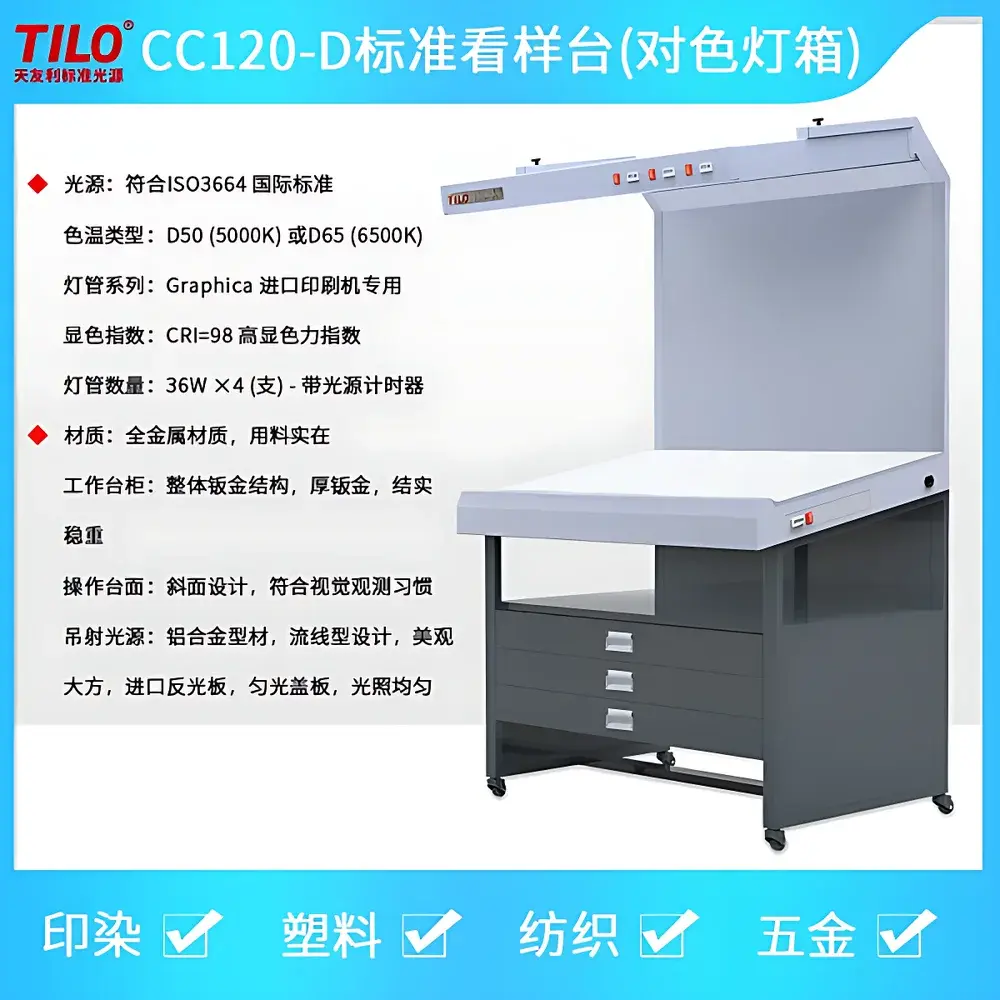
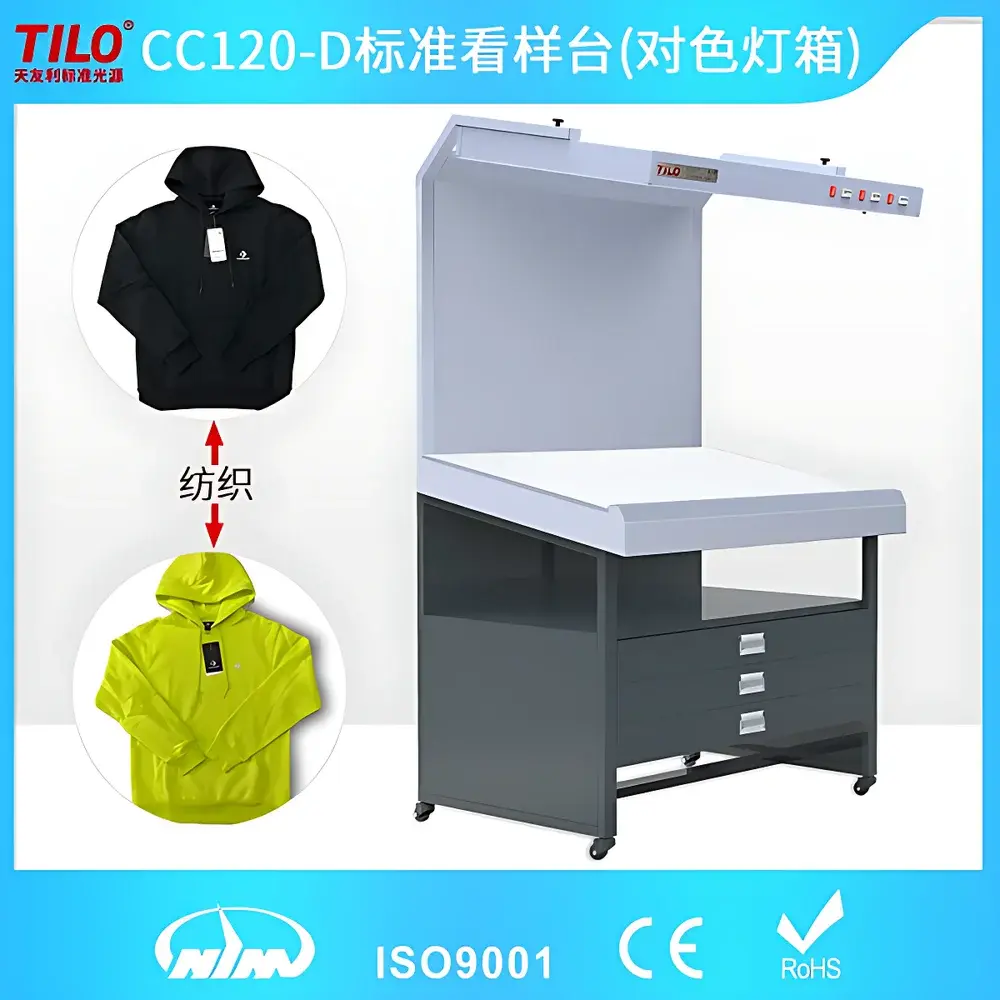
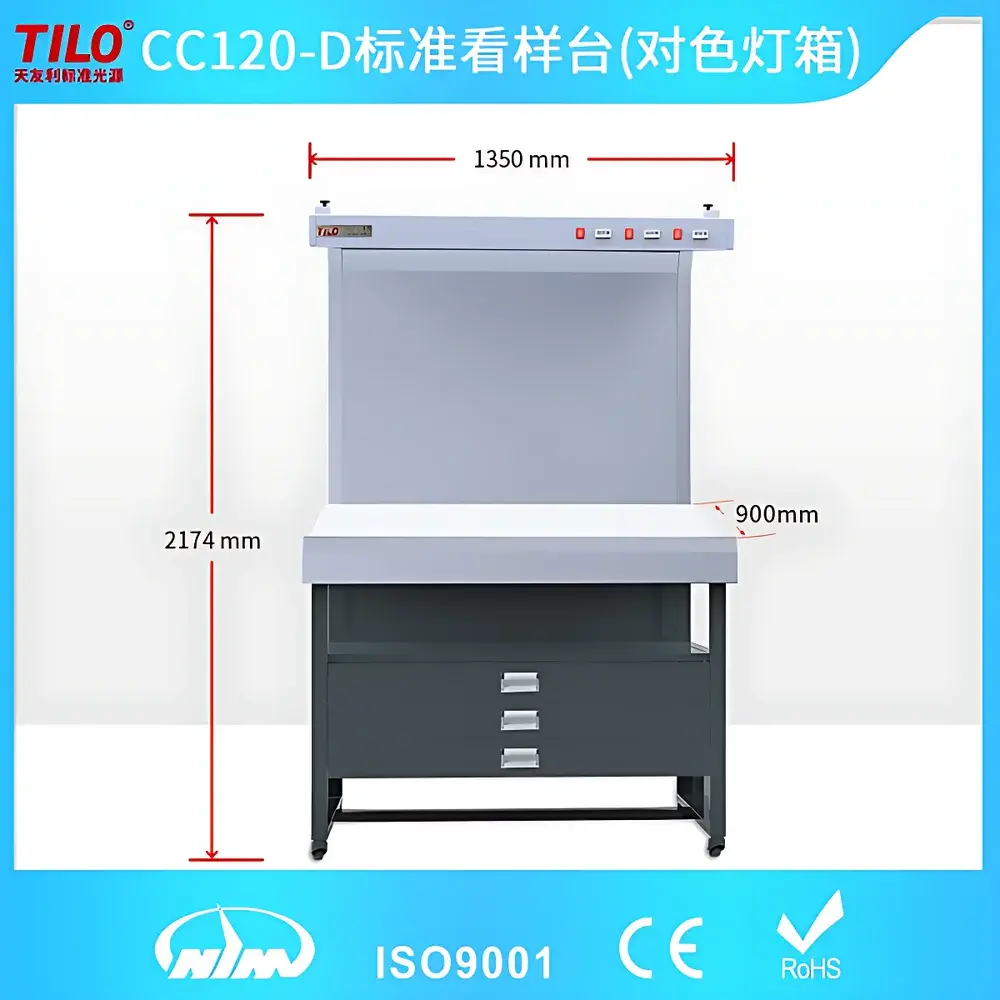
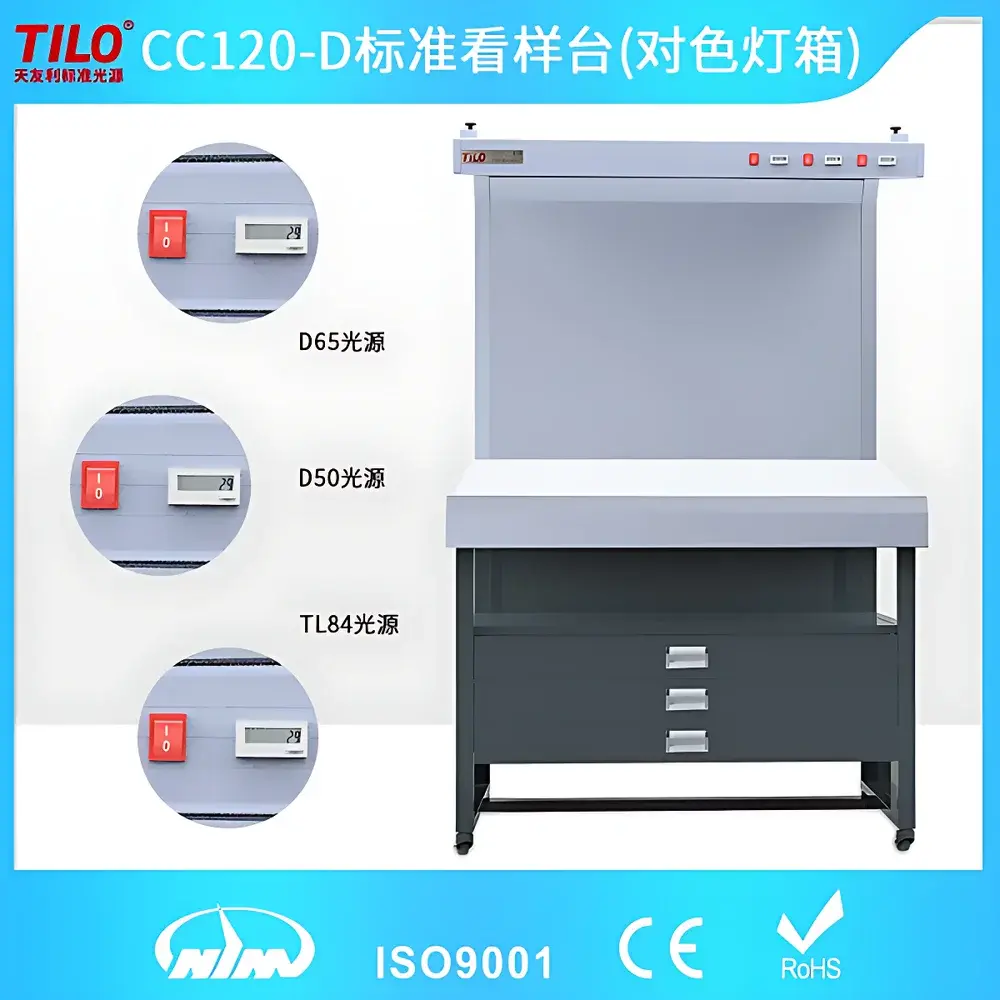
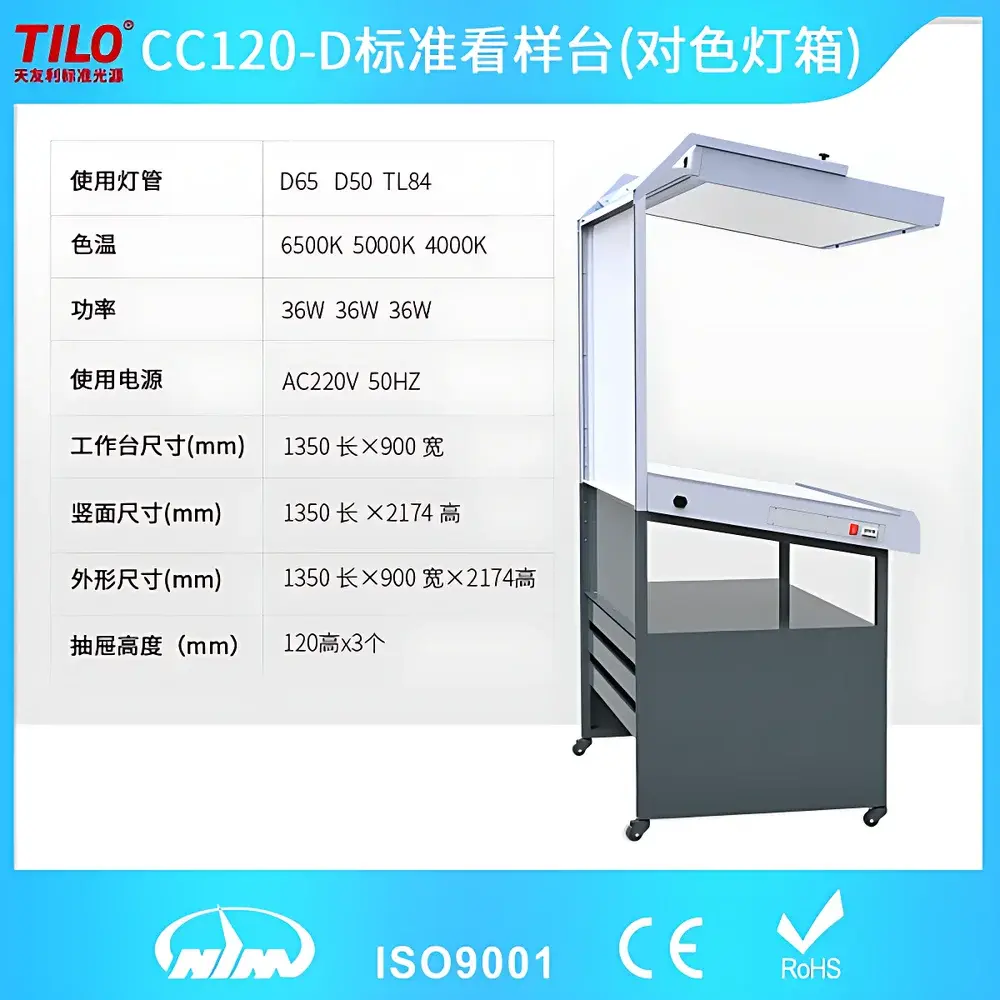
TILO CC120-D Dual-Mode Reflective/Transmissive Standard Light Booth
| Brand | TILO |
|---|---|
| Model | CC120-D |
| Light Sources | Single / Dual / Triple Configurable |
| CRI (Ra) | ≥98 |
| Compliance | ISO 3664:2009 |
| Construction | Full Metal Chassis with Reinforced Steel Panels |
| Viewing Area | A2 Format (420 × 594 mm) |
| Illumination Uniformity | ±5% across viewing surface |
| Lamp Timer | Integrated Digital Hour Counter |
| Light Source Type | Graphica Series High-CRI Fluorescent Tubes |
| Mounting | Ceiling-Suspended or Benchtop-Compatible Aluminum Extrusion Frame |
| Reflective/Transmissive Mode | Switchable via Removable Backlight Panel and Diffuser Assembly |
Overview
The TILO CC120-D Dual-Mode Reflective/Transmissive Standard Light Booth is an engineered color evaluation workstation designed for precise visual color assessment in controlled illumination environments. It operates on the fundamental principle of standardized metamerism assessment—enabling observers to evaluate color appearance under multiple defined spectral power distributions (SPDs), thereby detecting metamerism, illuminant dependency, and observer variability. Engineered to meet ISO 3664:2009 requirements for graphic technology and photography, the CC120-D delivers photometric stability, spectral fidelity, and geometric consistency essential for prepress proofing, pressroom verification, and quality assurance workflows. Its dual-mode architecture supports both reflective sample inspection (e.g., printed sheets, coated substrates) and transmissive evaluation (e.g., film positives, backlit signage, transparent packaging), eliminating the need for separate dedicated booths in integrated print production facilities.
Key Features
- Dual-mode optical configuration: Seamless transition between reflective and transmissive viewing via tool-free removal of the rear diffuser panel and activation of the integrated backlight module.
- Graphica-series high-CRI fluorescent lamps (CRI Ra ≥98), specifically formulated for graphic arts applications to replicate D50, D65, and TL84 spectral profiles with minimal deviation from CIE reference illuminants.
- Full-metal structural chassis constructed from 1.5 mm cold-rolled steel panels, providing mechanical rigidity, electromagnetic shielding, and long-term dimensional stability under continuous thermal cycling.
- Ergonomic inclined viewing surface (25° tilt angle) aligned with ISO 3664 recommended observation geometry, reducing parallax error and minimizing observer fatigue during extended evaluation sessions.
- Integrated digital lamp-hour counter per light source channel, enabling predictive maintenance scheduling and compliance documentation for ISO 9001 and ISO 15378 audit trails.
- Uniform illumination distribution (±5% spatial uniformity across A2-format viewing area), achieved through precision-machined aluminum reflectors and opal polycarbonate diffuser optics.
Sample Compatibility & Compliance
The CC120-D accommodates standard A2-sized substrates (420 × 594 mm), including coated/uncoated paper, cardboard, flexographic films, gravure cylinders (via flat-mounted proofing sheets), textile swatches, plastic injection-molded parts, and anodized metal samples. Its optical design conforms strictly to ISO 3664:2009 Annex A specifications for illuminance (2000 ± 500 lx at viewing plane), UV content control (<0.1% relative to visible irradiance), and surround conditions (Munsell N8 neutral surround). The booth satisfies prerequisite conditions for ISO 13655:2017 (spectral measurement of printed color) and supports implementation of ISO 12647-2:2013 process standard controls. It is routinely deployed in facilities maintaining G7-certified grayscale calibration protocols and serves as a foundational element in ANSI IT8.7-based color management system validation.
Software & Data Management
While the CC120-D is a hardware-only visual assessment platform, its operational parameters are fully traceable and documentable within enterprise quality management systems (QMS). Lamp usage hours, source activation logs, and calibration verification records (per ISO/IEC 17025 clause 6.4.10) can be exported manually for inclusion in FDA 21 CFR Part 11–compliant audit trails when integrated with laboratory information management systems (LIMS) or electronic batch record (EBR) platforms. Optional TILO-branded calibration verification kits—including certified reference tiles (NIST-traceable L*a*b* values) and spectral irradiance meters—are available to support periodic performance verification per ISO 13655 Annex B.
Applications
- Prepress proof-to-press validation in commercial offset, flexo, and gravure printing operations.
- Color approval sign-off for brand-critical packaging (e.g., pharmaceutical blister cards, FMCG labels) under D50/D65/UV-A lighting conditions.
- Textile dye lot matching under FWA-compensated illumination (TL84 + UV) in accordance with AATCC Evaluation Procedure 1.
- Plastic part color consistency checks across injection molding batches, supporting PPAP submissions per AIAG standards.
- Automotive interior trim evaluation against OEM color specification sheets under metamerism-sensitive illuminants (e.g., Horizon, CWF).
- Academic and industrial R&D labs conducting psychophysical color difference studies (ΔE00, ΔEcmc) under controlled viewing geometry.
FAQ
Does the CC120-D support D50 illumination for ISO 12647-compliant proof viewing?
Yes. The Graphica D50 lamp set meets ISO 3664:2009 spectral and irradiance requirements for graphic arts applications, including tolerance limits for CCT (5000 K ± 200 K) and UV content.
Can the booth be integrated into a GLP/GMP environment with full traceability?
Yes. Lamp-hour counters, physical calibration certificates, and documented verification procedures satisfy ISO/IEC 17025 and FDA 21 CFR Part 11 data integrity requirements when maintained within a validated QMS.
Is the transmissive mode suitable for evaluating transparency and haze in PET films?
The CC120-D provides uniform backlighting appropriate for qualitative transparency assessment and gross haze detection; however, quantitative haze measurement requires ASTM D1003-compliant instrumentation.
What maintenance schedule is recommended for lamp replacement?
Graphica lamps should be replaced after 2000 hours of cumulative operation per tube, as tracked by the integrated hour counter—consistent with ISO 3664:2009 lamp aging recommendations.
Does TILO provide third-party calibration certification?
Yes. Accredited calibration services (ISO/IEC 17025) are available upon request, including spectral irradiance mapping and CRI verification reports issued by CNAS-accredited laboratories.




