
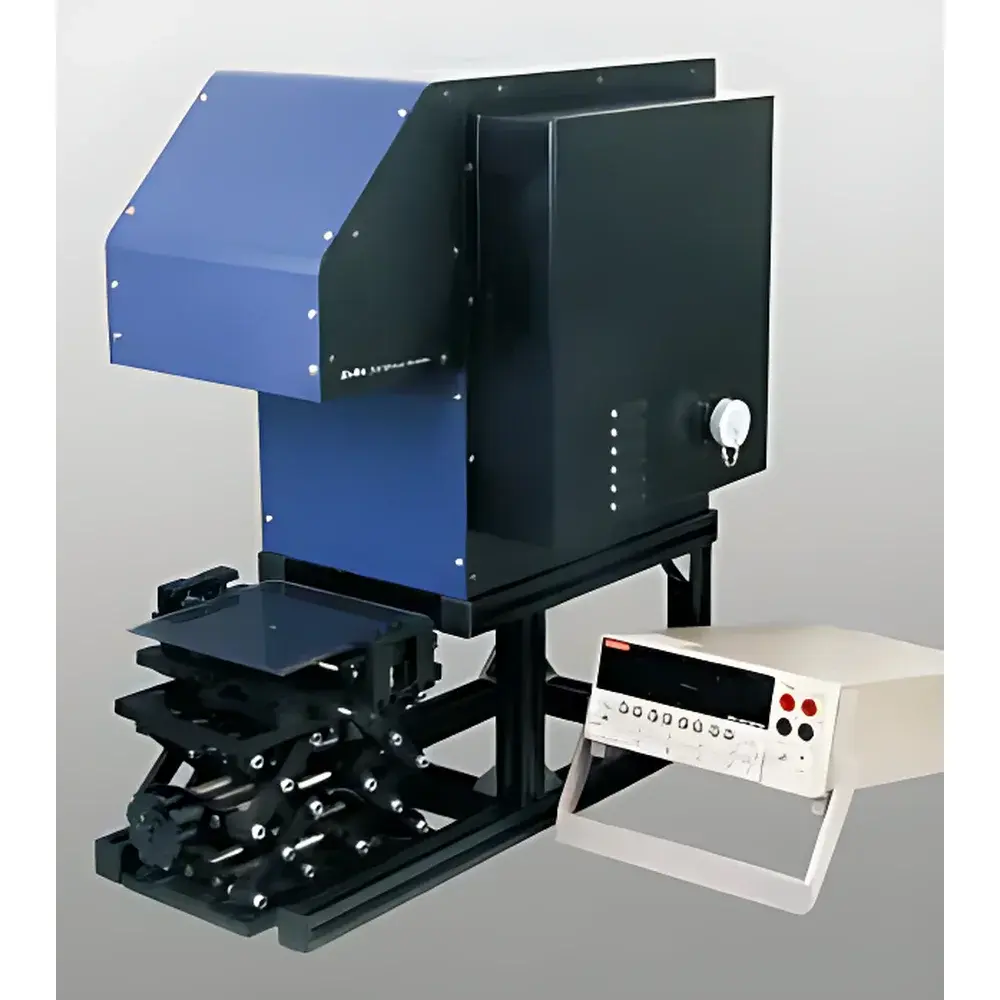
CEL-IV Solar Cell I-V Characterization System by CEA-Light
| Brand | CEA-Light |
|---|---|
| Model | CEL-IV |
| Origin | Beijing, China |
| Manufacturer Type | Original Equipment Manufacturer (OEM) |
| Automation Level | Fully Automated |
| Compliance | IEC 61215, IEC 61646, IEC 60904-1, IEC 60904-3 |
| Measurement Modes | Light I-V & Dark I-V |
| Data Export Formats | Excel (.xlsx), ASCII (.txt), XML (.xml) |
| Software Interface | Graphical User Interface (GUI) with Real-time Curve Rendering |
| Sample Fixation | Vacuum Chuck |
| Temperature Control | Integrated Peltier-based Thermal Stage (±0.5 °C stability) |
| Probe Design | Low-Shadow Four-Point Kelvin Probes |
Overview
The CEL-IV Solar Cell I-V Characterization System is a fully automated, laboratory-grade instrument engineered for precise current–voltage (I–V) performance evaluation of photovoltaic (PV) devices under standard test conditions (STC) and controlled ambient environments. Based on the fundamental principle of source-measure unit (SMU)-driven voltage sweep with simultaneous high-resolution current acquisition, the system implements a four-quadrant biasing architecture to capture both forward and reverse bias characteristics—essential for evaluating recombination losses, shunt resistance (Rsh), series resistance (Rs), and diode ideality factor. Designed in strict alignment with IEC 60904-1 (photovoltaic device measurement procedures) and IEC 60904-3 (reference solar spectral irradiance), the CEL-IV enables traceable, repeatable, and metrologically sound characterization required for R&D validation, quality assurance, and certification pre-screening.
Key Features
- Fully automated I–V sweep execution with programmable voltage ramp rate, step resolution, and dwell time per point—supporting both light and dark measurements without manual intervention
- Integrated Peltier-controlled thermal stage maintaining ±0.5 °C uniformity across sample surface, enabling compliance with IEC-defined STC (25 °C, 1000 W/m², AM1.5G spectrum)
- Low-shadow, spring-loaded Kelvin probe array minimizing contact-induced shading errors and ensuring accurate current collection from small-area or textured solar cells
- Vacuum chuck sample holder accommodating rigid and flexible substrates up to 200 mm × 200 mm with adjustable vacuum pressure (10–80 kPa)
- Real-time curve rendering and on-the-fly parameter extraction—including Voc, Isc, Jsc, Vmp, Imp, FF, η, Rs, and Rsh
- Dark current subtraction algorithm to isolate photogenerated current from leakage components, critical for thin-film and perovskite device analysis
- Standard solar cell calibration interface supporting certified reference cells (e.g., KG5-filtered Si, GaAs, or c-Si references) with spectral mismatch correction per IEC 60904-7
Sample Compatibility & Compliance
The CEL-IV supports a broad range of PV technologies: crystalline silicon (c-Si), heterojunction (HJT), cadmium telluride (CdTe), copper indium gallium selenide (CIGS), organic photovoltaics (OPV), and metal-halide perovskites. Its mechanical design accommodates planar, textured, and semi-transparent architectures with thicknesses from 100 µm to 3 mm. All measurement protocols adhere to IEC 61215 (terrestrial PV module qualification), IEC 61646 (thin-film module qualification), and ISO/IEC 17025-accredited laboratory workflows. The system’s firmware includes audit-trail logging compliant with GLP and GMP documentation requirements, with timestamped operator ID, environmental sensor readings (temperature, irradiance), and calibration history embedded in each exported dataset.
Software & Data Management
The proprietary IVLab software provides a Windows-based GUI with intuitive workflow navigation, multi-sample batch sequencing, and customizable report templates. Raw I–V data are stored in HDF5 format for long-term integrity and metadata-rich archiving. Export modules support Excel (.xlsx) for spreadsheet integration, ASCII (.txt) for third-party modeling tools (e.g., SCAPS, PC1D), and XML (.xml) for LIMS interoperability. All reports include header metadata (test date, operator, ambient conditions, calibration certificate ID), annotated I–V plots with legend overlays, tabulated parameters with uncertainty estimates (based on SMU accuracy class), and pass/fail flags against user-defined specification limits. Software updates are delivered via secure HTTPS with SHA-256 signature verification.
Applications
- R&D labs performing comparative efficiency benchmarking across novel absorber materials and interfacial layer stacks
- Manufacturing QA/QC departments conducting 100% inline screening of mini-modules prior to lamination
- Independent testing laboratories preparing IEC-compliant test reports for TÜV Rheinland, UL, or CSA certification submissions
- University teaching laboratories demonstrating fundamental PV physics—including Shockley diode equation fitting and recombination mechanism analysis
- Field-deployable validation of accelerated aging studies (e.g., damp heat, thermal cycling) using portable reference illumination sources
FAQ
Does the CEL-IV support pulsed-light I–V measurements for minimizing heating artifacts?
Yes—the system offers optional gated sweep mode synchronized with external flash simulators (e.g., Class AAA solar simulators), enabling transient I–V capture within 10–100 ms windows.
Can it be integrated into an existing automation line via industrial communication protocols?
Yes—it supports Modbus TCP and Ethernet/IP interfaces for PLC-level coordination, including start/stop commands, status polling, and error code reporting.
Is NIST-traceable calibration documentation provided with shipment?
Yes—each unit ships with a factory calibration certificate referencing NIST-traceable standards for voltage (Fluke 732B), current (Keysight B2902A), and irradiance (NIST-calibrated reference cell + spectroradiometer).
What is the maximum sample size supported without optical field-of-view truncation?
The standard probe station accommodates samples up to 200 mm × 200 mm; larger formats require optional extended-stage configuration with recalibrated illumination uniformity mapping.
How does the system handle spectral mismatch correction during reference cell calibration?
It implements the IEC 60904-7 methodology using user-uploaded EQE data or built-in spectral response libraries for Si, GaAs, and perovskite reference cells, applying weighted correction factors to measured Jsc.
Related Products






