
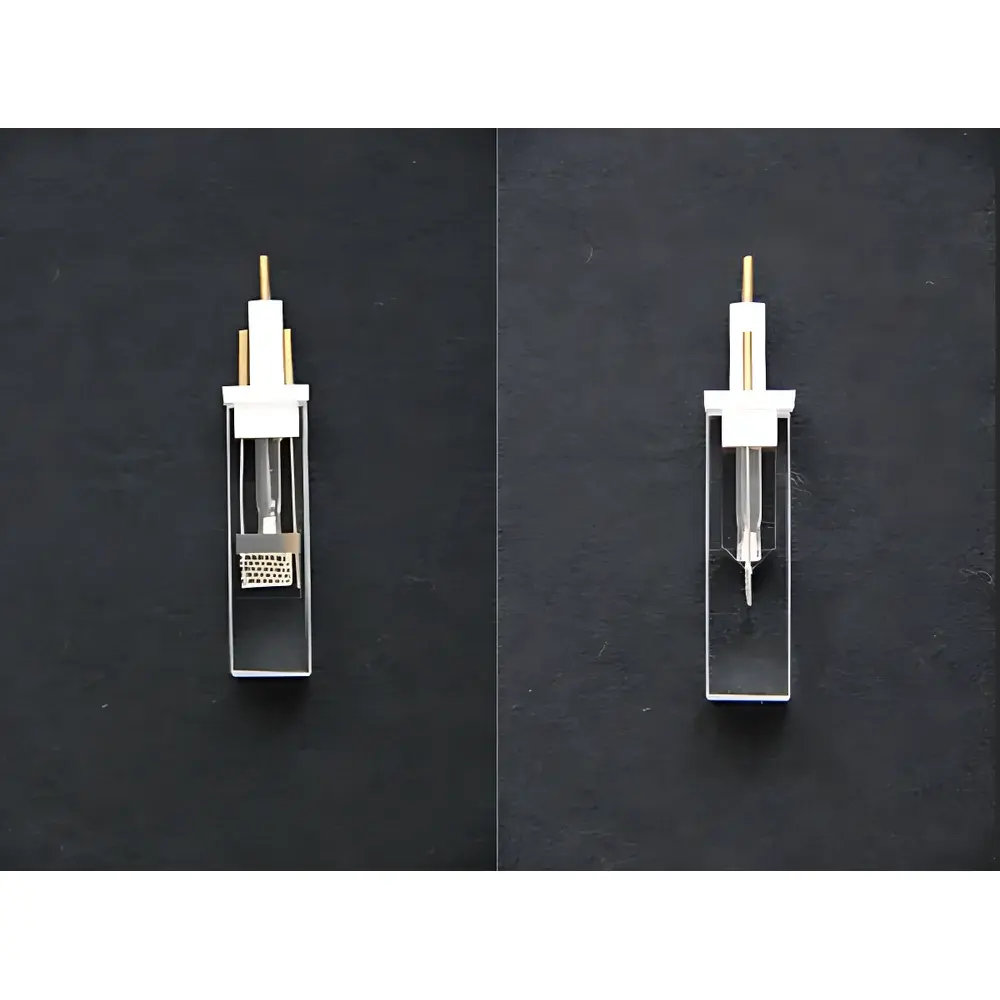
Zhongjiaojinyuan PECK03 Spectroelectrochemical Cell
| Brand | Zhongjiaojinyuan |
|---|---|
| Origin | Beijing, China |
| Manufacturer Type | Direct Manufacturer |
| Product Category | Domestic |
| Model | PECK03 |
| Price | USD 335 (excl. VAT & shipping) |
| Component Type | Optical Element |
| Cell Dimensions | 8 mm × 6.5 mm × 1 mm |
| Optical Window Material | Fused Silica (UV-grade) |
| Cap Material | PTFE |
| Electrode Configuration | Pt mesh working electrode, Pt wire counter electrode, Ag/AgCl reference electrode |
| Optical Path | Four-sided transparent |
| Compatible Techniques | In situ UV-Vis absorption spectroscopy, fluorescence spectroscopy, IPCE (Incident Photon-to-Current Efficiency) measurement |
Overview
The Zhongjiaojinyuan PECK03 Spectroelectrochemical Cell is an optically transparent, three-electrode electrochemical flow cell engineered for simultaneous electrochemical control and optical interrogation in the ultraviolet–visible (UV–Vis) spectral range. Designed around a planar, rectangular microcuvette geometry with dimensions of 8 mm × 6.5 mm × 1 mm, the cell enables precise in situ and operando spectroscopic monitoring during potentiostatic or galvanostatic experiments. Its core architecture leverages fused silica (synthetic quartz) for all four optical windows—ensuring high transmission from 190 nm to 2500 nm—and a chemically inert, low-outgassing PTFE cap that maintains electrolyte containment while permitting electrical feedthroughs for electrode connections. Unlike conventional sealed cells, the PECK03 supports both static and quasi-flow configurations, making it suitable for kinetic studies requiring controlled mass transport or extended stability under prolonged polarization.
Key Features
- Fused silica body with four orthogonal optical access paths—enabling transmission-mode UV–Vis absorbance, reflection-mode spectroscopy, and front-face fluorescence collection without reorientation.
- Integrated three-electrode configuration: Pt mesh working electrode (geometric area ≈ 0.05 cm²), coiled Pt wire counter electrode, and miniaturized Ag/AgCl (3 M KCl) reference electrode—all pre-aligned and hermetically sealed within the optical path.
- PTFE cap with precision-machined electrode ports and O-ring sealing, rated for use with aqueous and common organic electrolytes (e.g., acetonitrile, DMF, propylene carbonate) up to 80 °C and ambient pressure.
- Minimal internal dead volume (~50 µL) and uniform 1-mm optical path length—optimized for high signal-to-noise ratio in low-concentration or thin-film systems.
- Compatible with standard 1-cm spectrophotometer cuvette holders and modular optical breadboards via optional alignment brackets (not included).
Sample Compatibility & Compliance
The PECK03 cell is validated for use with liquid-phase electroactive species—including metal complexes, organic redox mediators, semiconductor colloids, and molecular catalysts—in both aqueous and aprotic media. Its fused silica construction complies with ISO 17025 requirements for optical calibration traceability, and its electrode materials conform to ASTM E2074 (Standard Practice for Calibration of Reference Electrodes). The cell design facilitates GLP-compliant documentation when paired with audit-trail-enabled potentiostats (e.g., BioLogic SP-300, Metrohm Autolab PGSTAT302N) and spectrometers supporting NIST-traceable wavelength calibration. No regulatory certification (e.g., CE, FDA) applies, as the device is classified as a laboratory research component—not a medical or industrial process instrument.
Software & Data Management
While the PECK03 itself contains no embedded electronics, it interoperates seamlessly with industry-standard electrochemical and spectroscopic software platforms. When coupled with a bipotentiostat and diode-array or CCD-based spectrometer, time-resolved spectral datasets (e.g., ΔA vs. λ vs. t) can be synchronized using TTL triggers or shared clock signals. Data acquisition workflows support HDF5 or MATLAB .mat export formats for downstream analysis in Python (SciPy, NumPy), Igor Pro, or OriginLab. For regulated environments, full metadata logging—including timestamped electrode potentials, current values, and spectrometer integration times—is achievable via third-party middleware compliant with FDA 21 CFR Part 11 (e.g., LabArchives ELN integration modules).
Applications
- In situ monitoring of redox-state transitions in transition-metal catalysts during CO₂ reduction or water oxidation.
- Time-resolved UV–Vis spectroelectrochemistry of conducting polymer films (e.g., PEDOT:PSS, polyaniline) during doping/dedoping cycles.
- IPCE quantification in photoelectrochemical cells using monochromated light sources and lock-in detection.
- Fluorescence quenching studies of excited-state electron transfer kinetics in dye-sensitized systems.
- Validation of DFT-predicted electronic transitions via potential-dependent spectral shifts in molecular electrochromes.
FAQ
Can the PECK03 be used with non-aqueous solvents such as acetonitrile or THF?
Yes—the fused silica body and PTFE cap are chemically resistant to most common organic electrolytes; however, prolonged exposure to strong Lewis acids or nucleophiles (e.g., AlCl₃, n-BuLi) is not recommended.
Is the Pt mesh electrode replaceable?
The working electrode is permanently embedded during cell assembly; replacement requires disassembly by qualified technical personnel and voids the factory seal.
What is the maximum scan rate compatible with stable optical transmission?
At scan rates ≤ 500 mV/s, baseline optical drift remains below 0.002 AU over 5-minute acquisitions; higher rates may induce convective artifacts requiring flow compensation.
Does the cell support temperature control?
No integrated heating/cooling is provided; external Peltier stages or thermostatted cuvette holders (e.g., Quantum Northwest TC125) may be used with mechanical adaptation.
Are custom electrode configurations available?
OEM customization—including carbon fiber WE, glassy carbon RE, or microfabricated interdigitated arrays—is offered under NDA for volume orders ≥ 20 units.





