
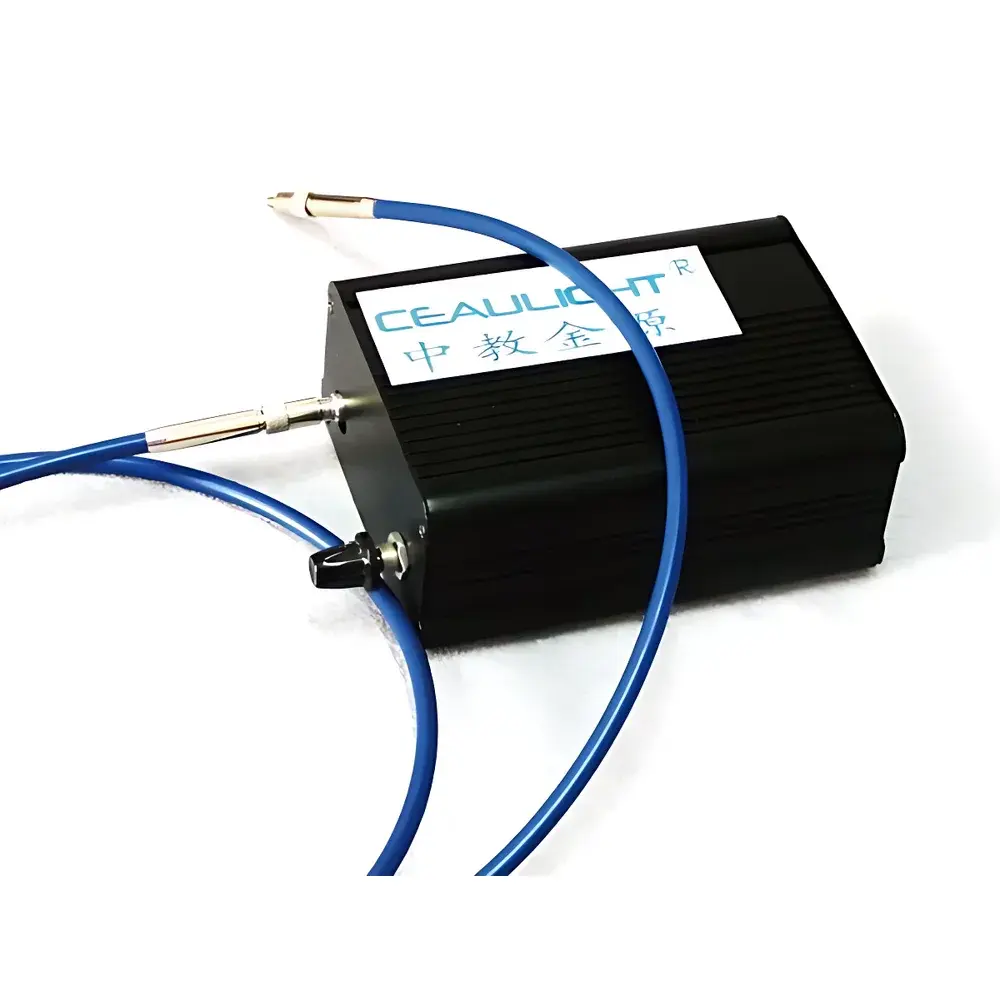
CEL-GW10 Fiber-Coupled Tungsten-Halogen Light Source
| Brand | CEAULIGHT (Zhongjiaojinyuan) |
|---|---|
| Model | CEL-GW10 |
| Light Source Type | Tungsten-halogen lamp |
| Spectral Output Range | 350–1100 nm |
| Optical Power Output | 10 W |
| Input Voltage | 150–250 V AC |
| Operating Temperature | 5–35 °C |
| Warm-up Time | 1–5 min |
| Weight | 2.5 kg |
| Fiber Interface | SMA905 |
| Lamp Lifetime | ≥2000 h |
| Spectral Stability | <0.25 %/h |
| Drift | <1×10⁻³ AU |
| Illumination Mode | External illumination |
| Origin | Beijing, China |
| Manufacturer | CEAULIGHT (Zhongjiaojinyuan) |
Overview
The CEL-GW10 Fiber-Coupled Tungsten-Halogen Light Source is a precision-engineered broadband illumination system designed for demanding optical laboratory applications requiring stable, continuous-spectrum output across the visible and near-infrared (NIR) spectral regions. Based on a high-stability tungsten-halogen filament architecture, the source operates via thermal radiation principles—emitting a smooth, Planckian blackbody-like spectrum from 350 nm to 1100 nm without discrete emission lines. This makes it particularly suitable as a reference or calibration source in spectrophotometry, reflectance/transmittance measurements, hyperspectral imaging setup validation, and fiber-optic sensor excitation where spectral continuity and temporal stability are critical. Unlike pulsed or line-emission sources (e.g., mercury or xenon arcs), the CEL-GW10 delivers inherently low noise, minimal flicker, and no spectral discontinuities—enabling high-fidelity baseline correction and quantitative intensity calibration in UV-Vis-NIR instrumentation chains.
Key Features
- Fiber-coupled output via standardized SMA905 connector, ensuring repeatable alignment and compatibility with commercial spectrometers, monochromators, and custom optical benches.
- Optimized thermal management system enabling stable radiometric output over extended operation periods; spectral drift remains below 0.25 %/h under constant ambient conditions (23 ± 2 °C).
- Integrated power regulation circuitry maintains consistent filament temperature across input voltage fluctuations (150–250 V AC), minimizing intensity variation and extending lamp lifetime to ≥2000 hours.
- Compact, benchtop-ready housing (2.5 kg) with external illumination configuration—ideal for integration into multi-source optical platforms where spatial separation between source and sample is required.
- Fast warm-up performance: reaches photometric stability within 1–5 minutes, reducing experimental downtime and improving throughput in routine QA/QC or teaching lab environments.
Sample Compatibility & Compliance
The CEL-GW10 is compatible with standard silica-core optical fibers (200–1000 µm core diameter, NA ≤ 0.22) and supports both free-space and fiber-delivered measurement geometries. Its broadband output enables calibration traceability to NIST-traceable standards when used with calibrated photodiodes or spectroradiometers. While not certified to specific regulatory frameworks (e.g., ISO/IEC 17025), the instrument’s design adheres to general laboratory equipment requirements outlined in ISO/IEC Guide 98-3 (GUM) for uncertainty-aware photometric applications. It meets electromagnetic compatibility (EMC) Class B limits per CISPR 32 and operates safely within IEC 61010-1 safety guidelines for laboratory electrical equipment.
Software & Data Management
The CEL-GW10 operates as a standalone analog light source with no embedded digital control interface. However, its stable output enables seamless integration with third-party data acquisition systems—including those compliant with USB/RS-232 protocols—for synchronized triggering, intensity logging, or closed-loop feedback control. When paired with spectrometers supporting ASTM E308-compliant colorimetric analysis or ISO 13406-2 transmittance protocols, the source contributes to auditable measurement workflows. Full audit trails—including lamp operating hours, ambient temperature logs, and intensity calibration timestamps—can be maintained externally using LIMS or ELN platforms aligned with GLP/GMP documentation practices.
Applications
- Reference illumination for UV-Vis-NIR spectrophotometer wavelength and photometric calibration (per ASTM E275 and ISO 6780).
- Excitation source for fiber-optic oxygen sensors, NIR moisture analyzers, and absorption-based gas detection modules.
- Broadband background source in FTIR interferometer alignment and detector linearity verification.
- Educational demonstration of blackbody radiation, color temperature dependence, and spectral filtering effects in undergraduate optics laboratories.
- Stable illumination in automated reflectance standards characterization (e.g., against BaSO₄ or PTFE tiles per ASTM E259).
FAQ
What is the recommended fiber type for optimal coupling efficiency with the CEL-GW10?
Standard multimode silica fibers with SMA905 termination and numerical aperture ≤0.22 are recommended; core diameters of 400–600 µm provide best balance between throughput and spatial uniformity.
Can the CEL-GW10 be operated continuously for >8 hours without degradation?
Yes—under controlled ambient temperature (≤30 °C) and stable line voltage, continuous operation up to 12 hours per session is supported without measurable impact on spectral stability or lamp lifetime.
Is this source suitable for use with monochromators requiring high étendue matching?
The source’s effective étendue is optimized for coupling into 0.22 NA fibers; when interfaced with monochromators, collimation optics must preserve this NA to avoid vignetting or intensity loss.
Does the unit include internal shuttering or intensity modulation capability?
No—intensity control requires external neutral density filters or mechanical shutters; analog dimming is not supported due to filament thermal inertia constraints.
How does the CEL-GW10 compare to deuterium-tungsten combined systems in terms of UV coverage?
The CEL-GW10 covers 350–1100 nm only; for full 200–1100 nm coverage, it is intended to be paired with the complementary CEL-GX30D deuterium source (200–400 nm), enabling seamless broadband illumination when combined via dichroic beam combiners.




