
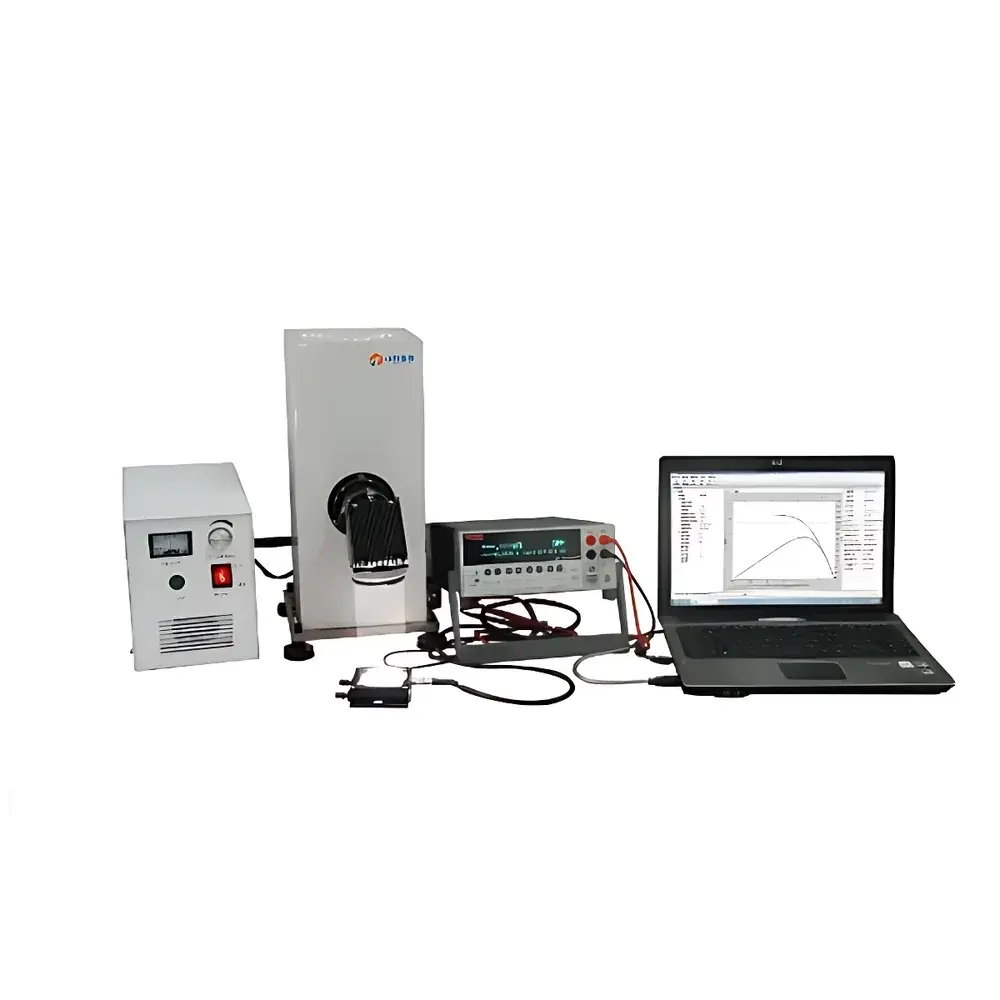
CEL-IV Solar Cell I-V Characterization System
| Brand | CEA (China Education Goldsource) |
|---|---|
| Origin | Beijing, China |
| Manufacturer Type | Direct Manufacturer |
| Product Category | Domestic |
| Model | CEL-IV Solar Cell I-V Characterization System |
| Light Source Type | Broadband Simulated Sunlight (AM1.5G) |
| Illumination Mode | External Illumination |
| Spectral Match | Class A per IEC 60904-9:2020 |
| Irradiance Range | 800–2000 W/m² |
| Max Sample Area | 50 mm × 50 mm (Ø60 mm) |
| Current Measurement Range | 1 nA – 1.05 A (3.15 A overload) |
| Voltage Measurement Range | 200 µV – 21 V (210 V overload) |
| Power Meter Spectral Response | 190 nm – 11,000 nm |
| Power Meter Resolution | 0.001 mW |
| Uniformity (Irradiance) | <5% (±) |
| Temporal Stability (RMS) | <2% |
| Calibration Standard | Traceable Si reference cell (20 mm × 20 mm) |
| Electrode Configuration | Four-point probe interface |
| Software Export Formats | Excel (.xlsx), ASCII (.txt), XML (.xml) |
| Compliance | IEC 60904-1, IEC 60904-3, IEC 60904-9, ASTM E948, ASTM E1036 |
Overview
The CEL-IV Solar Cell I-V Characterization System is a turnkey laboratory instrument engineered for precision current–voltage (I-V) and power–voltage (P-V) curve acquisition of photovoltaic (PV) devices under controlled simulated sunlight conditions. Based on the fundamental principle of source-measure unit (SMU)-driven DC bias sweep combined with calibrated broadband illumination, the system enables quantitative extraction of critical PV parameters—including open-circuit voltage (Voc), short-circuit current (Isc), maximum power point (Vmpp, Impp), fill factor (FF), and power conversion efficiency (η)—in both illuminated and dark conditions. Its optical architecture implements a Class A spectral match to AM1.5G reference spectra (IEC 60904-9:2020), ensuring metrological traceability for R&D labs, quality control facilities, and certification testing environments.
Key Features
- Integrated SMU-based measurement engine using original KEITHLEY 2401 SourceMeter®—providing high-resolution current sourcing (1 nA minimum resolution) and four-quadrant operation for bidirectional IV sweeps.
- Stabilized solar simulator (CEL-S500) with collimated output, AM1.5G spectral filtering, and real-time irradiance monitoring via NIST-traceable silicon reference cell (CEL-RC series).
- Optical uniformity <5% across Ø60 mm field and temporal stability <2% RMS over 30 minutes—meeting IEC 60904-9 requirements for Class A spatial and temporal classification.
- Dual-mode operation: simultaneous dark and illuminated I-V acquisition with automated switching and thermal drift compensation algorithms.
- Four-point probe compatible sample stage with low-shadow electrode contact design—minimizing series resistance artifacts during low-resistance device characterization.
- Full-spectrum radiometric calibration capability (190–11,000 nm) using CEL-NP2000 power meter with ±0.001 mW resolution and integrated spectral responsivity correction.
Sample Compatibility & Compliance
The CEL-IV system supports rigid and flexible PV devices including crystalline silicon (c-Si), polycrystalline silicon (mc-Si), thin-film technologies (CIGS, CdTe, a-Si), perovskite solar cells (PSCs), organic photovoltaics (OPVs), and emerging tandem architectures. Sample mounting accommodates standard test coupons (up to 50 × 50 mm) and custom substrates via adjustable clamping fixtures. All measurement protocols align with international standards: IEC 60904-1 (photovoltaic current–voltage characteristics), IEC 60904-3 (reference solar spectral irradiance data), and ASTM E948/E1036 (test methods for determining electrical performance of non-concentrator terrestrial PV devices). The system’s calibration chain—spanning reference cell, power meter, and SMU—is documented per ISO/IEC 17025 guidelines and supports GLP-compliant audit trails when paired with timestamped data export.
Software & Data Management
The system operates via a native Windows-based GUI (English and Chinese language toggle), offering intuitive parameter configuration, real-time curve visualization, and automated report generation. Measurement sequences are scriptable via built-in macro editor or external Python API (via VISA/SCPI). Raw I-V datasets are stored in structured binary format with embedded metadata (irradiance value, temperature stamp, spectral match grade, operator ID). Export functions support Excel (.xlsx) for spreadsheet analysis, ASCII (.txt) for legacy instrument integration, and XML (.xml) for LIMS or ELN ingestion. Reports include annotated curves, tabulated parameters with uncertainty estimates (based on SMU accuracy specs and irradiance calibration uncertainty), pass/fail flags against user-defined thresholds, and optional watermarking for QA documentation.
Applications
- Routine performance screening of lab-scale and pilot-line PV devices during materials development and process optimization.
- Stability assessment under light soaking or thermal cycling—when coupled with optional temperature-controlled stage (CEL-TCP) and real-time thermocouple monitoring.
- Series/shunt resistance analysis via dark I-V fitting (single-diode model) and recombination loss quantification.
- Calibration transfer between reference cells and production-line flash testers using matched spectral weighting functions.
- Educational laboratories requiring hands-on training in PV metrology fundamentals, standards compliance, and uncertainty budgeting.
- Third-party verification testing for CE marking, UL 1703, or IEC 61215 qualification campaigns.
FAQ
Does the CEL-IV system comply with IEC 60904-9:2020 Class A requirements?
Yes—the CEL-S500 solar simulator achieves Class A spectral match, spatial uniformity (<5%), and temporal stability (<2% RMS), verified by third-party calibration reports included with each shipment.
Can the system measure devices larger than 50 × 50 mm?
The standard stage supports up to Ø60 mm active area; larger samples require optional motorized XY translation stage (CEL-XYZ-40) with programmable raster scanning and stitched I-V mapping.
Is the KEITHLEY 2401 fully integrated and driver-supported?
Yes—the instrument uses native KEITHLEY KUSB-488B GPIB-to-USB interface with certified IVI-compliant drivers and SCPI command set for remote automation.
What reference cell options are supplied, and are calibration certificates included?
Each system ships with either CEL-RCCN (monocrystalline Si) or CEL-RCCO (multicrystalline Si) reference cell, accompanied by NIST-traceable calibration certificate valid for 12 months.
How is irradiance calibrated during routine operation?
Users perform daily or per-session calibration using the included reference cell and CEL-NP2000 power meter; software auto-applies spectral mismatch correction factors based on device bandgap input.




