
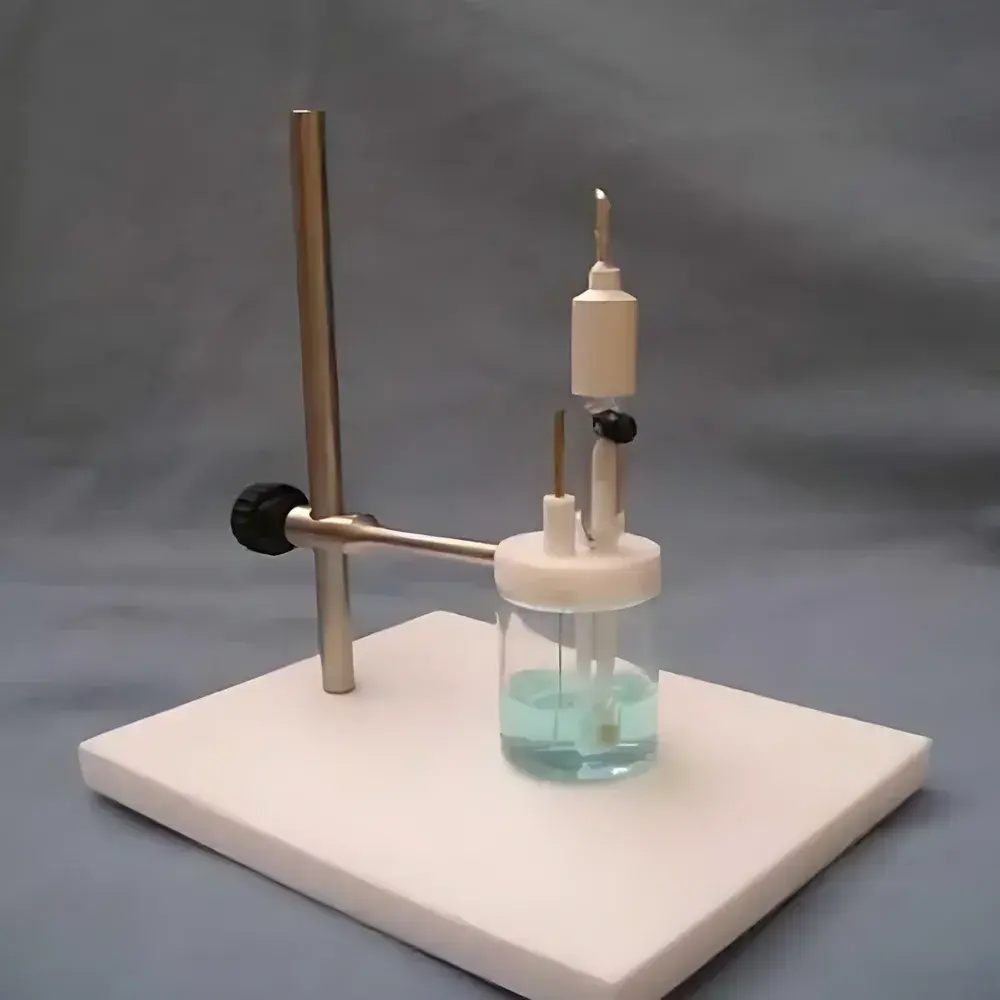
Electrode Holder Stand by CME (Zhongjiao Jinyuan)
| Brand | CME (Zhongjiao Jinyuan) |
|---|---|
| Origin | Beijing, China |
| Manufacturer Type | Direct Manufacturer |
| Origin Classification | Domestic (China) |
| Model | Electrode Holder Stand |
| Pricing | Available Upon Request |
| Construction | Full PTFE + Stainless Steel |
| PTFE Base Plate Dimensions | 150 mm × 120 mm |
| Stainless Steel Support Rod | Ø8 mm × 160 mm |
| Compatible Vessel Capacities | 15 mL, 30 mL, 50 mL, 100 mL, 150 mL, 200 mL, 250 mL, 300 mL |
Overview
The CME Electrode Holder Stand is a precision-engineered laboratory support system designed for secure, stable, and chemically inert positioning of working, reference, and counter electrodes during electrochemical measurements. Built on the fundamental requirement of mechanical stability and material compatibility in corrosive or high-purity environments, this stand employs a dual-material architecture—combining high-density molded polytetrafluoroethylene (PTFE) with 316 stainless steel—to ensure long-term dimensional integrity and resistance to aggressive electrolytes, strong acids (e.g., H₂SO₄, HCl), alkalis (e.g., KOH, NaOH), and organic solvents commonly used in cyclic voltammetry, chronoamperometry, and impedance spectroscopy. Unlike generic lab clamps or custom-machined fixtures, the CME stand integrates standardized mounting geometry with calibrated vertical adjustability, enabling reproducible electrode immersion depth and inter-electrode spacing—critical parameters governing current distribution, mass transport, and measurement repeatability in three-electrode cells.
Key Features
- Chemically inert PTFE base plate (150 mm × 120 mm) provides non-slip surface stability and eliminates metallic contamination risks in trace-level analyses.
- Vertical support rod constructed from electropolished 316 stainless steel (Ø8 mm × 160 mm) offers high tensile strength, corrosion resistance, and compatibility with standard laboratory clamping hardware.
- Modular design accommodates glassware and electrochemical cells across eight standard volumes (15–300 mL), supporting common geometries including cylindrical beakers, rectangular cuvettes, and custom flow cells.
- No integrated fasteners or adhesives—electrode holders (e.g., Luggin capillaries, Pt wire mounts, Ag/AgCl reference sleeves) are secured via standard PTFE-tipped clamps or compression fittings, preserving user flexibility and instrument interchangeability.
- Designed for benchtop use under ambient conditions; no power supply, vacuum interface, or external actuation required—ensuring operational simplicity and compliance with ISO/IEC 17025 general requirements for test equipment stability.
Sample Compatibility & Compliance
The CME Electrode Holder Stand is compatible with all standard electrochemical cell configurations requiring fixed electrode alignment, including but not limited to: aqueous and non-aqueous battery electrolyte testing (Li-ion, Na-ion), corrosion rate evaluation per ASTM G59/G102, sensor calibration protocols (e.g., pH, dissolved oxygen), and academic research in electrocatalysis and bioelectrochemistry. Its PTFE/stainless steel construction meets USP material safety criteria for laboratory contact surfaces and complies with ISO 9001 manufacturing controls as implemented by Zhongjiao Jinyuan Co., Ltd. The absence of leachable metals or plasticizers ensures suitability for GLP-regulated studies where extractables must be minimized. While the stand itself is not a measuring instrument, its mechanical consistency supports adherence to ASTM E2913 (Standard Guide for Electrochemical Impedance Spectroscopy) and IUPAC-recommended cell assembly practices.
Software & Data Management
As a passive mechanical support device, the CME Electrode Holder Stand does not incorporate embedded electronics, firmware, or software interfaces. It operates independently of potentiostats (e.g., BioLogic SP-300, Metrohm Autolab PGSTAT series) or data acquisition systems. However, its consistent geometry directly contributes to measurement traceability: repeatable electrode positioning reduces positional variance—a known source of systematic error in Rct and Cdl determination. Laboratories implementing 21 CFR Part 11-compliant workflows may document stand usage (e.g., lot number, calibration verification date, cell volume selected) within their electronic lab notebooks (ELN) alongside raw electrochemical data files (.mpt, .gamry, .z) to satisfy audit requirements for experimental setup reproducibility.
Applications
- Controlled-depth immersion of rotating disk electrodes (RDE) in kinetic studies of oxygen reduction reaction (ORR) and hydrogen evolution reaction (HER).
- Stabilization of fragile quasi-reference electrodes (e.g., Ag wire in LiCl) during long-duration chronoamperometric stability tests.
- Multi-electrode array alignment in localized corrosion monitoring setups per ASTM G199.
- Support for photoelectrochemical cells using UV-transparent quartz vessels (15–100 mL range) where PTFE minimizes stray light absorption.
- Teaching laboratories conducting standardized experiments per ACS Division of Chemical Education guidelines, where mechanical consistency aids student technique validation.
FAQ
Is the electrode holder supplied with electrodes?
No. Electrodes (working, reference, counter) are not included and must be selected separately based on application requirements.
Can this stand be used with hotplate-stirrers or temperature-controlled cells?
Yes—the PTFE base plate is rated for continuous use up to 260 °C; however, prolonged exposure above 200 °C may reduce mechanical rigidity of the PTFE component over time.
What clamping accessories are recommended for securing electrodes?
Standard PTFE-coated alligator clips, PTFE-tipped micromanipulator clamps (e.g., Thorlabs KCH101), or OEM-compatible electrode holders with M4 threading are mechanically and chemically appropriate.
Does the stand meet cleanroom classification standards?
While not certified to ISO 14644 classes, the fully assembled unit generates no particulates under static conditions and may be cleaned via ultrasonic bath in IPA followed by Class 100 laminar flow drying.
Is technical documentation available in English with dimensional drawings?
Yes—dimensional schematics, material certifications (ASTM D4894 for PTFE, ASTM A276 for 316 SS), and RoHS/REACH declarations are provided upon request to international distributors and institutional purchasers.



