
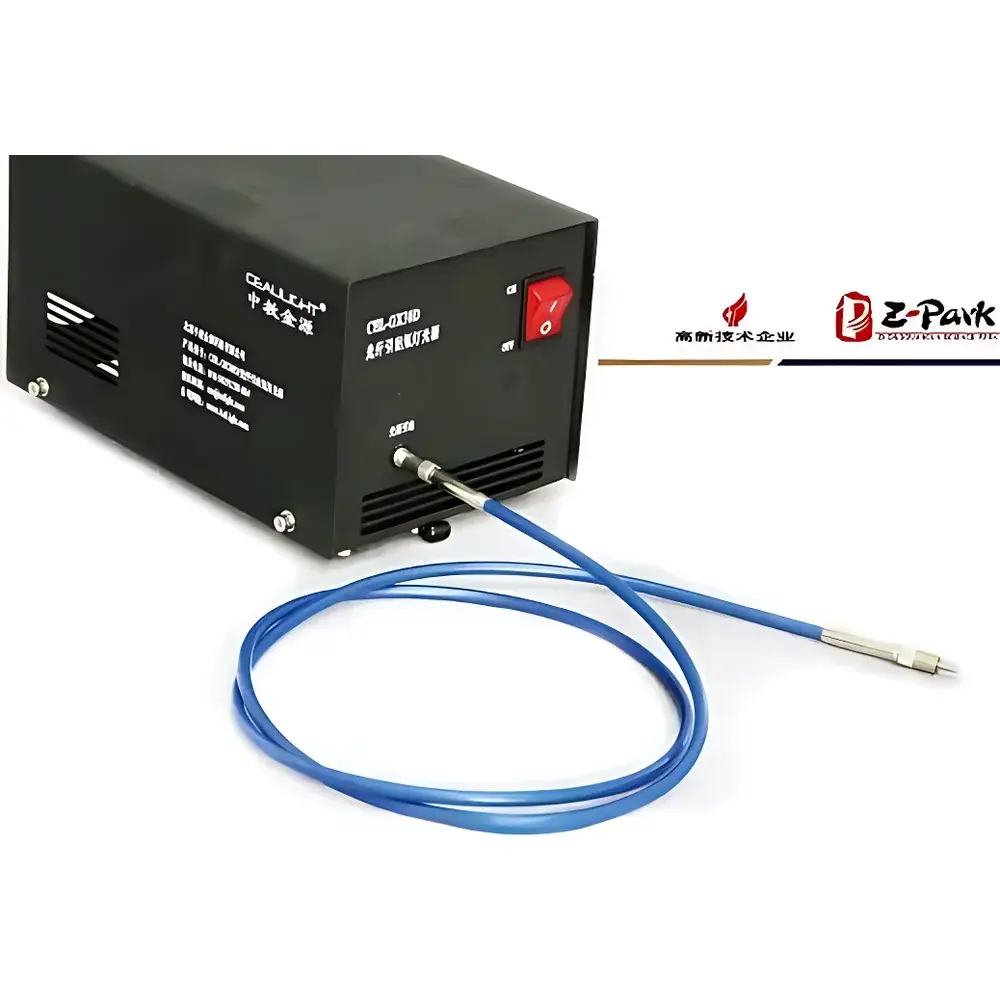
CEL-GX30D Fiber-Coupled Deuterium Lamp Light Source
| Brand | CEA (China Education Goldsource) |
|---|---|
| Model | CEL-GX30D |
| Light Source Type | Deuterium Lamp |
| Output Spectral Range | 200–400 nm |
| Optical Power | 30 W |
| Lifetime | >1000 h |
| Intensity Stability | <1×10⁻³ AU |
| Drift | <0.25 %/h |
| Ignition Voltage | ~1 kV |
| Excitation Frequency | 250 kHz |
| Fiber Coupling Interface | SMA905 |
| Input Voltage | 150–250 V AC |
| Operating Temperature | 5–35 °C |
| Warm-up Time | 1–5 min |
| Weight | 2.5 kg |
| Illumination Mode | External (Fiber-Output) |
Overview
The CEL-GX30D is a high-stability, fiber-coupled deuterium lamp light source engineered for precision ultraviolet (UV) spectral applications in optical laboratory environments. Based on low-pressure deuterium arc discharge physics, it delivers continuous, broadband UV emission from 200 nm to 400 nm—covering the critical deep-UV through near-UV region essential for absorption spectroscopy, UV-Vis spectrophotometer calibration, photochemical reaction initiation, and fluorescence excitation. Unlike pulsed or LED-based UV sources, the CEL-GX30D provides thermally stabilized, continuum radiation with minimal spectral discontinuities, enabling high-fidelity baseline establishment and quantitative photometric traceability. Its integrated thermal management and regulated high-frequency (250 kHz) electronic ballast ensure consistent plasma ignition and reduced cathode sputtering—key factors contributing to its >1000-hour operational lifetime and sub-0.25 %/h intensity drift.
Key Features
- Fiber-coupled output via standardized SMA905 connector, enabling seamless integration with spectrometers, monochromators, integrating spheres, and custom optical benches.
- Optimized deuterium lamp module with quartz envelope transmission >85 % at 200 nm, supporting reliable deep-UV delivery without ozone generation.
- Electronic ignition system with ~1 kV cold-start voltage ensures rapid, repeatable lamp activation—no external starter required.
- Active thermal stabilization maintains lamp envelope temperature within ±2 °C during operation, minimizing spectral shift and intensity fluctuation.
- Compact, fan-cooled chassis (2.5 kg) designed for benchtop deployment; compatible with standard optical tables and automated stage systems.
- Compliant with IEC 61000-6-3 (EMC emission) and IEC 61000-6-2 (immunity) for stable performance in shared lab infrastructure.
Sample Compatibility & Compliance
The CEL-GX30D is routinely deployed in configurations requiring UV irradiance homogeneity and spectral fidelity—including cuvette-based absorbance assays (e.g., nucleic acid quantification per ISO 8655), thin-film transmittance mapping, and catalyst photoactivation studies under controlled irradiance (ASTM E2739). Its 200–400 nm output aligns with key photobiological action spectra (CIE S 026/E:2019) and supports validation of UV-sensitive detectors per NIST SRM 2035 traceability protocols. While not intrinsically certified for GMP environments, the unit’s deterministic warm-up behavior (<5 min to <1×10⁻³ AU stability), non-volatile construction, and absence of mercury or xenon enable straightforward IQ/OQ documentation for GLP-compliant laboratories.
Software & Data Management
The CEL-GX30D operates as a stand-alone analog source and does not require proprietary drivers or firmware. Its AC-input architecture allows direct integration into programmable power sequencers (e.g., National Instruments PXI systems) for time-synchronized illumination control in kinetic experiments. For long-term monitoring, users may log output stability using external photodiode sensors interfaced via USB data acquisition modules (e.g., Thorlabs PM100D + S120VC). All operational parameters—including warm-up profile, intensity drift, and lamp-on hours—are recordable in laboratory information management systems (LIMS) compliant with 21 CFR Part 11 when paired with audit-trail-capable acquisition software.
Applications
- Calibration of UV-Vis spectrophotometers across the 200–400 nm range per ASTM E275 and ISO/IEC 17025 requirements.
- In situ monitoring of photocatalytic degradation kinetics (e.g., TiO₂-mediated organic pollutant decomposition).
- Excitation source for UV resonance Raman spectroscopy of aromatic amino acids and nucleobases.
- Benchmarking quantum yield measurements in photochemistry setups (e.g., actinometry using potassium ferrioxalate).
- Reference illumination in accelerated weathering test chambers where spectral fidelity below 300 nm is critical (ISO 4892-2).
FAQ
What is the recommended fiber optic cable specification for optimal UV throughput?
Use solarization-resistant fused silica fibers with OH⁻-free core (e.g., Ocean Insight QP400-UV-VIS or Thorlabs UVFS-based patch cables); avoid standard multimode silica which exhibits strong 200–250 nm attenuation.
Can the CEL-GX30D be operated continuously for extended periods?
Yes—continuous operation up to 8 h per session is supported provided ambient temperature remains ≤32 °C and airflow around the chassis is unobstructed.
Is the output intensity adjustable?
No—intensity is fixed by lamp design and ballast regulation; attenuation must be achieved externally using neutral density filters or variable apertures.
Does this unit include radiometric calibration data?
Factory spectral irradiance data (mW/cm²/nm at 1 m distance, referenced to NIST-traceable standards) is available upon request with optional calibration certificate (NIST-traceable, ±3 % uncertainty at 254 nm).
How does the CEL-GX30D compare to combined D₂ + tungsten-halogen sources?
The CEL-GX30D is optimized exclusively for UV stability and spectral purity; for full 200–1100 nm coverage, it is commonly paired with the complementary CEL-GW10 tungsten source—enabling dual-lamp switching without mechanical realignment.





