
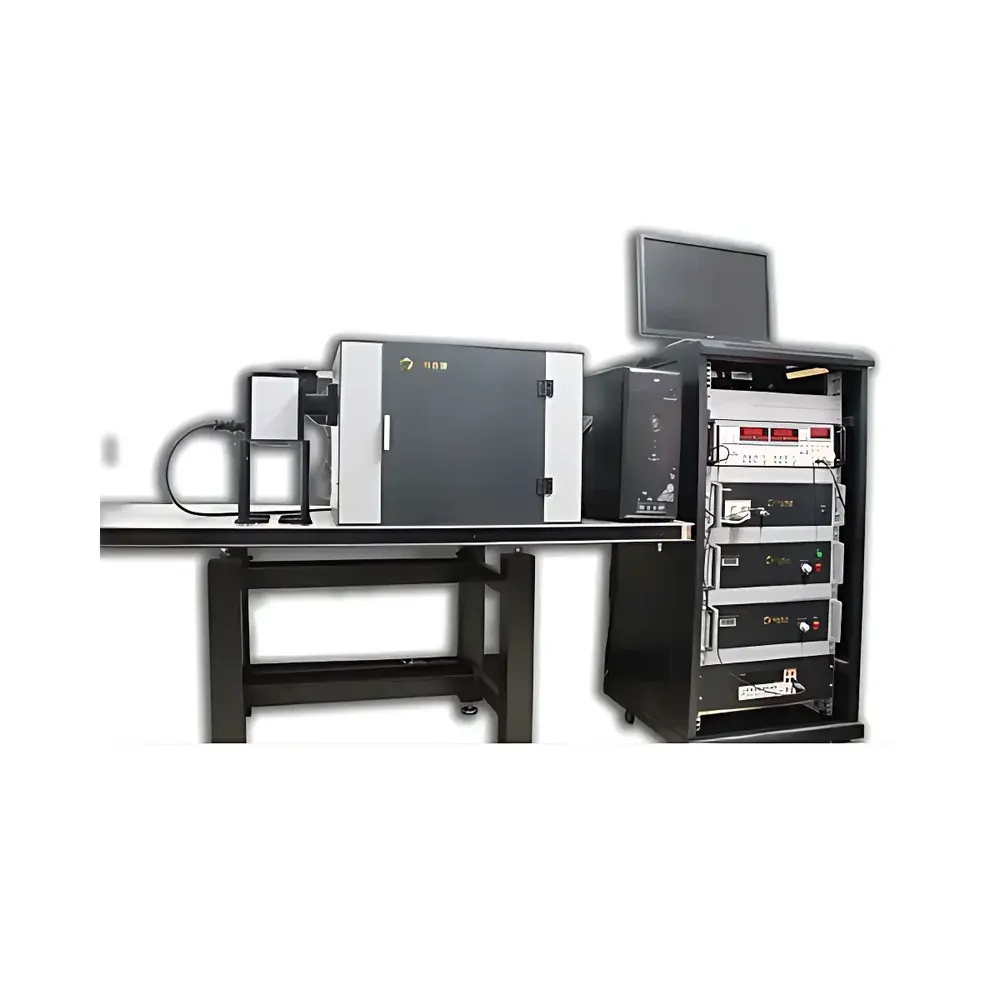
CEL-QPCE3000 Photoelectrochemical Quantum Efficiency Measurement System (QE/IPCE)
| Brand | CEL (Zhongjiaojinyuan) |
|---|---|
| Origin | Beijing, China |
| Manufacturer Type | Direct Manufacturer |
| Product Category | Domestic |
| Model | CEL-QPCE3000 |
| Light Source Type | Tunable Monochromatic Light (Xenon-based) |
| Illumination Mode | External Irradiation |
| Spectral Range | 300–1100 nm (optional 200–2500 nm) |
| Wavelength Step Resolution | ≥1 nm, continuously adjustable |
| QE/IPCE Repeatability (RSI) | <0.3% (photocurrent) |
| Chopping Frequency Range | 5–1000 Hz |
| Detection Modes | AC (lock-in), DC (potentiostatic/galvanostatic), Open-Circuit Voltage (OCV), Electrochemical Impedance |
| Sample Stage | Motorized Dual-Position Holder (Reference + Sample), housed in EMI-shielded dark chamber |
| Monochromator | 300 mm focal length, asymmetric Czerny-Turner design, astigmatism-corrected, stray-light-suppressed, nitrogen-purged port, precision stepper-driven slit (symmetrical adjustment, blade-protected edges), optical/mechanical isolation architecture |
| Light Source | 500 W Oslamp® Xenon Lamp (Osram, Germany), intensity stability <0.01% RMS |
| Standard Detector | UV-enhanced Si photodiode (300–1100 nm) |
| Optional Integration | Ivium electrochemical workstation (or compatible third-party potentiostats) |
Overview
The CEL-QPCE3000 Photoelectrochemical Quantum Efficiency Measurement System is a research-grade instrumentation platform engineered for quantitative spectral responsivity analysis of photoactive materials under controlled electrochemical conditions. It implements the fundamental principles of photoelectrochemistry—namely, the generation, separation, transport, and interfacial charge transfer of photogenerated electron-hole pairs in semiconductor/electrolyte junctions. The system measures incident photon-to-current efficiency (IPCE) and external quantum efficiency (EQE) across the ultraviolet–visible–near-infrared (UV-Vis-NIR) spectrum (standard 300–1100 nm; extended range up to 2500 nm with optional detectors), enabling rigorous kinetic and mechanistic evaluation of photocatalysts, photoelectrodes, perovskite absorbers, and dye-sensitized architectures. Its core measurement methodology relies on lock-in amplification synchronized to a mechanically chopped monochromatic beam, effectively isolating weak photocurrent signals (< pA to µA range) from broadband thermal, electronic, and 1/f noise—achieving signal-to-noise ratios sufficient for sub-0.3% relative standard deviation in repeated IPCE scans.
Key Features
- Automated, software-controlled spectral scanning with real-time background subtraction and zero-offset correction—eliminating manual drift compensation.
- High-stability 500 W xenon light source (Osram Oslamp®) delivering <0.01% RMS intensity fluctuation, coupled with a high-fidelity 300 mm Czerny-Turner monochromator featuring astigmatism correction, stray-light suppression, and nitrogen-purge capability for UV/NIR fidelity.
- Dual-mode operation: DC potentiostatic/galvanostatic mode compliant with ASTM G170 and ISO 15500 standards for photoelectrode characterization; AC lock-in mode (5–1000 Hz) optimized for low-noise, frequency-resolved photocurrent detection.
- Motorized dual-position sample stage housed within an EMI- and light-tight chamber—enabling rapid, repeatable comparison between reference and test electrodes without manual repositioning or ambient interference.
- Modular detector interface supporting UV-enhanced silicon photodiodes (300–1100 nm) and optional InGaAs detectors (800–1600 nm), ensuring spectral coverage continuity across critical bandgaps of emerging photoabsorbers.
- Full compatibility with third-party electrochemical workstations—including IviumStat, BioLogic SP-300, and Gamry Interface series—via standardized analog/digital I/O and USB 2.0 synchronization protocols.
Sample Compatibility & Compliance
The CEL-QPCE3000 supports planar and particulate photoelectrodes mounted on conductive substrates (FTO, ITO, Au, Pt mesh), liquid-junction cells (e.g., three-electrode H-cell configurations), and solid-state hybrid devices. It accommodates standard spectroelectrochemical cuvettes (1 cm pathlength), custom flow cells, and vacuum-sealed electrochemical cells. All measurements adhere to internationally recognized metrological frameworks: spectral irradiance calibration traceable to NIST SRM 2069 (silicon photodiode), wavelength accuracy validated per ISO 17025-accredited procedures, and electrical signal integrity verified against IEC 61000-4-30 EMC compliance thresholds. Data acquisition meets GLP/GMP audit requirements via timestamped, user-annotated metadata logging—including lamp hours, monochromator slit width, chopping frequency, applied bias potential, and electrolyte composition tags.
Software & Data Management
The proprietary QPCE-Suite v4.x provides a unified interface for instrument control, real-time visualization, and post-processing. It supports automated batch scanning, multi-bias IPCE mapping, Tafel analysis, Mott-Schottky derivation, and spectral transmittance/reflectance normalization. Raw data are exported in HDF5 format (compatible with Python, MATLAB, Origin), preserving full metadata hierarchy. Audit trails record all parameter changes, user logins, and calibration events—satisfying FDA 21 CFR Part 11 requirements for electronic records and signatures when configured with role-based access controls and digital certificate authentication.
Applications
- Quantitative IPCE/EQE profiling of metal oxide photoanodes (TiO₂, BiVO₄, Fe₂O₃) and chalcogenide photocathodes (CuInGaSe₂, CdTe) under simulated AM 1.5G illumination.
- Mechanistic deconvolution of charge-transfer resistance vs. recombination kinetics via bias-dependent IPCE onset shifts and wavelength-resolved photocurrent action spectra.
- Optical characterization of transparent conductive oxides and antireflection coatings via concurrent spectral transmittance measurement (with/without sample).
- Stability assessment through time-resolved IPCE decay monitoring at fixed wavelengths under continuous illumination and electrochemical bias.
- Validation of theoretical absorption edge predictions using Tauc plot derivation from QE onset data.
- Interlaboratory benchmarking of photoelectrochemical performance metrics aligned with IEA PVPS Task 12 reporting guidelines.
FAQ
What spectral range is standard, and how is extended-range operation achieved?
The base configuration covers 300–1100 nm using a UV-enhanced Si photodiode. Extension to 200–2500 nm requires optional InGaAs (800–1600 nm) and PbS/PbSe (1000–2500 nm) detectors, along with quartz/vacuum UV optics and nitrogen purging.
Is the system compatible with corrosive electrolytes such as concentrated KOH or HF-containing solutions?
Yes—sample chambers and electrode interfaces are constructed from PTFE, quartz, and chemically inert stainless steel (316L). Optional sealed quartz cells with Viton O-rings support long-term testing in aggressive media.
How is spectral irradiance calibrated, and what uncertainty is associated with QE values?
Calibration uses NIST-traceable reference photodiodes (SRM 2069) and calibrated tungsten-halogen sources. Combined uncertainty for absolute QE is ±2.1% (k=2) across 350–800 nm, dominated by detector responsivity uncertainty and monochromator bandpass error.
Can the system perform transient photocurrent/photovoltage measurements?
Not natively—transient capabilities require integration with an external fast-response potentiostat (e.g., BioLogic VSP-300) and digitizer (≥1 MS/s), which the QPCE-Suite can synchronize via TTL triggers and analog voltage output.
Does the software support automated Mott-Schottky analysis?
Yes—QPCE-Suite includes built-in Mott-Schottky module that computes flat-band potential, donor density, and space-charge capacitance from frequency-dependent impedance-derived C⁻² vs. applied bias plots.



