
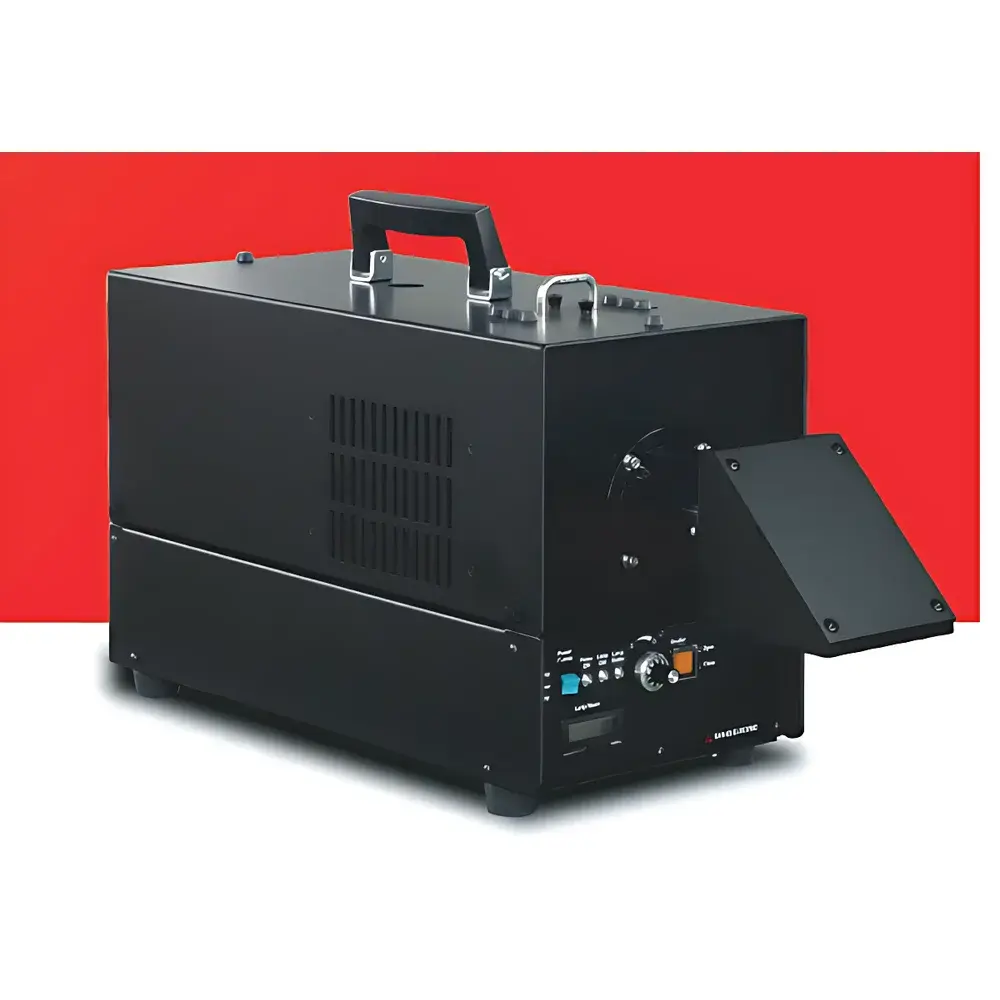
English Product Name
| Brand | CNI |
|---|---|
| Origin | Japan |
| Manufacturer Type | Manufacturer |
| Origin Category | Imported |
| Model | AAA-Class |
| Trigger Mode | Steady-State |
| Effective Illuminated Area | 50 mm × 50 mm |
| Irradiance Non-Uniformity | <2% (Class A) |
| Temporal Instability | <1% (long-term, ≥1 h), <0.5% (short-term, Class A) |
| Spectral Mismatch | <±25% (Class A) |
| Compliant Standards | JIS C 8912, ASTM E927-05, IEC 60904-9 |
| Light Source | 150 W Xenon Arc Lamp |
| Lamp Lifetime | 1000 h |
| AM1.5G Filter | Included |
| Adjustable Beam Orientation | 4-Directional |
| Visual Monitoring Ports | Dual Quadrant Arc View Windows |
| Lamp Warm-up Indicator System | Integrated |
Overview
The CNI AAA-Class Steady-State Solar Simulator is a fully integrated, Japan-manufactured photovoltaic characterization instrument engineered for high-fidelity solar irradiance replication under laboratory conditions. Designed in strict accordance with the international triple-A classification criteria—defined jointly by ASTM E927-05, IEC 60904-9, and JIS C 8912—the system delivers metrologically traceable illumination matching the AM1.5G reference spectrum (1000 W/m²). Its core architecture employs a stabilized 150 W xenon arc lamp coupled with precision-engineered optical conditioning optics, including a certified AM1.5G bandpass filter, to achieve spectral fidelity, spatial uniformity, and temporal stability required for calibration-grade photovoltaic device evaluation. Unlike pulsed or flash-based simulators, this steady-state configuration enables continuous, real-time current–voltage (I–V) sweeps, quantum efficiency (QE), incident photon-to-current efficiency (IPCE), and spectral response (SR) measurements without transient artifacts.
Key Features
- Triple-A certification verified per ASTM E927-05, IEC 60904-9, and JIS C 8912—ensuring conformance across spectral match (±25%), irradiance non-uniformity (<2%), and temporal instability (<0.5% short-term, <1% long-term).
- Steady-state illumination mode supports uninterrupted I–V curve acquisition, enabling accurate series/shunt resistance extraction and degradation monitoring over extended test durations.
- Four-directionally adjustable optical head allows precise alignment of incident light relative to sample plane—critical for angled-incidence studies, tandem cell characterization, and multi-junction device testing.
- Dual “quadrant arc view” optical windows enable real-time visual inspection of plasma arc stability and electrode alignment—supporting preventive maintenance and operational validation.
- Integrated lamp warm-up stabilization indicator provides objective confirmation of thermal and radiometric equilibrium prior to measurement initiation.
- Automated lamp hour counter logs cumulative operational time against rated 1000-hour service life—facilitating scheduled replacement and GLP-compliant instrument history tracking.
- User-defined irradiance control via calibrated feedback loop permits stepwise or continuous intensity adjustment between 0.1× and 1.5× AM1.5G—enabling low-light performance analysis and accelerated aging protocols.
Sample Compatibility & Compliance
The simulator accommodates standard photovoltaic samples up to 50 mm × 50 mm active area, with optional stage integration for larger substrates. It is routinely deployed in ISO/IEC 17025-accredited PV calibration labs and fulfills measurement traceability requirements under NIST SRM 2241 reference cell protocols. The system’s optical design minimizes UV-induced material degradation and thermal load on sensitive perovskite or organic photovoltaic (OPV) devices. All firmware and hardware interfaces comply with IEC 61000-4 electromagnetic compatibility standards. For regulated environments, the instrument supports audit-ready operation when paired with validated data acquisition software meeting FDA 21 CFR Part 11 requirements for electronic records and signatures.
Software & Data Management
Control and acquisition are managed via CNI’s dedicated PV Test Suite v3.x—a platform-agnostic application supporting Windows/Linux hosts and offering native drivers for Keithley 2400/2450 SMUs, lock-in amplifiers, and monochromators. The software enforces configurable measurement sequences (e.g., dark I–V, light I–V, QE sweep), automatic parameter annotation (lamp hours, ambient T/RH, filter ID), and export to standardized formats (CSV, HDF5, PVLib-compatible JSON). Raw spectral irradiance data is logged with timestamped metadata, enabling retrospective uncertainty budgeting per GUM (Guide to the Expression of Uncertainty in Measurement). Optional GLP modules provide electronic signature workflows, change logs, and user-access-level permissions aligned with ISO 17025 clause 7.7.
Applications
- Primary calibration of reference cells and PV module rating according to IEC 61215 and IEC 61646.
- Quantum efficiency and IPCE mapping of single-junction and multi-junction solar cells—including III–V, perovskite–Si tandems, and dye-sensitized devices.
- Light-soaking and bias-dependent degradation studies under controlled irradiance and temperature profiles.
- Validation of anti-reflective coating performance and angular response characterization.
- Research-grade photoelectrochemical cell (PEC) testing requiring spectrally resolved, stable illumination.
- Integration into automated PV production line test benches for inline efficiency binning and defect screening.
FAQ
What standards does this simulator meet for AAA classification?
It satisfies the full tripartite requirement: spectral mismatch ≤ ±25% (IEC 60904-9 Annex A), irradiance non-uniformity <2% (ASTM E927-05 Section 7.2), and temporal instability <0.5% over 10 s and <1% over 1 h (JIS C 8912 Clause 5.3).
Can the system be used for outdoor exposure correlation studies?
Yes—when operated with NIST-traceable reference diodes and environmental chamber coupling, it supports accelerated testing protocols aligned with IEC 61215-2 MQT 03 (UV pre-conditioning) and MQT 10 (thermal cycling).
Is AM0 spectrum simulation possible?
No—this unit is optimized exclusively for terrestrial AM1.5G; AM0 requires vacuum-compatible optics and different filter sets not included in the standard configuration.
Does the system include radiometric calibration documentation?
Yes—each unit ships with a factory-issued calibration certificate traceable to NMI-Japan (AIST), including spectral irradiance distribution, spatial uniformity map, and temporal stability report.
What maintenance intervals are recommended?
Xenon lamp replacement every 1000 h; AM1.5G filter inspection every 500 h; optical train cleaning quarterly or after 200 h of continuous operation in non-classified lab environments.




