
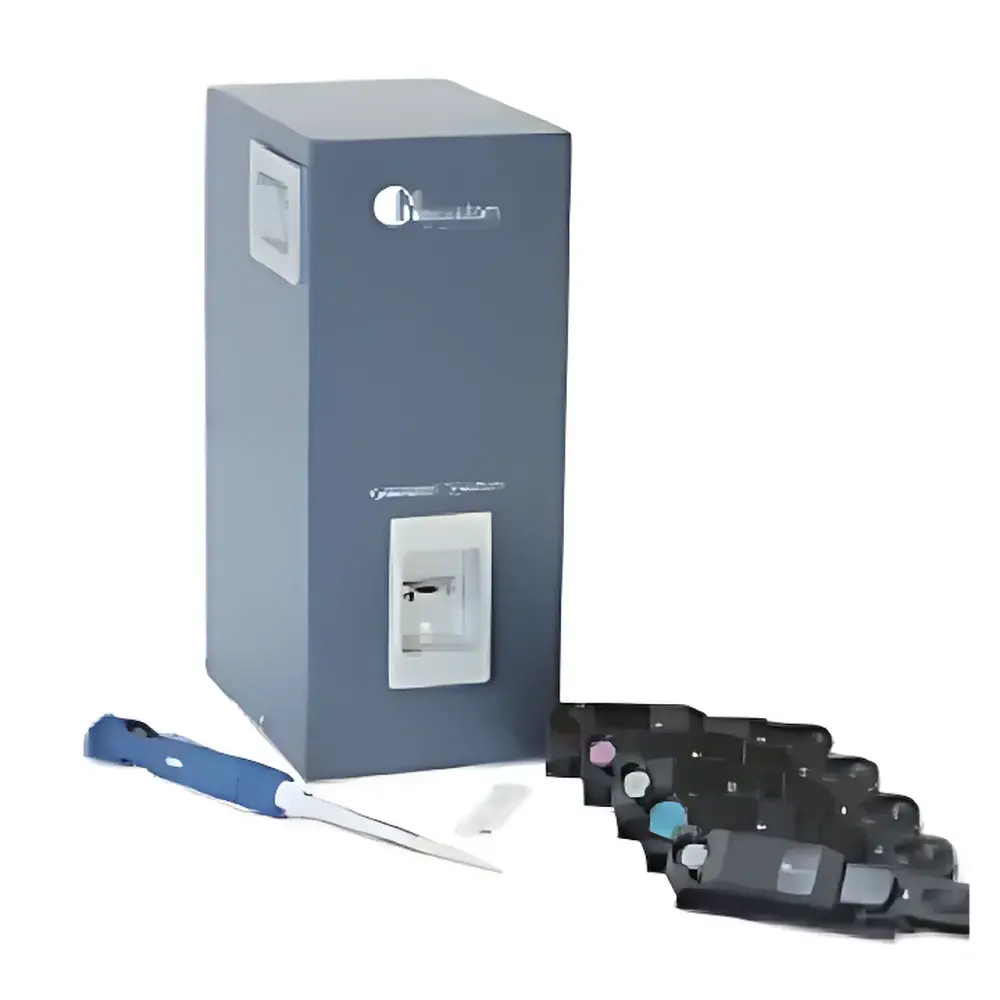
Revvity Cellometer Spectrum Imaging Cytometer
| Brand | Revvity |
|---|---|
| Origin | USA |
| Manufacturer | Revvity, Inc. |
| Product Type | Imported Instrument |
| Model | Cellometer Spectrum |
| Pricing | Available Upon Request |
Overview
The Revvity Cellometer Spectrum is an advanced benchtop imaging cytometer engineered for high-content, quantitative cell analysis in research and quality control laboratories. Unlike conventional flow cytometers that rely on hydrodynamic focusing and single-cell suspension, the Cellometer Spectrum employs brightfield and fluorescence microscopy-based image acquisition coupled with automated, algorithm-driven segmentation and classification. It operates on the principle of digital image cytometry—capturing high-resolution micrographs of cells immobilized in a disposable counting chamber, then applying pixel-intensity thresholding, morphological filtering, and multi-channel fluorescence co-localization to extract population-level statistics. Designed for reproducible, operator-independent measurements, the system supports both routine viability assessment and complex phenotypic profiling—including cell cycle distribution, apoptosis staging, fluorescent protein expression kinetics, and surface marker quantification—without requiring flow cytometry infrastructure or sheath fluid systems.
Key Features
- Modular optical architecture with interchangeable 5× and 10× objective lenses, enabling flexible resolution–field-of-view trade-offs for diverse cell types (e.g., adherent lines, primary lymphocytes, stem cell aggregates).
- Dual-channel simultaneous fluorescence imaging via plug-and-play filter modules; users select any two from six standardized excitation/emission configurations (DAPI, FITC, TRITC, Cy5, GFP, RFP), ensuring compatibility with common viability dyes (Trypan Blue, AO/PI) and reporter constructs.
- Integrated autofocus and auto-exposure algorithms that dynamically optimize focus depth and exposure time per field, minimizing user intervention and reducing inter-run variability.
- Proprietary image analysis engine with adaptive thresholding, background subtraction, and object separation logic—validated across >200 cell types including suspension cultures, adherent monolayers, and heterogeneous co-cultures.
- Compliance-ready data handling: audit trail logging, user access controls, and electronic signature support aligned with GLP and 21 CFR Part 11 requirements for regulated environments.
Sample Compatibility & Compliance
The Cellometer Spectrum accommodates standard 20–50 µL samples loaded into proprietary, sterile, single-use counting chambers with precision-machined 100-µm depth wells. It accepts unstained cells, dye-labeled suspensions (e.g., Trypan Blue for membrane integrity, Acridine Orange/Propidium Iodide for nucleic acid discrimination), and immunofluorescently stained preparations (e.g., CD4-FITC/CD8-PE). The instrument meets ISO 13485 design control requirements for in vitro diagnostic instrumentation and supports validation documentation packages compliant with ASTM E2877 (Standard Guide for Validation of Image-Based Cell Counters) and USP (Cell Culture Assays). All firmware and analysis software are developed under Revvity’s internal QMS, certified to ISO 9001:2015.
Software & Data Management
The Cellometer Spectrum runs on Revvity’s Spectrum Acquisition and Analysis Suite (v4.x), a Windows-based application providing real-time preview, batch processing, and customizable report generation (PDF, CSV, XLSX). Raw image stacks (TIFF), metadata (JSON), and analysis logs are stored in a structured local database with optional network share synchronization. Crucially, the system exports FCS 3.1-compliant files directly compatible with DeNovo FCS Express v7+, enabling downstream analysis of cell cycle (via DNA content histograms), Annexin V/PI dual-parameter apoptosis plots, GFP/RFP intensity correlation matrices, and multi-color surface marker co-expression heatmaps—all without re-acquisition or manual gating. Audit trails record every parameter change, user login/logout event, and file export action with timestamp and operator ID.
Applications
- Routine QC of mammalian cell cultures prior to transfection, bioreactor inoculation, or cryopreservation.
- Longitudinal monitoring of CRISPR-edited clones expressing fluorescent reporters under inducible promoters.
- Immunophenotyping of PBMC subsets using antibody-conjugated fluorophores (e.g., CD3-FITC/CD19-PE).
- Apoptosis kinetics assays tracking caspase activation and phosphatidylserine externalization over 72-hour time courses.
- Stem cell differentiation validation via nuclear morphology metrics (area, circularity, chromatin texture) combined with lineage-specific marker fluorescence.
- Support for GMP-compliant cell therapy manufacturing workflows, including release testing per ISCT criteria.
FAQ
Does the Cellometer Spectrum require calibration with NIST-traceable standards?
Yes—each instrument ships with a certified reference slide containing polystyrene microspheres (10 µm ±0.2 µm) and calibrated fluorescence intensity standards. Annual recalibration is recommended per Revvity’s Service Agreement.
Can the system analyze adherent cells without trypsinization?
No—adherent cells must be detached and resuspended to ensure uniform monolayer formation in the counting chamber. However, gentle enzymatic or EDTA-based dissociation protocols preserve viability and surface epitopes.
Is FCS file export limited to two parameters?
No—the exported FCS file contains all measured parameters per event (e.g., brightfield area, fluorescence intensities across both selected channels, aspect ratio, solidity), enabling multi-dimensional analysis in FCS Express.
What is the maximum sample throughput per hour?
Under standard protocol (6 fields per sample, dual-channel acquisition), the system processes up to 24 samples/hour with full analysis and report generation.
Does Revvity provide IQ/OQ/PQ documentation for GMP labs?
Yes—qualified installation (IQ), operational qualification (OQ), and performance qualification (PQ) protocols are available upon request and include acceptance criteria traceable to ASTM E2877 and ISO 21501-3.




