
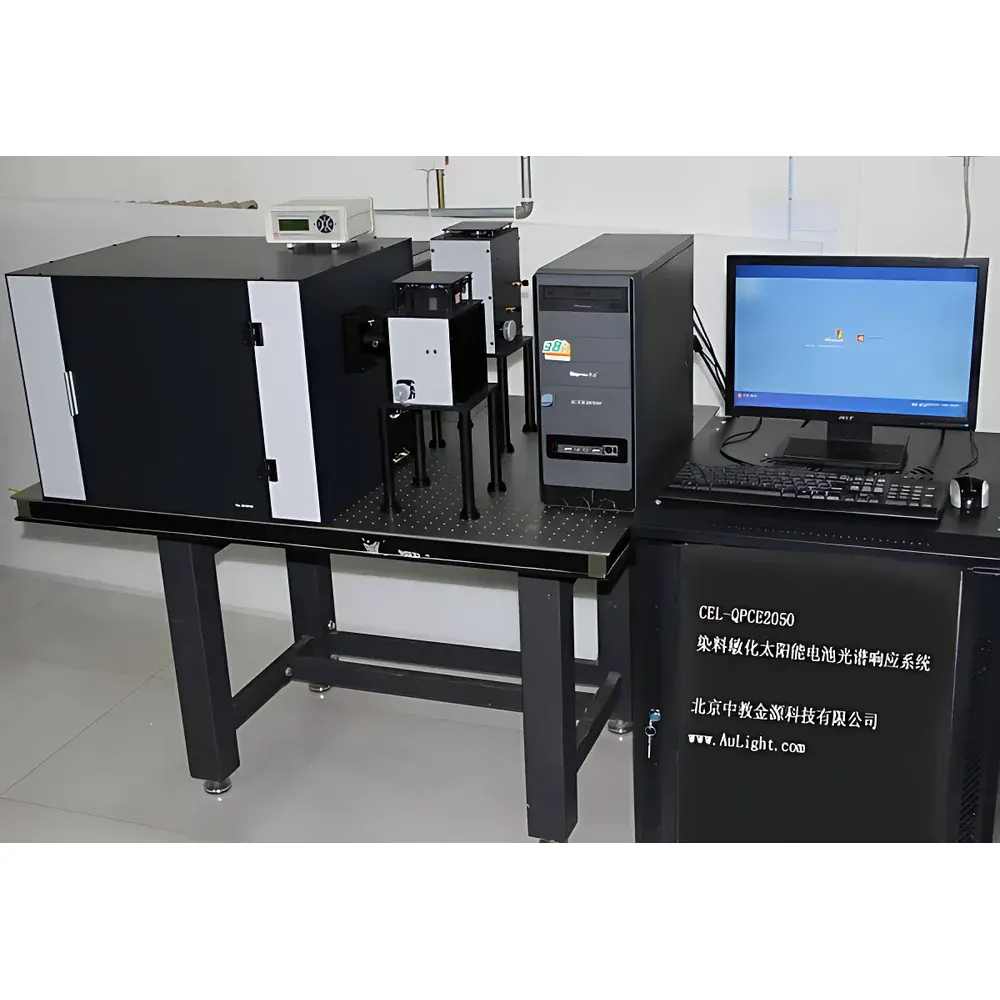
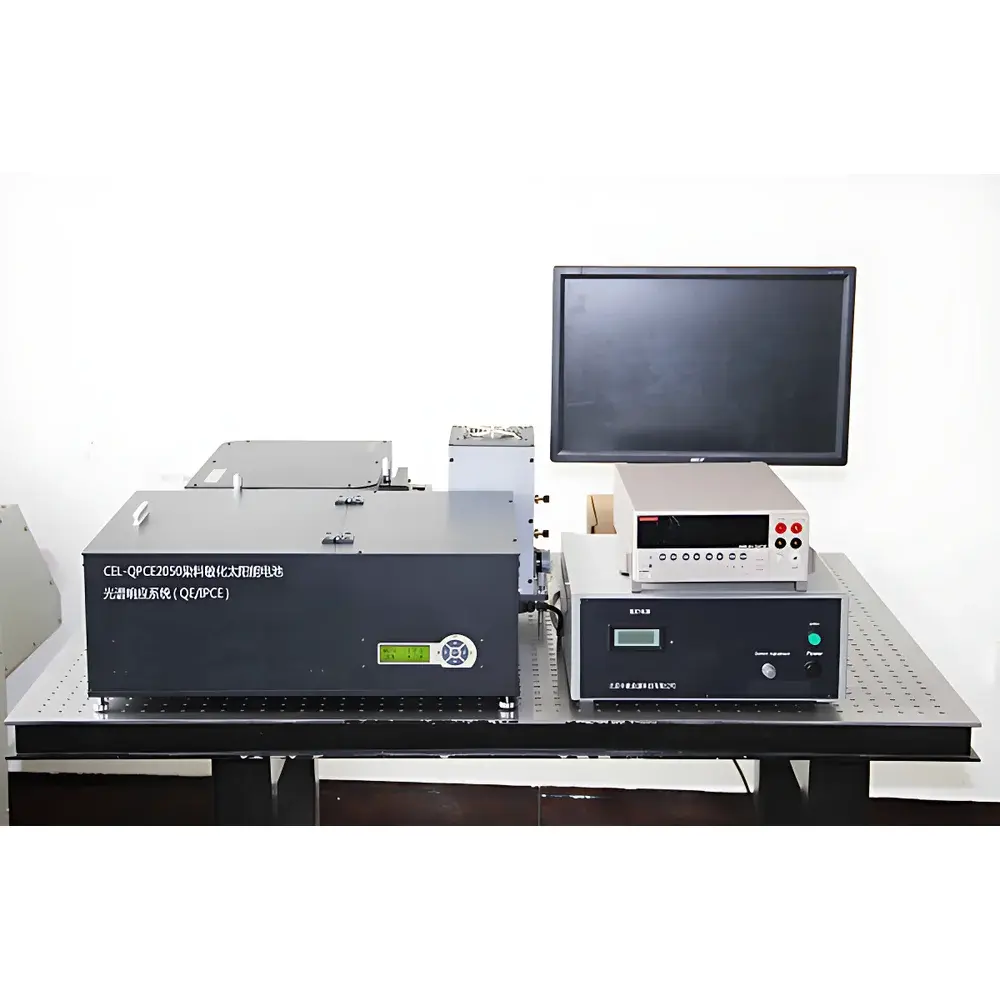
CEL-QPCE2050 Quantum Efficiency / Incident Photon-to-Current Efficiency (QE/IPCE) Measurement System for Dye-Sensitized Solar Cells
| Brand | CEAULIGHT (Zhongjiao Jinyuan) |
|---|---|
| Origin | Beijing, China |
| Manufacturer Type | Direct Manufacturer |
| Product Category | Domestic |
| Model | CEL-QPCE2050 |
| Trigger Mode | Steady-State DC Operation |
| Spectral Range | 200–1100 nm |
| Wavelength Resolution | ≥1 nm (continuously adjustable) |
| Scan Mode | Fully Automated, Continuous Monochromatic Illumination |
| Repeatability | <0.3% (short-circuit current density, J<sub>sc</sub>) |
| Control Interface | PC-based Software with Auto-Calibration & Background Subtraction |
| Bias Light Source | Integrated White-Light Xenon Lamp (≈0.5 SUN, AM1.5G spectrum) |
| Monochromator | 300 mm or 150 mm focal length options |
| Sample Chamber | All-Reflective Optical Path (no transmissive optics) |
| Detection | Keithley Digital Multimeter (high-accuracy, high-speed DC current measurement) |
| Temperature Control Stage | Optional (5–40 °C, ±0.5 °C stability) |
| Compliance | ASTM E1021-12, IEC 60904-8, GB/T 6495.8–2002 |
Overview
The CEL-QPCE2050 QE/IPCE Measurement System is a purpose-engineered, steady-state DC quantum efficiency characterization platform designed specifically for dye-sensitized solar cells (DSSCs) and other single-junction photovoltaic devices compatible with direct-current photoresponse analysis. Unlike AC-modulated systems—whose frequency limitations (typically <1 Hz for DSSCs due to slow redox kinetics in the electrolyte/dye interface) compromise signal integrity—the CEL-QPCE2050 operates exclusively in DC mode, eliminating phase-sensitive artifacts and enabling true steady-state photocurrent quantification. Its optical architecture integrates a high-stability monochromator, calibrated broadband bias illumination, and an all-reflective sample chamber to minimize spectral distortion, stray light, and multi-order diffraction effects. The system measures absolute spectral responsivity (A/W), external quantum efficiency (EQE), and incident photon-to-current conversion efficiency (IPCE) across 200–1100 nm, fully traceable to NIST-traceable reference detectors and aligned with the metrological requirements of ASTM E1021-12, IEC 60904-8, and GB/T 6495.8–2002.
Key Features
- Steady-state DC operation optimized for DSSC electrochemical response times (seconds-scale carrier recombination and redox diffusion dynamics)
- Fully automated workflow: software-controlled monochromator scanning, synchronized standard-cell/sample switching, real-time background subtraction, and auto-zero correction
- High-stability monochromatic illumination: thermally managed grating monochromator (300 mm or 150 mm focal length) with <0.3% Jsc repeatability over extended acquisition sequences
- Dual-source optical design: independently stabilized monochromatic probe beam + spectrally matched white-light bias source (≈0.5 SUN, AM1.5G-equivalent xenon output)
- All-reflective optical path within the sample chamber eliminates chromatic aberration, Fresnel losses, and parasitic reflections from transmissive optics
- Keithley digital multimeter integration ensures sub-picoampere current resolution, low-noise DC acquisition, and compliance with GLP-grade data logging requirements
- Wavelength calibration traceable to certified emission lines (e.g., Hg/Ar lamps); spectral accuracy ±0.2 nm, stray light <1×10⁻⁵
Sample Compatibility & Compliance
The CEL-QPCE2050 supports planar, mesoporous, and flexible DSSC architectures, as well as any single-junction PV device validated for DC-based spectral response characterization—including perovskite solar cells under stabilized operating conditions. Sample mounting accommodates standard 1 cm × 1 cm active-area substrates with electrical contact via spring-loaded probes or vacuum chuck interfaces. All measurement protocols adhere to international photovoltaic metrology standards: spectral irradiance calibration follows ASTM E1021-12 Annex A1; bias light intensity is verified per IEC 60904-8 Clause 7.2; and system-level uncertainty budgets are documented per ISO/IEC 17025 guidelines. Data audit trails—including instrument configuration logs, calibration timestamps, and raw current/voltage arrays—are retained for FDA 21 CFR Part 11-compliant environments when paired with validated laboratory information management systems (LIMS).
Software & Data Management
The proprietary QPCEControl software provides full instrument orchestration via USB 2.0 or Ethernet interface. It enables customizable scan profiles (start/stop wavelength, step size ≥1 nm, dwell time per point), automatic normalization to reference diode responsivity, and real-time Jsc calculation using measured monochromatic irradiance and cell active area. Export formats include CSV, ASCII, and MATLAB-compatible .mat files. All datasets embed metadata tags (date/time, operator ID, calibration certificate IDs, environmental conditions). For regulated laboratories, optional 21 CFR Part 11 modules support electronic signatures, role-based access control, and immutable audit logs—fully compatible with GxP-aligned quality management systems.
Applications
- Quantitative IPCE mapping of DSSC sensitizers (e.g., N719, Z907, organic dyes) across UV-Vis-NIR range
- Electrolyte optimization studies: correlating iodide/triiodide diffusion kinetics with wavelength-dependent charge collection efficiency
- Interfacial engineering validation: TiO2/dye/electrolyte band alignment assessment via onset wavelength shifts
- Accelerated aging analysis: tracking EQE degradation modes (dye desorption, Pt counter-electrode corrosion, electrolyte evaporation)
- Cross-platform benchmarking against silicon reference cells under identical optical conditions
- Supporting ISO 15387-compliant PV module qualification workflows where spectral mismatch correction is required
FAQ
Why is DC-mode operation essential for DSSC QE/IPCE testing?
DSSCs exhibit slow interfacial redox kinetics (time constants >1 s), making them incompatible with typical AC lock-in detection schemes (>1 Hz). DC measurement avoids phase lag errors and captures true steady-state photocurrent under defined monochromatic excitation and bias conditions.
How is monochromatic irradiance calibrated and maintained during scanning?
Calibration uses a NIST-traceable silicon photodiode with known spectral responsivity. The system performs in situ verification before each scan using a dedicated reference port; optical power stability is actively monitored via feedback-controlled lamp drivers (<±0.2% drift over 1 h).
Can the system measure temperature-dependent QE?
Yes—when equipped with the optional Peltier-controlled stage (5–40 °C, ±0.5 °C), users can acquire full IPCE spectra at discrete temperatures to extract activation energies of charge-transfer processes.
Is the bias light spectrum truly AM1.5G-matched?
The xenon-based bias source includes a custom interference filter set that replicates the spectral distribution of AM1.5G within ±5% across 350–1100 nm, verified by double-monochromator spectroradiometry.
What level of spectral stray light rejection does the monochromator achieve?
Using holographic gratings and multi-blade slit design, the system achieves stray light suppression of ≤1×10⁻⁵ relative to peak signal—critical for accurate near-IR IPCE measurements where detector dark current dominates.






