
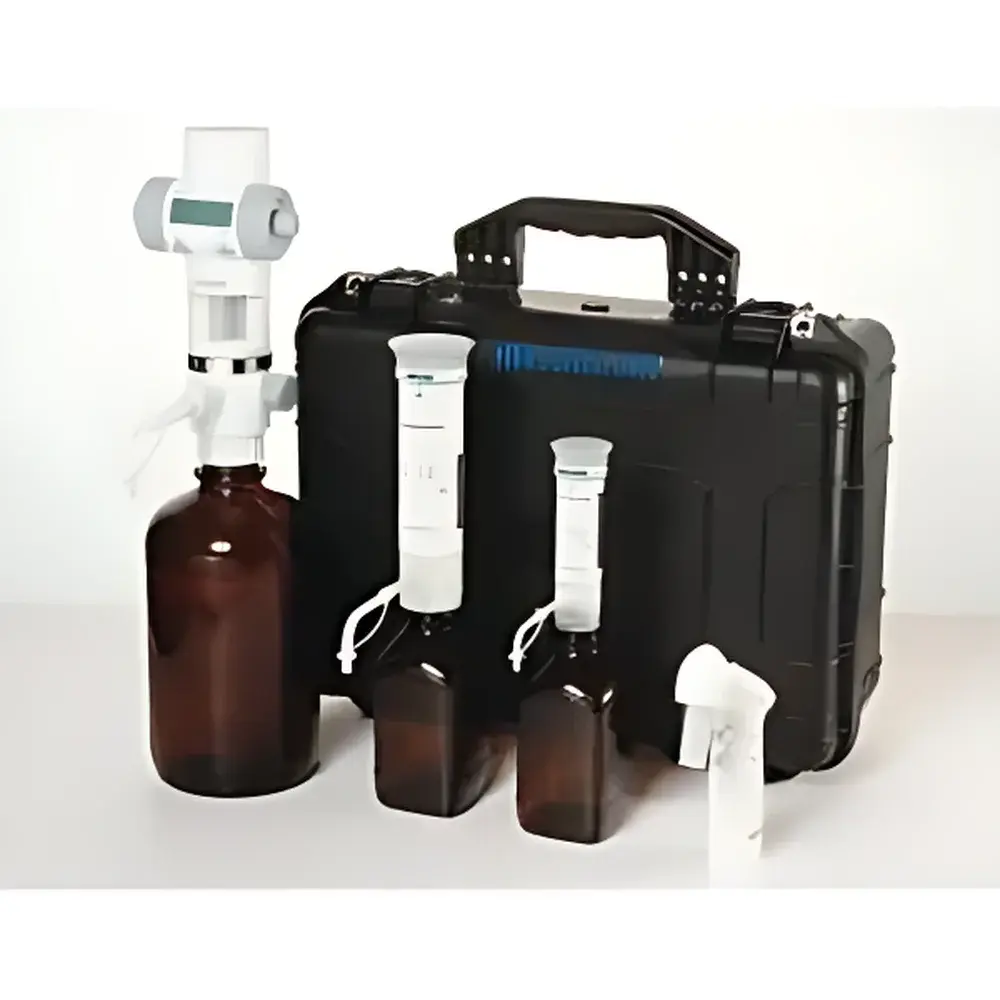
Hirschmann COD Analysis System for Dichromate Method
| Brand | Hirschmann |
|---|---|
| Origin | Germany |
| Manufacturer Type | Authorized Distributor |
| Product Origin | Imported |
| Model | COD |
| Pricing | Available Upon Request |
Overview
The Hirschmann COD Analysis System for Dichromate Method is a precision-engineered, portable laboratory solution designed to perform chemical oxygen demand (COD) determination in accordance with ISO 6060 and the Chinese national standard GB 11914–1989. Based on the open-reflux, dichromate oxidation principle, this system quantifies the amount of oxygen consumed during the complete oxidation of organic and inorganic reducible substances in water samples under strongly acidic conditions using potassium dichromate (K₂Cr₂O₇) as the oxidant and silver sulfate (Ag₂SO₄) as a catalyst. The method delivers high reproducibility and traceable results suitable for wastewater characterization, regulatory compliance reporting, and routine environmental quality control in municipal, industrial, and field-deployed monitoring applications.
Key Features
- Modular, vehicle-mountable design optimized for mobile monitoring vehicles and emergency response units — compact footprint, vibration-dampened mounting interface, and 12–24 V DC power compatibility.
- Pre-calibrated, sealed digestion modules with integrated temperature control (150 °C ± 1 °C) and precise reflux timing (2 hours ± 30 s), eliminating manual timer dependency and reducing operator variability.
- Corrosion-resistant borosilicate glass digestion tubes with PTFE-lined caps, rated for sustained exposure to concentrated sulfuric acid (H₂SO₄) and dichromate solutions at elevated temperatures.
- Dual-wavelength photometric detection module (600 nm and 420 nm) enabling interference correction for chloride ion masking and turbidity compensation per ISO 6060 Annex B.
- Integrated safety interlocks including overtemperature cutoff, pressure-relief venting, and fume containment via optional active carbon filtration ducting — compliant with EN 61010-1:2019 for laboratory equipment safety.
Sample Compatibility & Compliance
The system accommodates aqueous samples with COD concentrations ranging from 10 to 1,000 mg/L O₂ (dilution-adjustable up to 10,000 mg/L). It supports raw influent, secondary effluent, industrial process water, and stormwater runoff. All wetted components meet USP Class VI and FDA 21 CFR Part 177 requirements for contact with aqueous environmental matrices. Method validation documentation includes spike recovery studies (85–115% across matrix types), repeatability (RSD ≤ 4.2%, n = 6), and inter-laboratory comparison data aligned with ISO/IEC 17025:2017 accreditation criteria. Full traceability to NIST-traceable KHP standards is maintained through onboard calibration certificate management.
Software & Data Management
The embedded firmware supports GLP-compliant data handling with automatic timestamping, user ID logging, and audit trail generation per FDA 21 CFR Part 11 requirements. Results are exportable in CSV and PDF formats via USB or Ethernet (optional Wi-Fi module). The Hirschmann COD Manager software (v3.2+) provides instrument configuration, method template storage, QC charting (X-bar/R control charts), and electronic signature capability. All data files include embedded metadata: sample ID, digestion batch number, reagent lot codes, ambient temperature/humidity logs, and instrument serial number — facilitating seamless integration into LIMS environments.
Applications
- Routine compliance monitoring for municipal wastewater treatment plants (WWTPs) under national discharge permits.
- Field-based assessment during environmental incident response (e.g., chemical spills, illegal discharges).
- Process optimization support in electroplating, pharmaceutical, food & beverage, and pulp & paper industries.
- Educational use in university environmental engineering laboratories requiring standardized, safe COD training protocols.
- Third-party verification testing for ISO 14001-certified facilities conducting internal environmental audits.
FAQ
What digestion temperature and duration does the system maintain per standard protocol?
The system maintains a precise digestion temperature of 150 °C for exactly 120 minutes, conforming to GB 11914–1989 and ISO 6060 Section 7.2.
Can the system handle high-chloride samples without pre-treatment?
Chloride interference is mitigated using mercury-free Ag₂SO₄ catalysis and dual-wavelength photometry; samples with ≤ 2,000 mg/L Cl⁻ require no additional masking — validated per ISO 6060 Annex C.
Is the system certified for use in accredited environmental testing laboratories?
Yes — the system meets ISO/IEC 17025:2017 technical requirements for COD analysis when operated within defined scope and supported by documented method validation reports.
Does the system support remote diagnostics or firmware updates?
Firmware updates are performed via secure USB transfer; remote diagnostic access is available through optional Hirschmann Remote Service Module (RS-232 + TLS-encrypted telemetry).
What consumables require periodic replacement?
Digestion tubes (recommended replacement after 500 cycles), PTFE caps (every 200 cycles), and photometer light source (rated life ≥ 10,000 h). Reagent kits are supplied with full CoA and shelf-life tracking.







