
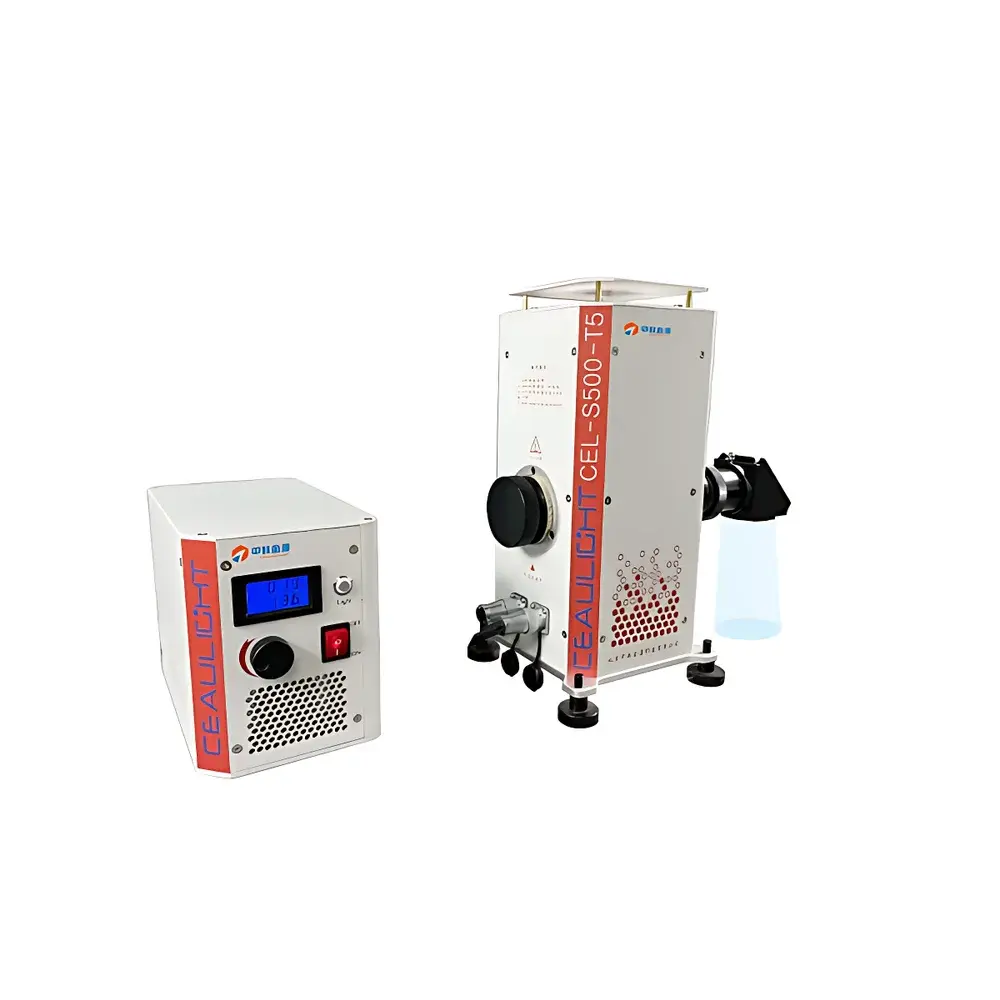
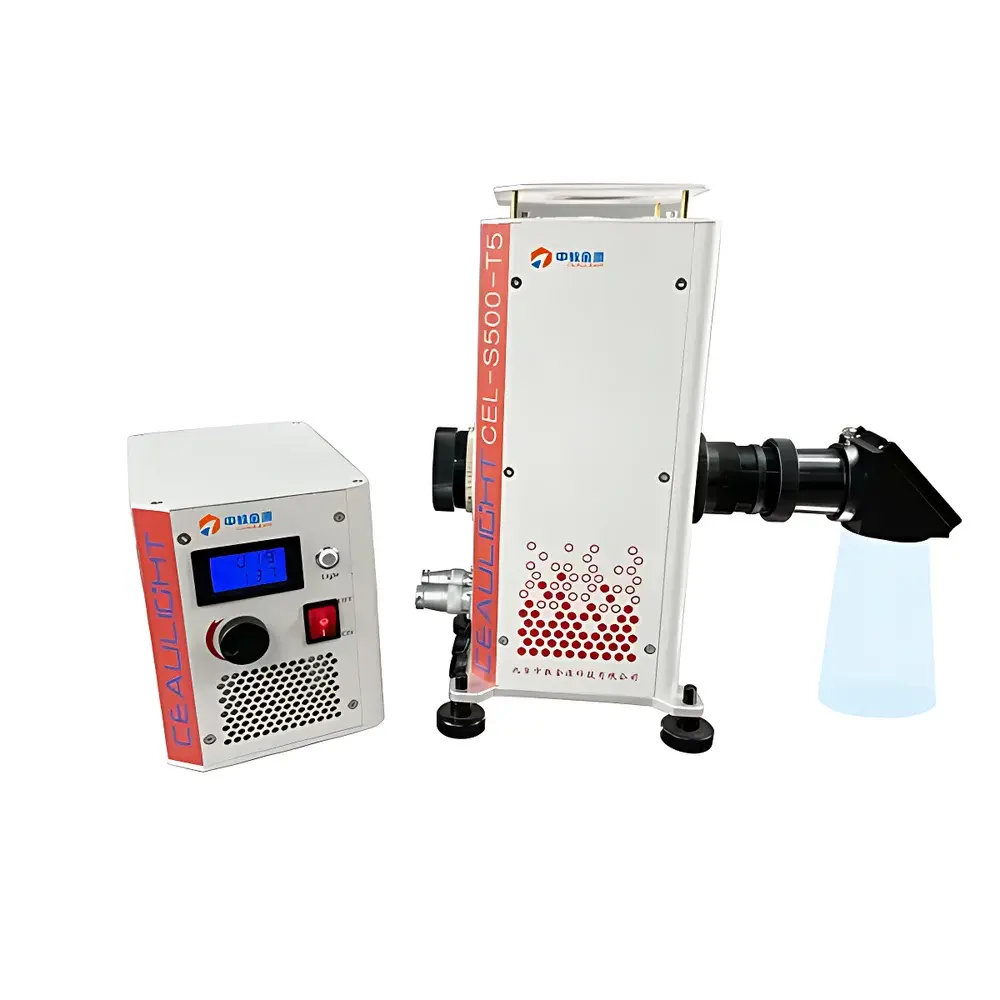
CEL-S500-T5 High-Stability Solar-Simulating Xenon Light Source
| Brand | CEAULIGHT (Zhongjiao Jinyuan) |
|---|---|
| Origin | Beijing, China |
| Manufacturer Type | OEM/ODM Manufacturer |
| Product Category | Domestic |
| Model | CEL-S500-T5 |
| Light Source Type | Short-Arc Spherical Xenon Lamp |
| Illumination Mode | External Irradiation Configuration |
| Spectral Range | 300–2500 nm |
| Color Temperature | ~6000 K |
| Power Output Options | 150 W / 350 W / 500 W (standard 500 W installed) |
| Light Stability | < ±0.5% (RMS, over 8 h) |
| Power Supply Stability | ±0.01% |
| Collimated Beam Diameter | 50–60 mm |
| Point Source Output Diameter | 2–3 mm |
| Adjustable Spot Size | 3–50 mm (via iris diaphragm) |
| Cooling Method | Forced-Air Convection with Delayed Shutdown |
| Lamp Lifetime | 500–1000 h |
| Compatible Mounting Threads | SM25.4, SM50.8, M52, M62 |
| Filter Compatibility | Quartz, K9, UV-grade fused silica, AM1.5G, bandpass, longpass, and custom interference filters |
| Optional Fiber Coupling | SMA905 or FC/PC interface available |
| Compliance | Designed for ASTM E927-22, IEC 60904-9 Ed. 3, ISO 9001 manufacturing environment |
Overview
The CEL-S500-T5 High-Stability Solar-Simulating Xenon Light Source is an engineered optical instrument designed to deliver spectrally continuous, high-intensity illumination closely matching natural solar irradiance under standard test conditions (AM1.5G, 100 mW/cm² = 1 Sun). It utilizes a short-arc spherical xenon lamp—ignited via high-frequency, high-voltage discharge—to generate a stable, broadband emission spectrum spanning 300–2500 nm, with peak spectral density in the visible region (400–700 nm) and strong UV and NIR components. Its color temperature of approximately 6000 K enables high-fidelity simulation of terrestrial sunlight, making it suitable for photovoltaic device characterization, photoelectrochemical (PEC) cell evaluation, photocatalytic reaction kinetics, and controlled biological irradiation studies. The system integrates real-time electrical monitoring (voltage/current), thermal safety interlocks, and programmable delayed shutdown to extend lamp service life and ensure operational repeatability across extended experimental sessions.
Key Features
- Ultra-stable light output (< ±0.5% RMS intensity drift over 8 hours), achieved through proprietary high-stability xenon power supply with active feedback control
- Dual optical configurations: collimated parallel beam (50–60 mm diameter) and focused point source (2–3 mm spot), both accessible via modular light path assembly
- Integrated three-axis micrometer-adjustable platform for sub-millimeter alignment of lamp position, optical axis, and sample plane
- Thermal management system featuring intelligent fan-speed modulation and post-power-off cooling delay (up to 5 min) to mitigate thermal shock on quartz envelopes
- Universal filter mount compatibility (SM25.4, SM50.8, M52, M62) supporting standardized and custom optical elements—including AM1.5G reference filters per IEC 60904-9 Ed. 3
- Optional fiber-optic coupling (SMA905 or FC/PC) enabling remote illumination of confined reactors, spectroelectrochemical cells, or microfluidic platforms
- Real-time digital display of lamp voltage, current, and calculated instantaneous power (15–25 A range, 300–500 W max)
Sample Compatibility & Compliance
The CEL-S500-T5 supports a wide range of optically active samples—from silicon and perovskite solar cells to TiO₂-based photocatalysts, dye-sensitized electrodes, and microbial cultures under defined photobiological irradiance. Its spectral fidelity and spatial uniformity meet the minimum requirements outlined in ASTM E927-22 (Standard Specification for Solar Simulation for Terrestrial Photovoltaic Testing) and IEC 60904-9 Ed. 3 (Photovoltaic devices — Part 9: Solar simulator performance requirements). While not certified as a Class AAA solar simulator out-of-the-box, its performance can be validated and calibrated using NIST-traceable reference cells and spectroradiometers. All mechanical interfaces adhere to ISO metric threading standards; optical components are fabricated from UV-grade fused silica or BK7-grade K9 glass to minimize spectral distortion and thermal birefringence.
Software & Data Management
The CEL-S500-T5 operates as a standalone hardware platform without embedded firmware or proprietary software. However, its analog voltage/current outputs and optional RS-232/USB interface (available on T10 variant) allow integration into LabVIEW, Python-controlled DAQ systems, or custom SCADA environments for synchronized data logging of irradiance, temperature, and electrical parameters. For GLP/GMP-aligned laboratories, users may implement audit-trail-capable acquisition protocols compliant with FDA 21 CFR Part 11 when paired with validated third-party software. No cloud connectivity or vendor-specific drivers are required—system operation remains fully transparent and reproducible at the hardware level.
Applications
- Current–voltage (I–V) characterization of photovoltaic devices under simulated AM1.5G illumination
- Photoelectrochemical water splitting and CO₂ reduction experiments requiring stable, broadband excitation
- Kinetic analysis of heterogeneous photocatalysis (e.g., degradation of organic pollutants under UV–vis–NIR irradiation)
- Photothermal evaporation studies using localized high-flux irradiation on hydrophilic/hydrophobic membranes
- Biological photostimulation assays including circadian rhythm entrainment and UV stress response profiling
- Calibration of radiometric sensors, spectroradiometers, and quantum yield measurement systems
- Accelerated aging tests of polymer coatings and encapsulation materials under controlled solar-spectrum exposure
FAQ
What lamp types are compatible with the CEL-S500-T5?
The system accepts standard 500 W short-arc spherical xenon lamps; optional upgrade to Osram XBO 500 W lamps is supported with appropriate ballast calibration.
Can the CEL-S500-T5 be used for accelerated weathering tests?
Yes—when coupled with calibrated UV-enhancing filters and temperature-controlled sample stages, it meets baseline requirements for ISO 4892-2 cyclic exposure testing, though full compliance requires chamber-integrated environmental control.
Is AM1.5G spectral matching verified per IEC 60904-9?
The system achieves spectral match Class B (≤25% deviation in each wavelength band) with a certified AM1.5G filter; Class A matching requires additional spectral shaping optics and post-calibration correction.
Does the unit include radiometric calibration documentation?
No factory-provided NIST-traceable calibration certificate is included; users must perform initial spectral irradiance mapping using a calibrated spectroradiometer prior to quantitative experiments.
How is lamp alignment maintained during long-term operation?
The integrated three-axis translation stage allows periodic re-centering of the arc image onto the target plane; thermal drift compensation is achieved via passive mechanical design rather than active servo control.




