
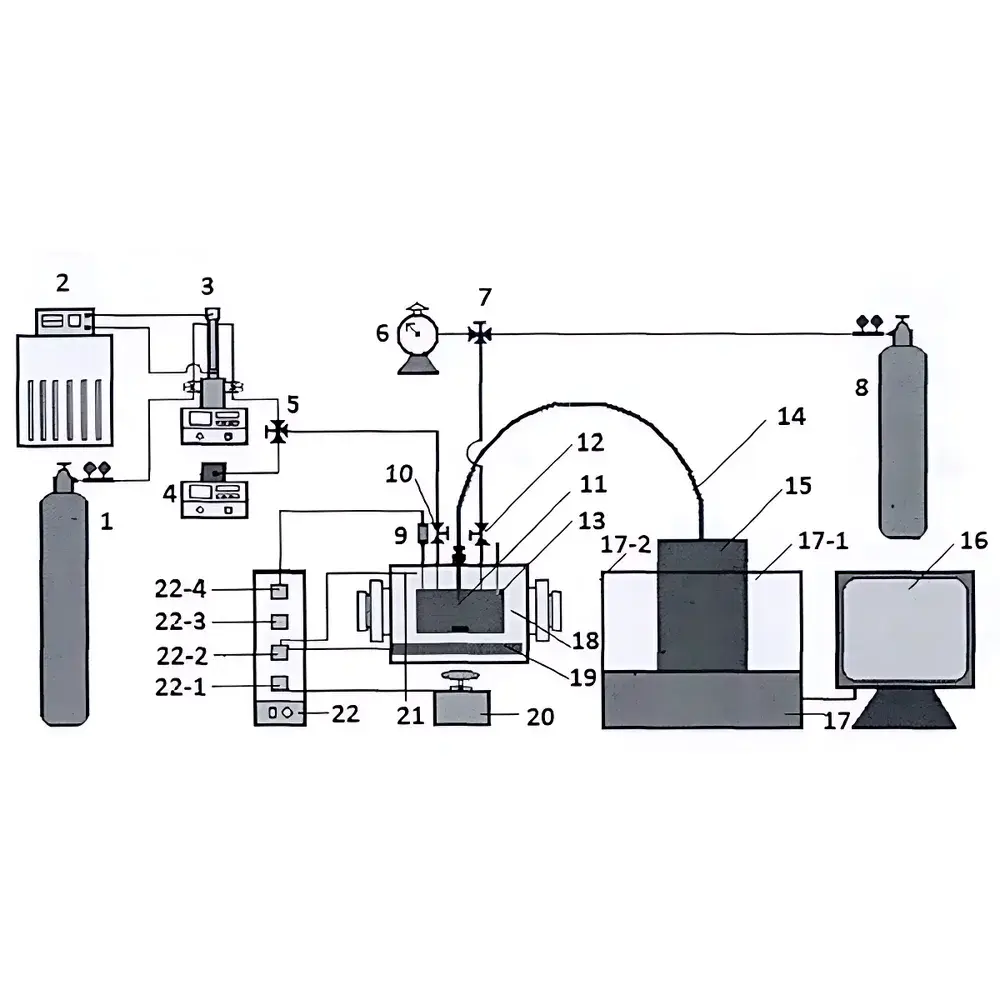
CEL-HPATR4000 High-Pressure In Situ Attenuated Total Reflectance Fourier Transform Mid-Infrared Spectroscopy System (HP ATR FT-MIR)
| Brand | CEL (Zhongjiaojinyuan) |
|---|---|
| Origin | Beijing, China |
| Manufacturer Type | OEM Manufacturer |
| Product Origin | Domestic (China) |
| Model | CEL-HPATR4000 |
| Pricing | Upon Request |
| Pressure Range | 0.1–40 MPa |
| Temperature Range | 20–200 °C (293–473 K) |
| Stirring Speed | 0–1000 rpm (magnetic drive) |
| Sample Cell Volume | 50 mL |
| Cell Material | Standard 316L stainless steel (Hastelloy optional) |
| Viewports | Dual sapphire windows |
| Spectral Range | 4000–500 cm⁻¹ |
| ATR Crystal | High-refractive-index, pressure-rated mid-IR transparent crystal (e.g., diamond or ZnSe) |
| Optical Coupling | Dual-ended IR fiber + reflective cavity |
| Pressure Sensors | Integrated high-accuracy transducers |
| Temperature Control | PID-regulated, programmable ramping |
| Fluid Handling | Swagelok 1/16″ fittings |
| Compatibility | Benchtop FT-IR spectrometers (PerkinElmer, Shimadzu, Bruker, Thermo Fisher) |
Overview
The CEL-HPATR4000 High-Pressure In Situ Attenuated Total Reflectance Fourier Transform Mid-Infrared Spectroscopy System (HP ATR FT-MIR) is an engineered platform for real-time molecular-level characterization of phase behavior, solvation dynamics, and reaction mechanisms under elevated pressure and temperature conditions. It integrates a robust high-pressure reaction cell with an optically isolated ATR infrared sensing module, enabling direct, non-invasive spectroscopic interrogation of supercritical fluids (SCFs) — particularly supercritical CO₂ (scCO₂) — and their interactions with solutes during physical transitions or chemical transformations. The system operates on the principle of evanescent wave absorption: mid-IR radiation from a compatible FT-IR spectrometer is guided via dual-ended infrared optical fiber to a high-refractive-index ATR crystal mounted within the pressurized sample chamber. Molecules in direct contact with the crystal surface absorb characteristic vibrational bands, yielding spectra sensitive to changes in bond polarity, hydrogen bonding, coordination geometry, and intermolecular association. This enables quantitative tracking of functional group perturbations — such as C=O stretching shifts in carbonyl-containing compounds or O–H broadening in protic systems — as functions of pressure, temperature, and time.
Key Features
- Structurally decoupled ATR sensor design: The infrared sensing element — comprising a pressure-rated ATR crystal (e.g., diamond or ZnSe), reflective cavity, and fiber-optic interface — is mechanically isolated from the main reactor body, eliminating optical misalignment due to thermal expansion or mechanical drift.
- High-fidelity pressure containment: 50 mL sample cell constructed from ASTM-certified 316L stainless steel (Hastelloy C-276 available for aggressive chemistries), rated to 40 MPa and 200 °C, with dual sapphire viewports ensuring broadband mid-IR transmission and mechanical integrity.
- Controlled dynamic sampling: Integrated magnetic stirring (0–1000 rpm) ensures homogeneous mixing and enhanced mass transfer, critical for reproducible spectral acquisition in heterogeneous or diffusion-limited SCF systems.
- Modular optical architecture: Uses low-OH silica-based mid-IR optical fiber and precision-aligned reflective optics to deliver stable, low-loss coupling between external FT-IR spectrometers and the in situ ATR probe — compatible with PerkinElmer, Shimadzu, Bruker, and Thermo Fisher platforms.
- Full environmental control: Independent PID-regulated heating (±0.5 °C accuracy), digital pressure monitoring (±0.1 MPa), and programmable temperature ramping support GLP-compliant experimental protocols.
Sample Compatibility & Compliance
The CEL-HPATR4000 supports a broad range of high-pressure fluid systems, including pure scCO₂, scH₂O, scNH₃, scC₂H₆, scC₂H₄, and scC₅H₁₂, as well as multicomponent mixtures relevant to green chemistry, polymer processing, pharmaceutical crystallization, and catalytic synthesis. Its design conforms to ASME B31.3 process piping standards for pressure boundary integrity and incorporates Swagelok® 1/16″ instrumentation-grade fittings compliant with ISO 8434-1. For regulated environments, the system supports audit-trail-capable data logging when paired with 21 CFR Part 11–compliant FT-IR software (e.g., OPUS, Spectrum Touch, or Spectrum OMNIC). All thermal and pressure control modules are calibrated traceable to NIST standards, and materials of construction meet USP Class VI biocompatibility requirements where applicable.
Software & Data Management
Spectral acquisition is synchronized with environmental parameters via TTL-triggered data streaming to a host PC running vendor-neutral acquisition software (e.g., MATLAB-based custom scripts or Python-controlled PySpectra frameworks). Time-resolved spectral series (e.g., 16 cm⁻¹ resolution, 32 scans per spectrum, 1–60 s interval) are stored in standardized JCAMP-DX format with embedded metadata: timestamp, pressure, temperature, stir rate, and gas/liquid feed status. Post-acquisition analysis leverages second-derivative preprocessing, baseline correction (Rubberband or Asymmetric Least Squares), and multivariate curve resolution–alternating least squares (MCR-ALS) for component-resolved kinetic modeling. Export options include CSV, HDF5, and XML for integration into LIMS or ELN platforms supporting ASTM E2500-20 or ISO/IEC 17025 workflows.
Applications
- In situ monitoring of scCO₂-induced swelling and plasticization in polymer membranes during gas separation studies.
- Quantification of H-bonding evolution between CO₂-philic surfactants (e.g., fluorinated alcohols) and scCO₂ across phase boundaries.
- Tracking carbamate formation kinetics in amine–CO₂ capture systems under industrially relevant P/T conditions.
- Probing solvent–solute coordination shifts during scCO₂-assisted nanoparticle synthesis or crystallization.
- Validating thermodynamic models (e.g., PC-SAFT, CPA) through direct observation of functional group-specific spectral shifts correlated with density and composition.
FAQ
What FT-IR spectrometers are compatible with the CEL-HPATR4000?
The system interfaces with any benchtop FT-IR instrument equipped with a standard external beam port and mid-IR output (4000–500 cm⁻¹), including PerkinElmer Frontier, Shimadzu IRTracer-100, Bruker Tensor series, and Thermo Fisher Nicolet iS50.
Can the system operate under vacuum prior to pressurization?
Yes — integrated Swagelok three-way valves and a dedicated vacuum pump line enable full system evacuation (<10⁻² mbar) before gas introduction, ensuring contaminant-free baseline acquisition.
Is the ATR crystal replaceable, and what materials are available?
The ATR element is field-replaceable; standard configurations use diamond (highest durability, 4000–500 cm⁻¹), with ZnSe (cost-effective, 4000–600 cm⁻¹) and Ge (high refractive index, 4000–2000 cm⁻¹) offered as options.
How is temperature uniformity ensured across the sample volume during spectroscopic acquisition?
A dual thermocouple configuration — one embedded in the reactor wall (control sensor) and one immersed near the ATR crystal surface (monitoring sensor) — enables active compensation for radial thermal gradients, maintaining ±0.8 °C homogeneity over the 50 mL active zone.
Does the system support automated sequential experiments?
When integrated with optional SSI Series II high-pressure pumps and programmable PLC controllers, the CEL-HPATR4000 supports unattended multi-step protocols — e.g., isothermal pressure ramps, stepwise co-solvent addition, or cyclic T/P sweeps — with full parameter logging and spectral triggering.



