
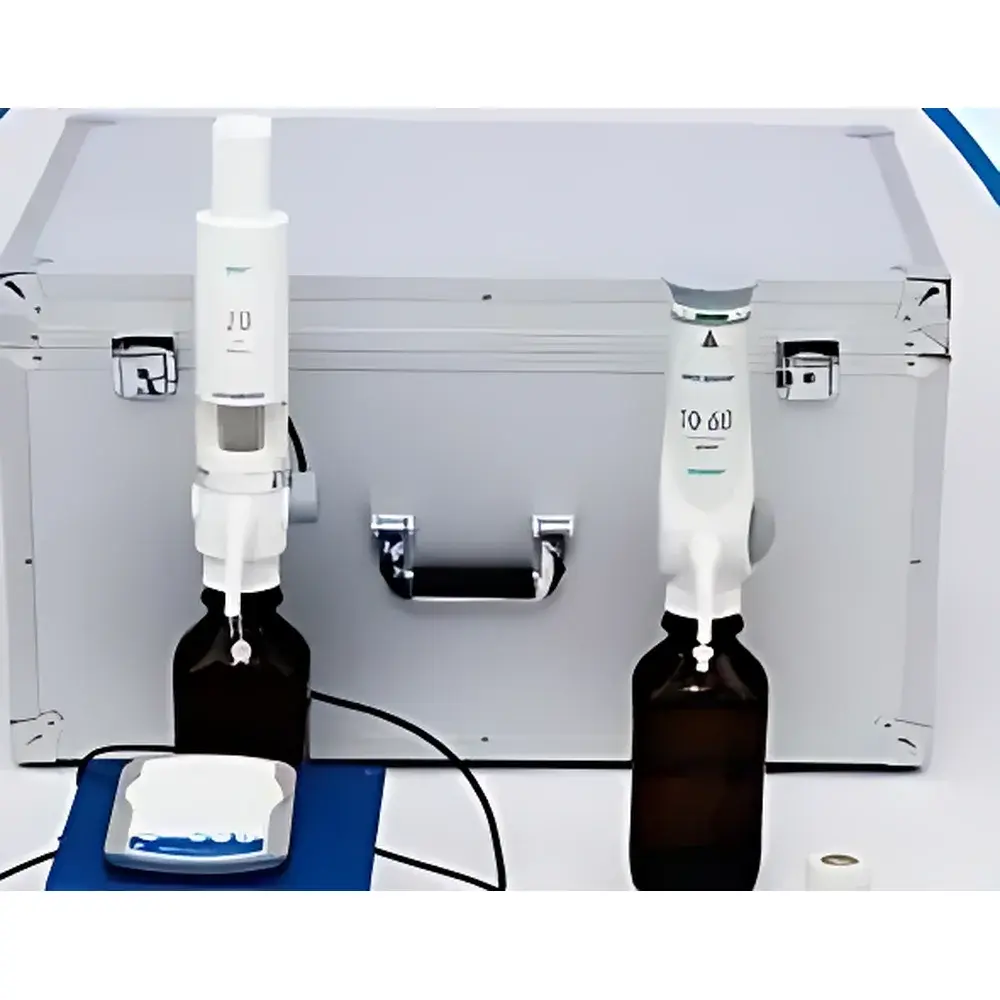
Hirschmann Food Acid Value Liquid Pre-Treatment System
| Brand | Hirschmann |
|---|---|
| Origin | Germany |
| Manufacturer Type | Authorized Distributor |
| Origin Category | Imported |
| Model | Suandu |
| Price Range | USD 7,000 – 14,000 (FOB Hamburg) |
| Plate Capacity | N/A |
| Pipetting Accuracy | ±0.01 mL |
| Pipetting Volume Range | 10–60 mL |
| Sample Throughput | 2 samples per run |
| Dimensions (W×D×H) | 450 × 500 × 300 mm |
Overview
The Hirschmann Food Acid Value Liquid Pre-Treatment System is a dedicated, semi-automated liquid handling platform engineered for standardized acid value (AV) determination in edible oils and fat-containing food matrices per internationally harmonized analytical protocols—including GB 5009.229–2016 (Determination of acid value in foods), GB 5009.268–2016 (Determination of peroxide value and acid value in edible oils), AOAC Official Method 940.28, and ISO 660:2020. Unlike generic liquid handlers, this system integrates purpose-built hardware—ceramic-tipped bottle-top dispensers and solar-powered electronic titrators—to execute the cold solvent indicator titration method with metrological rigor. It eliminates manual volumetric transfer errors inherent to graduated cylinders and burettes, while mitigating operator exposure to caustic titrants (e.g., 0.1 mol/L KOH in ethanol/water) and flammable solvents (e.g., diethyl ether–isopropanol 1:1 v/v). Its architecture follows the principle of “defined-step automation”: precise solvent delivery, controlled indicator addition, and endpoint-stable potentiometric or visual endpoint detection—all within a compact benchtop footprint.
Key Features
- Integrated ceramic bottle-top dispenser (Hirschmann Ceramus series) for accurate, non-corrosive dispensing of ether–isopropanol mixtures (50–100 mL) into 250 mL Erlenmeyer flasks—resistant to organic solvents and alkali corrosion.
- Solarus Light-Powered Electronic Titrator or Opus Digital Titrator: battery-free operation via integrated photovoltaic cell; programmable titrant delivery rate (0.01–1.0 mL/s); real-time volume tracking with ±0.01 mL resolution.
- Dedicated workflow logic aligned with GB 5009.229–2016 Section 7.2: automatic timing of 15-second color persistence verification for phenolphthalein endpoint, reducing subjective interpretation.
- Chemical-resistant housing (PP/PE-coated stainless steel frame) and splash-guard design compliant with IEC 61000-6-3 for laboratory electromagnetic compatibility.
- No plate-based automation—optimized for low-throughput, high-integrity analysis where sample integrity and reagent stability outweigh batch speed requirements.
Sample Compatibility & Compliance
The system accommodates viscous and semi-solid lipid matrices including refined vegetable oils, animal fats, fried food extracts, and dairy-based emulsions. All wetted components meet USP Class VI biocompatibility standards and are certified free of extractables per FDA 21 CFR 177.2600. The titration methodology satisfies mandatory validation criteria under ISO/IEC 17025:2017 (Clause 7.2.2) for method accuracy (recovery ≥95–105%), repeatability (RSD ≤2% at AV = 1.0 mg KOH/g), and intermediate precision across operators and days. Documentation packages support GLP-compliant audit trails when paired with Hirschmann’s optional TitraSoft v3.2 data logger (21 CFR Part 11-ready with electronic signatures and audit log export).
Software & Data Management
While the core Suandu system operates without embedded software, it interfaces seamlessly with Hirschmann TitraSoft v3.2—a Windows-based application enabling method storage (up to 99 protocols), automated calculation of acid value (AV = (V₁ − V₀) × C × 56.1 / m), and direct export to LIMS via CSV or ASTM E1384-compliant XML. All titration events—including start time, endpoint volume, ambient temperature, and operator ID—are timestamped and cryptographically hashed for tamper-evident recordkeeping. Audit logs comply with ALCOA+ principles (Attributable, Legible, Contemporaneous, Original, Accurate, Complete, Consistent, Enduring, Available) and are retained for ≥10 years per internal QA policy.
Applications
- Regulatory testing labs performing routine AV screening for compliance with Codex Alimentarius Standard 210–1999 (Fats and Oils).
- QC laboratories in edible oil refineries validating deodorization efficiency and shelf-life prediction models.
- Research institutions studying lipid oxidation kinetics under accelerated storage conditions (e.g., Rancimat EN 14112).
- Contract testing facilities requiring auditable, repeatable AV results for ISO/IEC 17025 accreditation renewal.
- Academic teaching labs demonstrating traceable titrimetric analysis principles with minimized safety risk.
FAQ
Does the Suandu system support automatic sample weighing integration?
No—it assumes pre-weighed samples (typically 2–10 g, per GB 5009.229–2016 Section 6.1) placed manually into conical flasks. Integration with METTLER TOLEDO or Sartorius analytical balances requires third-party serial command scripting via RS232.
Can the system be validated for ISO/IEC 17025 accreditation?
Yes. Full validation documentation—including Installation Qualification (IQ), Operational Qualification (OQ), and Performance Qualification (PQ) templates—is provided upon purchase. PQ protocols include linearity testing across 0.1–10.0 mg KOH/g AV range and robustness assessment against solvent evaporation rates.
Is the solar-powered titrator suitable for low-light laboratory environments?
Yes. Solarus units include a rechargeable LiFePO₄ battery (72 h standby life) and maintain full functionality under standard LED lab lighting (≥300 lux).
What maintenance is required for the Ceramus dispenser?
Annual recalibration of volumetric output using certified Class A glassware and gravimetric verification per ISO 8655-3 is recommended. No lubrication or seal replacement is needed due to all-ceramic valve construction.
Does the system comply with EU REACH and RoHS directives?
Yes. Certificate of Conformance (CoC) and SVHC declaration are supplied with each unit. All plastics meet REACH Annex XIV exemption criteria; no restricted substances exceed threshold limits.



