
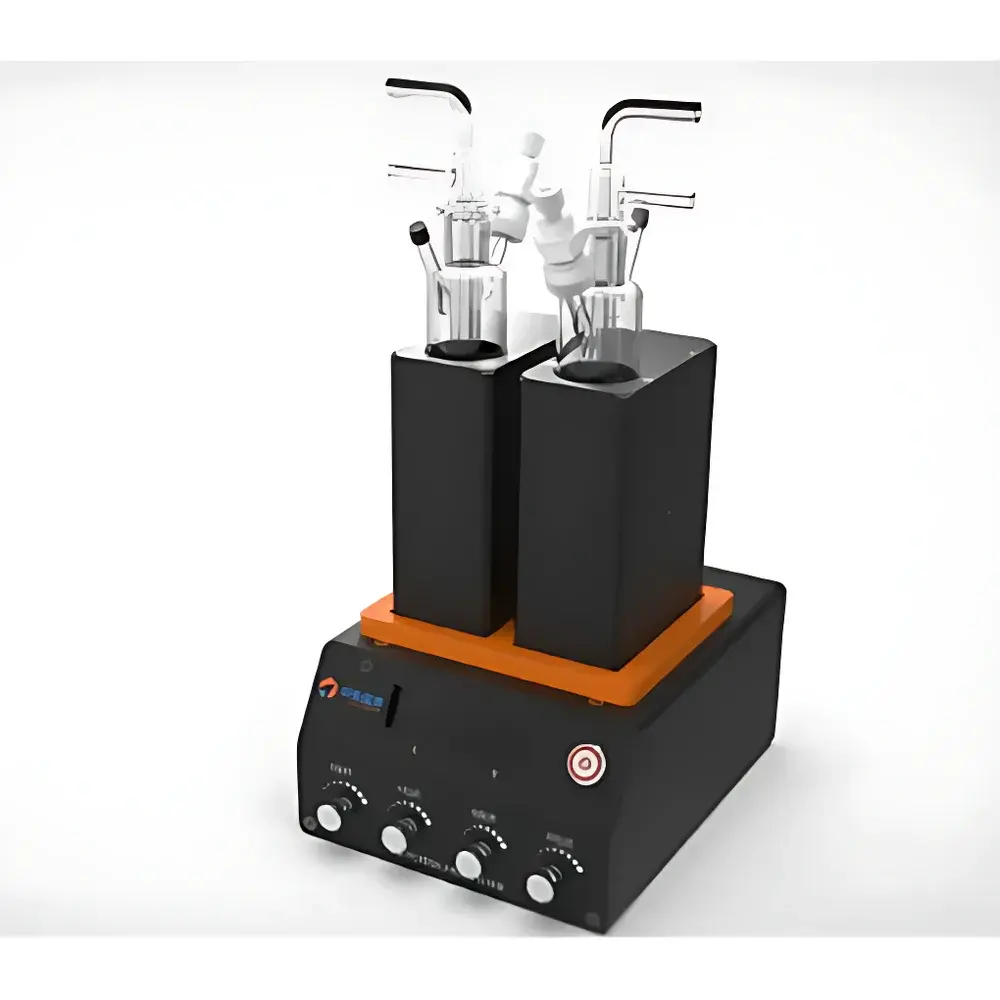
CEL-PCRD50-2 LED Photoreactor
| Brand | CEL (China Education Goldsource) |
|---|---|
| Origin | Beijing, China |
| Manufacturer Type | Direct Manufacturer |
| Product Category | Domestic |
| Model | CEL-PCRD50-2 LED Photoreactor |
| Pricing | Upon Request |
| Sample Capacity | 2 × 50 mL (quartz reaction tubes) |
| Illumination Mode | Dual independent side-illumination |
| Illumination Area per Position | 100 mm × 20 mm (standard, for 50 mL) |
| LED Power | 2 × 25 W (DC 38 V, ±0.01%) |
| Total Input Power | 100 W (AC 220 V, ±0.01%) |
| Wavelength Options | 365, 395, 405, 420, 455, 470, 500, 520, 590, 620, 660, 740, 810, 850, 940 nm + white LED |
| Control Interface | Digital display with rotary knob adjustment |
| Modular Light Source | PCRS25 lamp housing with hot-swap capability |
| Cooling | Passive (fan-assisted, no water cooling required) |
| Uniformity | High-intensity uniform irradiation without filters or collimators |
| Temperature Control | Compatible with external cold well (optional) |
| Gas Handling | Integrated gas inlet/outlet and vacuum ports per station |
| Stirring | Dual independent magnetic stirring (speed adjustable) |
Overview
The CEL-PCRD50-2 LED Photoreactor is an engineered platform for controlled, quantitative photochemical experimentation under precisely defined irradiation conditions. Designed around the principles of actinometry and photon flux management, it enables reproducible evaluation of photocatalytic activity—particularly in heterogeneous systems involving semiconductor catalysts (e.g., TiO₂, g-C₃N₄, MOFs) suspended in liquid or exposed to gaseous reactants. Unlike conventional top-illuminated reactors, its dual-side illumination geometry delivers a 10× larger effective irradiated surface area (100 mm × 20 mm per 50 mL quartz tube), significantly improving photon absorption efficiency and reducing radial light gradient effects. The system operates without optical filters or water-cooling infrastructure, relying instead on thermally stable, narrow-band high-power LEDs—each independently addressable for wavelength-specific excitation. This architecture supports rigorous kinetic analysis, quantum yield determination (Φ), and comparative catalyst screening across multiple wavelengths in parallel—critical for mechanistic studies in solar fuel generation, environmental remediation, and synthetic photochemistry.
Key Features
- Dual independent reaction stations—each with fully decoupled control of LED wavelength, intensity, magnetic stirring speed, gas flow (inert or reactive), and vacuum evacuation.
- Modular PCRS25 lamp housing system enabling hot-swap replacement of LED modules without system shutdown—supporting rapid reconfiguration for multi-wavelength experimental sequences.
- Standardized 50 mL quartz reaction tubes with PEEK fluidic fittings and gas-tight sealing; optional 100 mL configuration available with extended illumination zone (100 mm × 30 mm).
- 15 discrete monochromatic LED wavelengths (365–940 nm) plus broadband white LED—covering UV-A through near-infrared spectral regions relevant to bandgap excitation of advanced photocatalysts.
- Passive thermal management with intelligent fan control—eliminating condensation risks, pump noise, and maintenance associated with water-cooled arc lamps.
- Digital front-panel interface with rotary encoder for real-time adjustment of irradiance (0–100% relative output), stirring rate (0–1200 rpm), and gas/vacuum timing profiles.
Sample Compatibility & Compliance
The CEL-PCRD50-2 accommodates both homogeneous and heterogeneous photochemical systems—including aqueous suspensions, organic solvent mixtures, gas-phase reactions (e.g., CO₂ reduction, NH₃ synthesis), and immobilized catalyst coatings on quartz substrates. Quartz reaction vessels ensure >90% transmittance from 185 nm to 2.5 µm, preserving spectral fidelity across all supported wavelengths. All wetted components (PEEK tubing, ferrules, valves) comply with USP Class VI and ISO 10993 biocompatibility standards, making the system suitable for photochemical synthesis under GLP-aligned workflows. While not intrinsically certified for hazardous area use, the reactor meets IEC 61010-1 safety requirements for laboratory electrical equipment and supports integration into ISO/IEC 17025-accredited testing environments when paired with validated calibration protocols (e.g., ferrioxalate actinometry per ASTM E2010).
Software & Data Management
The photoreactor operates in standalone mode via its embedded microcontroller, but also supports RS-232/USB serial communication for external logging and synchronization with analytical instrumentation (e.g., GC-TCD/FID, HPLC-UV/Vis, online MS). Optional LabVIEW-based control software enables automated wavelength ramping, time-resolved irradiance profiling, and timestamped correlation of reaction parameters with downstream detection signals. Audit trails—including operator ID, parameter setpoints, runtime logs, and hardware status flags—are exportable as CSV or XML files for FDA 21 CFR Part 11-compliant documentation when deployed in regulated R&D settings. No proprietary drivers or cloud dependencies are required; all firmware updates are delivered as signed binary packages verified via SHA-256 checksum.
Applications
- Quantitative comparison of photocatalyst performance (e.g., H₂ evolution rate, CO₂-to-CH₄ selectivity, phenol degradation kinetics) across defined photon energies.
- Wavelength-dependent quantum yield mapping for mechanistic elucidation of charge-carrier dynamics in emerging photocatalysts.
- Accelerated screening of co-catalyst combinations, sacrificial reagents, and pH-dependent reaction pathways under controlled atmospheres (N₂, Ar, O₂, CO₂, H₂).
- Photoelectrochemical precursor studies—preconditioning of photoanodes/cathodes prior to integration into PEC cells.
- Photobiocatalysis investigations involving light-sensitive enzymes or microbial consortia under non-thermal, narrowband excitation.
- Environmental simulation studies—e.g., UV-driven pollutant mineralization in wastewater matrices under realistic solar spectral proxies.
FAQ
Can the CEL-PCRD50-2 be used for gas-phase photocatalytic reactions?
Yes—each station includes dedicated gas inlet and outlet ports with Swagelok-compatible PEEK fittings, supporting continuous-flow or batch-mode operation with precise pressure regulation down to 10⁻² mbar (when paired with optional vacuum pump).
Is calibration traceable to NIST or other national standards?
While the instrument does not include built-in radiometric calibration, it is fully compatible with external NIST-traceable actinometers (e.g., potassium ferrioxalate, Re(bpy)₃²⁺), and users may implement in-house calibration protocols aligned with ISO/IEC 17025 requirements.
What is the expected lifetime of the LED modules?
Rated L70 lifetime exceeds 15,000 hours at nominal drive current, with minimal spectral shift (<2 nm centroid drift) over operational life—ensuring long-term repeatability in kinetic studies.
Does the system support temperature control during irradiation?
The base unit does not integrate active heating/cooling, but is designed for seamless coupling with external recirculating chillers or cryostats via standardized cold-well adapters (optional accessory).
Are custom wavelengths or higher-power LED configurations available?
Yes—CEL offers OEM customization including tailored spectral bands (e.g., 405 ± 5 nm, 630 ± 10 nm), increased radiant flux (up to 50 W per channel), and fiber-coupled delivery options for remote irradiation setups.
Related Products




